Smart Building Integration: IoT Access Controls and Energy Monitoring in PJ Offices
Originally published on Medium: read it on Medium
As the commercial real estate market across Greater Kuala Lumpur matures, physical office spaces are undergoing an unprecedented digital evolution. Within the thriving business corridors of Petaling Jaya — spanning Petaling Jaya Section 13, Damansara Uptown, Bandar Utama, and Kelana Jaya — corporate occupiers and institutional landlords are moving far beyond conventional brick-and-mortar parameters. The modern standard for Grade A commercial real estate is defined by smart building integration, where the Internet of Things anchors a new era of automated security and rigorous energy optimization.
For corporate real estate directors, chief financial officers, and forward-thinking property asset managers, understanding how IoT-enabled access controls and granular energy monitoring systems operate within PJ offices is essential. Implementing these advanced digital architectures not only slashes operating expenditures and aligns assets with national energy standards, but also delivers the frictionless, high-performance workspace experience that modern enterprise talent demands.
The Paradigm Shift Toward Smart Office Ecosystems in Petaling Jaya
Petaling Jaya has long anchored Selangor’s economic momentum as a primary decentralized business hub. However, as hybrid working models stabilize and corporate environmental, social, and governance obligations tighten, traditional static office buildings face a steep decline in tenant appeal. Modern multinational corporations and tech-forward enterprises no longer evaluate commercial leases based solely on square footage and baseline gross rental rates. They demand intelligent, responsive environments that adjust dynamically to human presence, optimize power consumption in real-time, and guarantee uncompromised physical security.
Smart building integration bridges this gap by embedding distributed networks of IoT sensors, microcontrollers, and cloud-managed software platforms directly into the physical core of commercial towers. By transforming passive concrete structures into active, data-driven ecosystems, property managers in Petaling Jaya can minimize operational inefficiencies, lower carbon footprints, and dramatically elevate tenant satisfaction.
IoT Access Controls: Redefining Commercial Security and Flow Dynamics
Physical security represents the first line of defense for any corporate headquarters, yet traditional mechanical keys, magnetic swipe cards, and static guard-sign-in protocols have become administrative bottlenecks. In modern PJ office suites, Internet of Things access control systems have revolutionized security infrastructure by introducing touchless, credential-based entry mechanisms integrated seamlessly with building management dashboards.
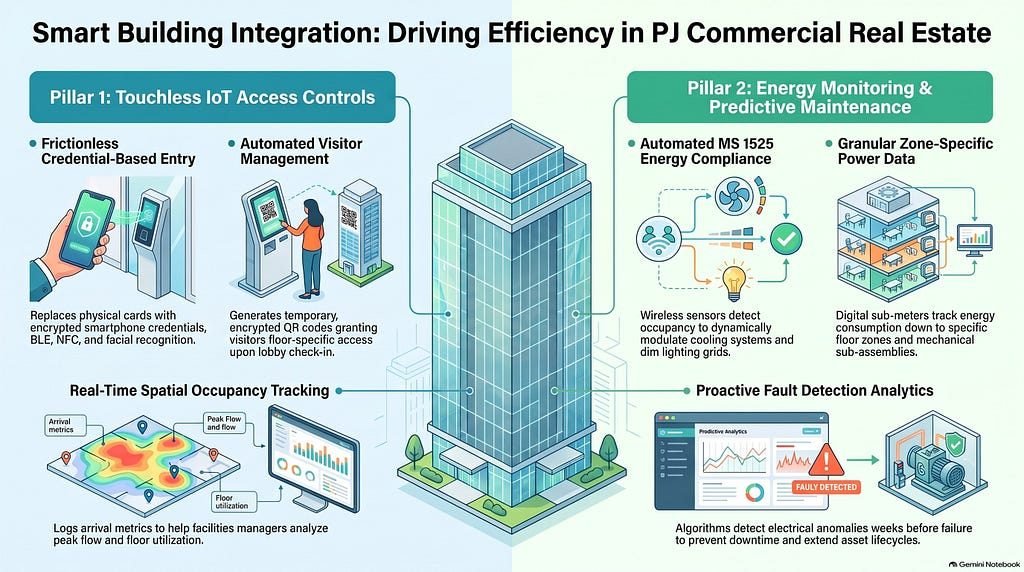
Contemporary IoT access controls leverage smartphone credentials, Bluetooth Low Energy technology, encrypted near-field communication, and facial recognition analytics. When an employee approaches an office turnstile or executive elevator bank in a Damansara Uptown corporate tower, the system authenticates their digital pass instantaneously, unlocking designated doors while simultaneously logging entry metrics in real-time. This frictionless entry eliminates the security risks associated with lost physical access cards and unauthorized visitor duplication.
Furthermore, IoT access controls integrate fluidly with elevator destination-control systems and visitor management software. When a client checks in at the ground-floor lobby via a digital kiosk, a temporary encrypted QR code is sent directly to their mobile device, granting them access only to the specific floor and meeting suite scheduled for their visit. This granular tracking enhances building safety while providing facility managers with valuable occupancy analytics, illustrating peak arrival times and spatial utilization patterns across multi-tenant floor plates.
Granular Energy Monitoring: Taming the Tropical Cooling Load
While intelligent access controls optimize human flow and security, energy monitoring systems address the single largest operational expenditure of any commercial office building in Malaysia: power consumption. Driven by the region’s hot and humid equatorial climate, centralized air-conditioning plants, mechanical ventilation systems, and artificial lighting accounts for the vast majority of a building’s monthly utility overhead.
Deploying IoT-enabled energy monitoring solutions transforms how power is tracked and managed across commercial assets. Unlike legacy analog meters that provide passive monthly totals, IoT power meters and environmental sensors capture high-frequency, granular data streams detailing kilowatt-hour consumption down to specific floor zones, individual tenant meters, and major mechanical sub-assemblies.
In compliance with national energy efficiency benchmarks outlined in Malaysian Standard MS 1525, which governs energy efficiency and indoor environmental quality in non-residential buildings, smart IoT networks enable dynamic load shifting. For instance, wireless occupancy sensors deployed across open-plan workspaces detect when specific conference rooms or workstation clusters are unoccupied. The system communicates instantly with the central building management system, automatically modulating local Variable Air Volume boxes and dimming LED lighting grids to conserve electricity without disrupting overall thermal comfort.
Predictive Maintenance and Fault Detection Analytics
The true financial potency of smart building integration extends beyond real-time energy savings into the realm of predictive maintenance. Traditional commercial property management relies heavily on calendar-based maintenance schedules, servicing air handling units and electrical switchboards at fixed intervals regardless of their mechanical condition. This reactive approach frequently results in unexpected equipment failures and expensive emergency repair outlays.
IoT energy monitoring and sensor networks incorporate advanced fault detection and diagnostics algorithms. By continuously tracking electrical current draws, motor vibrations, and temperature differentials within central chilled water plant equipment, the system can identify microscopic performance anomalies weeks before a physical breakdown occurs. If an air handling unit motor begins exhibiting abnormal electrical resistance or declining cooling efficiency, the platform generates an automated work order for the engineering team. This proactive intervention extends the operational lifecycle of multi-million-ringgit mechanical assets, slashes spare parts inventory overheads, and eliminates disruptive equipment downtime.
Navigating Implementation Challenges and Cybersecurity Protocols
Despite the compelling financial and operational advantages of smart building integration, deploying IoT infrastructure across Petaling Jaya office towers introduces distinct operational challenges that property stakeholders must navigate carefully.
The primary hurdle involves retrofitting legacy commercial structures built decades ago. Integrating modern IoT sensors, wireless gateways, and digital controllers with aging analog mechanical systems requires specialized engineering expertise and meticulous network planning to avoid data fragmentation. Furthermore, as a building’s operational technology converges with corporate information technology networks, cyber-security vulnerability expands exponentially.
Safeguarding smart PJ office towers requires robust network segmentation, end-to-end data encryption, multi-factor authentication protocols, and continuous vulnerability monitoring. Property managers must partner with certified system integrators and cybersecurity specialists to ensure that connected building systems remain fully protected against unauthorized digital intrusions.
The Strategic Return on Investment for Landlords and Tenants
Investing in smart building integration — comprising IoT access controls and advanced energy monitoring — represents a powerful value-creation strategy in Petaling Jaya’s competitive commercial property market.
For institutional landlords and property owners, the capital expenditure required for smart automation is rapidly amortized through double-digit percentage reductions in monthly utility bills and streamlined facilities management labor costs. Buildings equipped with intelligent automation achieve higher Green Building Index and LEED ratings, command premium rental yields, and exhibit superior asset valuation resilience.
For corporate tenants, occupying a smart, responsive office space translates directly into optimized operating expenditures, enhanced workplace safety, and an inspiring physical environment that attracts and retains elite professional talent. By embracing IoT-driven access and energy optimization, stakeholders in Petaling Jaya ensure their commercial assets remain future-proofed, highly efficient, and profitable for decades to come.
Sources & Statutory Authorities
- Department of Standards Malaysia: Malaysian Standard MS 1525: Code of Practice on Energy Efficiency and Use of Renewable Energy for Non-Residential Buildings.
- Green Building Index (GBI) Malaysia: Smart Building Automation and Energy Management Assessment Criteria.
- National Property Information Centre (NAPIC), Valuation and Property Services Department (JPPH) Malaysia: Klang Valley Commercial Real Estate and Building Technology Reports.
- Laws of Malaysia, Town and Country Planning Act 1976 (Act 172) and Street, Drainage and Building Act 1974 (Act 133).
- Independent International Smart Building Technology and IoT Analytics Research: Smart Building Trends and IoT Integration Frameworks.