Bank Lelong in the Klang Valley: A Practical Guide for First-Time Auction Buyers in 2026
Court auction or LACA, 10% deposit, 120 days to pay, and the costs nobody mentions. What the law and the conditions of sale actually say.
Originally published on Medium: read it on Medium

Bank auction ("lelong") listings attract buyers for one reason: the chance to buy below what a similar unit would fetch on the open market. Sometimes that works out. Sometimes the discount disappears into arrears, legal fees, a locked door and a tenant who won't leave.
This guide explains how lelong sales work in Peninsular Malaysia, what the law fixes and what the conditions of sale decide, and what to check before you bid.
Important: this is general information drawn from statutes, court rules and published legal commentary as at October 2026. It is not legal or financial advice. Every auction has its own Proclamation and Conditions of Sale, and those govern your purchase. Please have your own lawyer review them before you bid.
Why there is auction supply
Auction properties come from loans that have gone bad. The bank (the "chargee" or "assignee") enforces its security and sells the property to recover the debt.
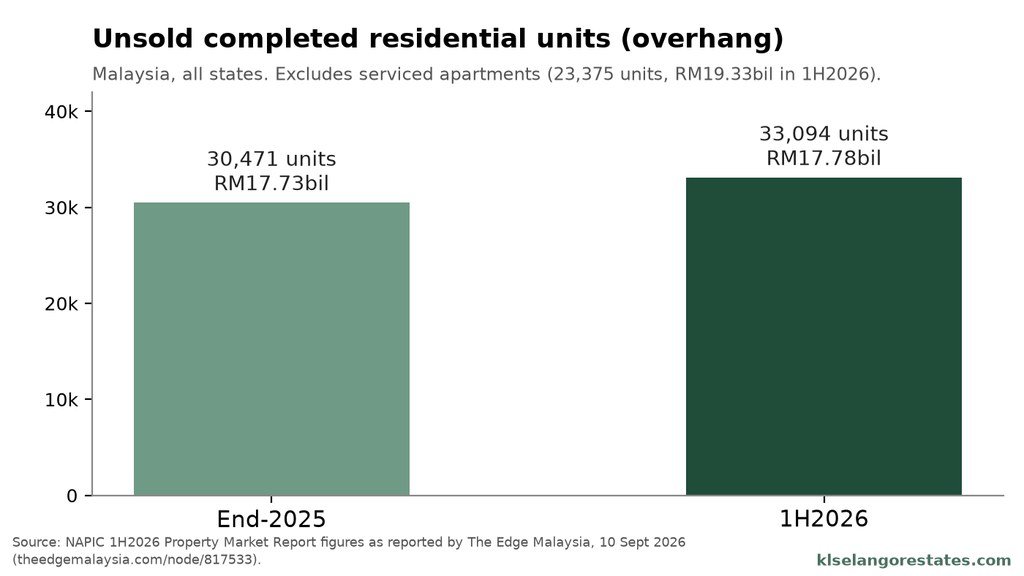
The wider market backdrop matters too. At the launch of NAPIC's 1H2026 Property Market Report, the Finance Ministry said there were 33,094 completed but unsold residential units worth RM17.78 billion in 1H2026. That compares with 30,471 units worth RM17.73 billion for the whole of 2025. Unsold completed serviced apartments stood at 23,375 units worth RM19.33 billion (The Edge, 10 September 2026).
Overhang is not the same as foreclosure. It counts developers' unsold stock, not repossessed homes. But it is a reminder that some segments have more supply than buyers, which affects both auction prices and resale prices.
The two kinds of lelong
Before anything else, find out which kind of auction you are looking at. The rules differ.
1. Judicial auctions (titled property)
These apply when the property has its own individual or strata title and the bank holds a registered charge under the National Land Code (NLC).
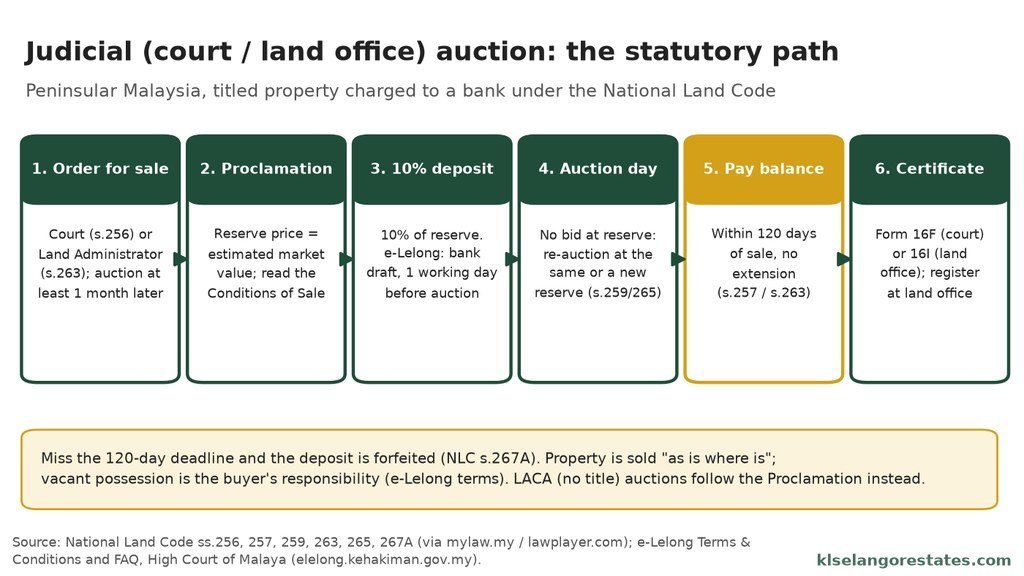
- For Registry titles, the bank applies to the High Court for an order for sale (NLC s.256). For Land Office titles, it applies to the Land Administrator (s.263).
- The NLC fixes key terms of the order:
- the sale must be by public auction, at least one month after the order;
- the reserve price is the estimated market value;
- bidders must have 10% of the reserve price;
- the balance must be paid within 120 days of the sale, with no extension.
These are set out in s.257 for court sales and s.263 for land office sales.
- If you miss the 120-day deadline, your deposit is forfeited (s.267A).
- If nobody bids at or above the reserve, the property is withdrawn and put up again later "either at the same or at a new reserve price" (s.259 for court sales, s.265 for land office sales). The law does not fix how much the reserve drops in each round.
High Court auctions in Peninsular Malaysia now run online through e-Lelong. Under its published terms:
- you pay the 10% deposit by bank draft, no later than one working day before the auction;
- the property is sold "as is where is", and vacant possession is the successful bidder's responsibility;
- after you pay the balance, the bank must settle fees due to the State Authority and charges owed to local authorities up to the auction date;
- you then receive a Certificate of Sale (Form 16F) to register.
2. Non-judicial auctions (LACA: no individual title yet)
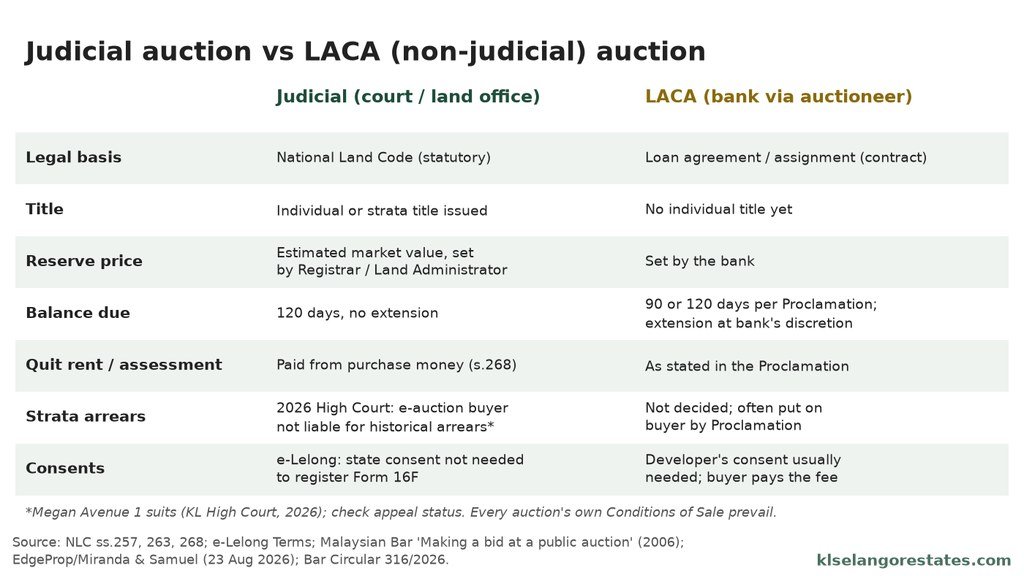
Many flats and condominiums are sold before the strata title is issued. In that case the buyer's loan is secured by a Loan Agreement cum Assignment (LACA): the buyer assigns their rights in the property to the bank. Because there is no title to charge, the NLC procedure does not apply. If the borrower defaults, the bank sells under its contract through a licensed auctioneer.
A Malaysian Bar Law & Realty column by Andrew Wong, then Deputy Chair of the Bar Council's Conveyancing Practice Committee, describes these sales as "not regulated by any legislation". The bank sets the reserve, and everything turns on the Proclamation. That column, and law-firm guides since, note several points:
- Payment period: some Proclamations give 90 days to pay the balance and others 120. Some allow no extension; others leave it to the bank's discretion, usually with interest charged.
- Deposit: Hong Leong Bank's auction FAQ, for example, asks bidders to bring 10% of the reserve price by bank draft or banker's cheque. The winning bidder then pays the difference up to 10% of the selling price straight after the auction, and the balance within 90 or 120 days. Other banks' terms may differ, so check your Proclamation.
- Developer's consent: this is usually the purchaser's job, and the purchaser usually pays the fee.
- Arrears: many Proclamations make the purchaser bear arrears of service charges and utilities.
- Bank's lawyers: the purchaser often pays the bank's solicitors' fees for the deed of assignment.
The column is from 2006, but its points about reading the Proclamation still hold.
Who pays the old arrears?
This is where many buyers get caught out.
Quit rent and assessment. In a judicial sale, the NLC (s.268) requires these to be paid out of the purchase money, and e-Lelong's terms say the same. In a LACA sale, it depends entirely on the Proclamation.
Strata maintenance charges and sinking fund. In 2026, the Kuala Lumpur High Court ruled on suits brought by the management corporation of Megan Avenue 1 against buyers of office units sold at High Court e-auctions. The suits are reported as Perbadanan Pengurusan Megan Avenue 1 v Harjinder Singh (EdgeProp) and a related suit in the Bar Council's September 2026 Case Spotlight.
The Court held that a buyer at a judicial auction is not a "successor-in-title" under ss.60(4) and 61(4) of the Strata Management Act 2013. That meant the buyer was not liable for the previous owner's historical arrears. In one suit the claim, with interest, was about RM268,000.
Commentators stress how narrow the ruling is:
- These are High Court decisions, so check whether they have been appealed before relying on them.
- It concerns true judicial sales only.
- It did not decide the position for LACA sales.
- The buyer still pays charges from the time they own the unit.
For ordinary private sales, the Court of Appeal's Brightvite decision still applies: arrears can be recovered from the buyer as successor-in-title.
The practical point: before you bid, get the latest statement of account from the management body, and read what the Proclamation says about arrears.
Vacant possession and inspection
Courts and banks generally do not hand over an empty property.
- e-Lelong's terms say the plaintiff (the bank) "shall not be responsible to deliver vacant possession".
- The Bar column says nearly all Proclamations put possession on the purchaser, at their own cost.
- You often cannot inspect inside, because the owner or occupant may still be there or the unit may be locked.
So budget time and money for the possibility that someone is living in the property, and that you may need legal action to recover possession. Visit the building, talk to the management office, and look at what you can see from outside.
Financing an auction purchase
The 120-day (or 90-day) clock is the biggest risk for buyers using a loan.
- Get loan eligibility checked before the auction. Give your bank the Proclamation of Sale so it can value the property and tell you how much it will lend, before you pay any deposit.
- Allow for slow conveyancing. The Bar column warns that 90 or 120 days may not be enough if you need a loan, especially for LACA properties, where consents and undertakings take time. If the property is a low-cost flat that needs state consent, 120 days may be too short.
- Keep a cash buffer. If the loan falls through, you either pay the balance in cash or lose your deposit.
Stamp duty and other costs
Expect to pay stamp duty on the instrument that transfers the property to you. That is the certificate of sale for a judicial auction or the assignment for a LACA property. For Malaysian buyers, the standard LHDN scale for transfers is:
- 1% on the first RM100,000;
- 2% on RM100,001 to RM500,000;
- 3% on RM500,001 to RM1,000,000;
- 4% above RM1,000,000.
It is charged on the price or market value, whichever is higher. A loan agreement adds 0.5% of the loan amount. I did not find an LHDN guideline that deals specifically with auction certificates, so have your lawyer confirm the computation.
What about the first-home exemption? The current orders exempt a first home of up to RM500,000 market value, but they tie the exemption to a sale and purchase agreement signed between 1 January 2021 and 31 December 2027. Budget 2027 proposes widening this relief to first homes up to RM750,000, with a 50% exemption on the portion between RM500,001 and RM750,000, for SPAs signed from 1 January 2027 to 31 December 2030; this is a proposal, not law, until the exemption order is gazetted (see Budget 2027 and Your First Condo). An auction purchase normally proceeds on a Proclamation and a memorandum of sale rather than an SPA. I could not find an official ruling on whether auction buyers qualify, so do not assume they do. Ask your lawyer before you budget for it.
Other costs to plan for:
- legal fees;
- developer's consent fees (LACA);
- the bank's solicitors' fees (often in LACA sales);
- any arrears the Proclamation puts on you;
- repairs, new locks and any eviction proceedings.
Condo or landed?
Strata units (condos, apartments):
- Check the title status. Is a strata title issued (usually a judicial auction) or not yet (usually LACA)?
- Check the maintenance and sinking fund arrears, and the condition of the building and the management body.
- Many low-cost and affordable units carry ownership restrictions.
Landed (terrace, semi-D):
- More likely to be under individual title and sold as a judicial auction.
- Check whether the land is freehold or leasehold, and whether the title carries restrictions in interest. Look out especially for Malay Reservation land or bumiputera lots, which only qualifying buyers can hold.
- e-Lelong's terms state that foreign citizens and companies cannot bid on property under legal restrictions without the relevant approvals.
- e-Lelong's terms also state that state consent for a restriction in interest is not needed to register the court's certificate of sale. LACA sales and low-cost units can still need developer or authority consent, so confirm this with your lawyer.
When a subsale is the better choice
An auction is not automatically cheaper once you add the risks. A subsale may suit you better if:
- you need a loan and cannot risk a fixed 90- or 120-day deadline;
- you want to inspect inside and negotiate repairs or a handover date;
- you want the seller to clear arrears before completion;
- you are a first-time buyer counting on the first-home stamp duty exemption.
Pre-bid checklist
- Get the Proclamation and Conditions of Sale and read every clause.
- Identify the auction type: judicial (court/land office) or LACA.
- Do a land search for titled property, or check the developer and the assignment chain for LACA.
- Check the tenure, restrictions in interest and any state consent requirements.
- Get the management statement (maintenance, sinking fund) and check quit rent and assessment.
- Visit the building and assess occupancy and condition.
- Get loan eligibility confirmed against the Proclamation, or confirm your cash.
- Prepare the 10% deposit in the required form, usually a bank draft, before the deadline.
- Set your maximum bid after all costs, and stick to it.
- Have your own lawyer review everything before you bid.
Sources
- National Land Code (Revised 2020), s.257: https://mylaw.my/legislation/national-land-code-revised-2020-2020/section-257
- National Land Code, s.259: https://lawplayer.com/my/article/act-828/s-259
- National Land Code, s.263: https://lawplayer.com/my/article/act-828/s-263
- National Land Code, s.265: https://lawplayer.com/my/article/act-828/s-265
- National Land Code, s.268: https://lawplayer.com/my/article/act-828/s-268
- e-Lelong (High Court of Malaya), Terms & Conditions: https://elelong.kehakiman.gov.my/BidderWeb/Home/Terms
- e-Lelong, FAQ: https://elelong.kehakiman.gov.my/BidderWeb/Home/FAQ
- Malaysian Bar, "LAW & REALTY: Making a bid at a public auction" (Andrew Wong, 2006): https://www.malaysianbar.org.my/article/about-us/committees/conveyancing-practice/law-realty-making-a-bid-at-a-public-auction
- EdgeProp, "Do auction buyers inherit sellers' strata arrears?" (George Miranda, Miranda & Samuel, 23 Aug 2026): https://www.edgeprop.my/content/1917209/do-auction-buyers-inherit-sellers%E2%80%99-strata-arrears
- Malaysian Bar, Circular No 316/2026, Conveyancing Practice Case Spotlight (2 Sept 2026): https://www.malaysianbar.org.my/cms/upload_files/document/Circular%20No%20316-2026.pdf
- Donovan & Ho, "Differences between buying an Auction Property vs Secondary Market Property": https://dnh.com.my/differences-between-buying-an-auction-property-vs-secondary-market-property/
- Hong Leong Bank, Property Auction Listing FAQ: https://www.hlb.com.my/content/dam/hlb/my/docs/pdf/Personal/Property-Auction/hlb-property-auction-listing-faq.pdf
- The Edge Malaysia, "Malaysia flags growing property overhang amid slowing transactions in 1H2026" (NAPIC figures): https://theedgemalaysia.com/node/817533
- Malaysian Bar, Circular No 128/2026 (first-home stamp duty exemption orders): https://www.malaysianbar.org.my/cms/upload_files/document/Circular%20No%20128-2026.pdf
- LHDN, Garis Panduan Pengenaan Duti Setem (transfer scale): https://www.hasil.gov.my/wp-content/uploads/garis-panduan-pengenaan-duti-setem-jadual-pertama-as-1949.pdf
About the author
Jessica Leong is a Registered Estate Agent (E 3208) with PropNex Realty Sdn Bhd (E (1) 1800/1), KL branch. She covers new launch condos in Kuala Lumpur and Petaling Jaya, industrial property in Selangor, bank auction (lelong) properties, and PJ/Selangor offices, shophouses and en-bloc deals.
PropNex Realty Sdn Bhd, A-G-03, Marc Residence, No. 3, Jalan Pinang, 50400 Kuala Lumpur
Office: 03-2161 8608 · WhatsApp: 010-464 6088
Website: klselangorestates.com
This article is general information based on public sources as at 19 October 2026. It is not legal, financial or tax advice. The Proclamation and Conditions of Sale for each auction prevail. Please consult your own lawyer and banker before bidding.