Serviced Offices vs. Bare Shell Spaces: CapEx Comparison for Regional Tech Hubs
Originally published on Medium: read it on Medium
In the fast-paced commercial real estate ecosystem of Greater Kuala Lumpur, expanding technology enterprises, regional multinational software houses, and fast-growing digital startups face a critical strategic crossroads when establishing a footprint. Across thriving tech hubs and digital corridors in Selangor — ranging from the high-tech campuses of Cyberjaya and the corporate towers of Petaling Jaya to Damansara Uptown and Bangsar South — choosing the right workspace model dictates more than just daily employee morale. It fundamentally shapes a company’s capital allocation, cash-flow liquidity, and speed-to-market.
When evaluating workspace options, corporate real estate directors and chief financial officers invariably arrive at a foundational capital expenditure dilemma: should the enterprise invest in a traditional bare shell commercial space requiring a custom, ground-up interior fit-out, or should they deploy a flexible serviced office or enterprise managed suite model? Navigating this financial and operational comparison requires a rigorous analysis of upfront capital requirements, deployment timelines, operational flexibility, and long-term total cost of occupancy.
The Strategic Reality of Bare Shell Spaces in Regional Tech Hubs
A bare shell commercial space represents the traditional baseline of commercial real estate leasing in Malaysia. When a tenant signs a long-term lease for a bare shell unit in an institutional-grade office building across Petaling Jaya or Cyberjaya, the landlord hands over an unadorned structural concrete envelope. The space typically features bare concrete flooring, exposed overhead concrete slabs, unpainted perimeter walls, a basic stub-out for incoming electrical and water utilities, and a fire sprinkler system conforming to local statutory guidelines.
The primary appeal of a bare shell space lies in complete operational autonomy and bespoke brand customization. For a regional tech hub housing hundreds of software engineers, data architects, and executive leadership, a bare shell lease allows the organization to design an architectural layout tailored precisely to its corporate culture. Every partition, collaborative breakout pod, acoustic phone booth, raised flooring system, specialized server room, and ergonomic workstation is planned and executed from scratch.
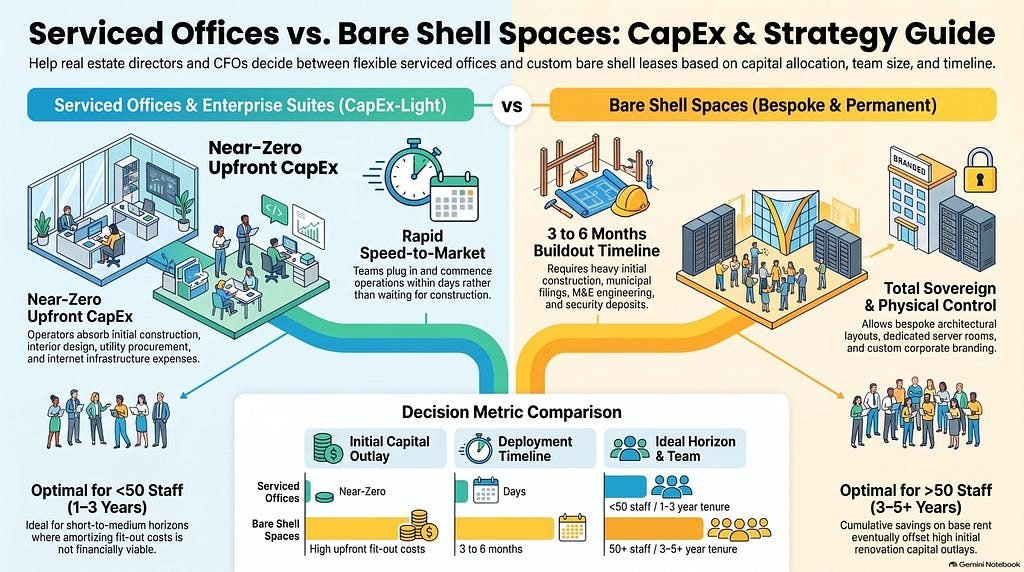
However, this absolute customization comes at a massive financial price: front-loaded capital expenditure. Transforming a raw concrete shell into a functioning, high-performance tech office requires extensive capital outlays. Corporations must self-fund professional interior design consultancy fees, mechanical and electrical engineering modifications, structured Cat6A or fiber-optic data cabling networks, specialized air-conditioning distribution, security access turnstiles, and ergonomic office furniture. In the Malaysian commercial context, outfitting a bare shell space typically demands anywhere from three to six months of heavy construction activity, combined with substantial security deposits spanning multiple months of gross rent and statutory submission fees to local municipal authorities.
Serviced Offices and Enterprise Suites: The CapEx-Light Alternative
In stark contrast to the capital-intensive nature of bare shell leases, the serviced office and managed enterprise workspace sector has evolved into a sophisticated corporate real estate solution. No longer viewed merely as temporary incubators for freelancers, modern flexible workspace operators provide enterprise-grade private floors, custom-branded suites, and fully managed corporate environments within landmark towers across Selangor and Kuala Lumpur.
Under a serviced office or enterprise managed agreement, the capital expenditure profile undergoes a radical transformation. The upfront capital cost drops close to zero. The workspace operator absorbs all initial construction outlays, interior design fees, utility procurement, architectural engineering, high-speed redundant internet infrastructure installation, and ongoing maintenance expenses. The tenant moves into a fully fitted, operational office complete with ergonomic sit-stand desks, meeting rooms equipped with enterprise-grade audiovisual conferencing gear, shared enterprise pantries, and front-desk reception services.
For a regional technology firm expanding into the Malaysian market, this cap-ex-light model preserves precious working capital. Instead of sinking millions of ringgit into depreciating leasehold improvements and construction contractors, the business preserves its liquidity to fund core operational priorities, software engineering talent acquisition, and market expansion initiatives. Furthermore, the speed-to-market advantage is profound. While a bare shell fit-out requires months of construction and municipal approvals, a serviced office suite allows a tech team to move in, plug in, and commence operations within a matter of days.
Financial Benchmarking: Total Cost of Occupancy over Time
When comparing the capital expenditure of serviced offices against bare shell spaces, finance committees must model the total cost of occupancy across a multi-year horizon rather than relying solely on monthly invoice comparisons.
On a surface-level monthly rental basis, a serviced office or managed suite appears significantly more expensive per square foot than a bare shell lease. Serviced office pricing operates on an all-inclusive per-seat or per-square-foot management fee that bundles rent, utilities, cleaning, security, internet bandwidth, and facility maintenance into a single monthly invoice. Conversely, a bare shell lease features a lower base rent per square foot, making it look exceptionally economical on paper.
However, financial modeling reveals a critical breakeven crossover point. For a small or mid-sized tech team scaling below thirty to fifty personnel over a short-to-medium-term horizon of one to three years, the massive upfront fit-out capital expenditure required for a bare shell space makes traditional leasing far more expensive on a total cash-flow basis. The sunk capital spent on renovating a bare shell office takes years to amortize. Conversely, as headcount scales beyond fifty personnel and enterprise tenure solidifies past three to five years, the cumulative per-seat premium of a serviced office eventually surpasses the total cost of a traditional bare shell lease, swinging long-term financial efficiency back toward traditional bare shell ownership.
Agility vs. Permanence: Headcount Projections and Tech Volatility
The technology sector is characterized by rapid growth trajectories, sudden pivots, and dynamic headcount fluctuations. This business volatility makes spatial forecasting exceptionally challenging for tech startup founders and regional expansion directors.
If a technology company leases a bare shell office and builds out custom fit-outs for a projected workforce of one hundred employees, but experiences a market contraction or rapid restructuring that reduces its local headcount to forty, the business is left holding an oversized, expensive footprint. Being locked into a rigid three-to-five-year bare shell lease means paying for thousands of square feet of underutilized space while remaining contractually bound to costly dilapidation and reinstatement obligations at the end of the term.
Serviced offices and enterprise managed suites absorb this business volatility effortlessly. Most flexible workspace agreements offer agile contract terms ranging from six months to three years, with contractual mechanisms allowing enterprises to scale their physical footprint up or down — adding or shedding private suites and dedicated desks — as their headcount evolves. This operational agility insulates technology firms against economic uncertainty, preventing real estate from becoming an inflexible financial anchor.
Security, Branding, and Corporate Culture Considerations
Beyond pure financial capital expenditure calculations, technology enterprises must weigh how workspace models impact their data security, intellectual property protection, and corporate culture.
Traditional bare shell spaces provide absolute physical security and sovereign control. Financial technology firms, cybersecurity enterprises, and software developers handling proprietary source code or sensitive client data often require dedicated, walled-off server rooms, isolated network switches, and strict access protocols that can be custom-engineered without sharing common administrative corridors with external entities.
On the other hand, enterprise serviced office operators have heavily upgraded their security frameworks, offering private, secure enterprise suites with dedicated biometric access control, isolated VLAN network architectures, and secure client-facing boardrooms. Furthermore, modern managed workspace providers offer extensive branding customization, allowing regional tech hubs to display their corporate logos, color schemes, and design aesthetics across their private enterprise zone, successfully marrying the CapEx-light benefits of flexible workspaces with a distinct corporate identity.
Strategic Verdict for Regional Tech Hub Decision-Makers
Choosing between serviced offices and bare shell spaces in Selangor’s regional tech hubs is a strategic exercise in balancing capital preservation against operational scale and permanence. For early-stage technology startups, regional expansion units testing the Malaysian market, and agile digital enterprises requiring rapid deployment with zero upfront capital expenditure, serviced offices and managed enterprise suites deliver unmatched financial efficiency and agility. For established technology giants and mature software powerhouses with stable headcount projections and a desire for absolute architectural control and long-term asset branding, investing in a bare shell corporate headquarters remains the premier pathway. By aligning real estate commitments with corporate growth velocity and financial governance, technology leaders can optimize their capital deployment and secure sustainable success across Malaysia’s thriving digital economy.
Sources & Statutory Authorities
- Malaysia Digital Economy Corporation (MDEC): Malaysia Digital (MD) Framework and Technology Hub Spatial Guidelines.
- National Property Information Centre (NAPIC), Valuation and Property Services Department (JPPH) Malaysia: Klang Valley Commercial Office Market and Flexible Workspace Reports.
- Laws of Malaysia, Contracts Act 1950 (Act 133) and Strata Management Act 2013 (Act 757).
- Independent Flex-Space and Commercial Real Estate Advisory Insights: CapEx Comparison Models for Regional Tech Hubs in Southeast Asia.