En-Bloc Building Acquisitions in Selangor: Structuring Share Purchases vs. Asset Sales
Originally published on Medium: read it on Medium
Acquiring an entire en-bloc commercial building or corporate tower in Selangor — whether situated in the mature commercial hubs of Petaling Jaya, Damansara, Subang Jaya, or the expanding nodes of Cyberjaya — represents a major capital deployment. For institutional funds, real estate investment trusts, and high-net-worth conglomerates, securing a standalone headquarters or income-generating trophy asset goes beyond selecting a physical location. It requires a sophisticated legal and financial framework to determine how the transaction is executed.
When structuring an en-bloc acquisition in Malaysia, investors and vendors fundamentally choose between two legal mechanisms: a share purchase or a direct asset sale. Each structure carries distinct implications for conveyancing timelines, statutory tax exposure, stamp duty calculations, and liability risk management under Malaysian jurisprudence.
The Core Structural Distinction
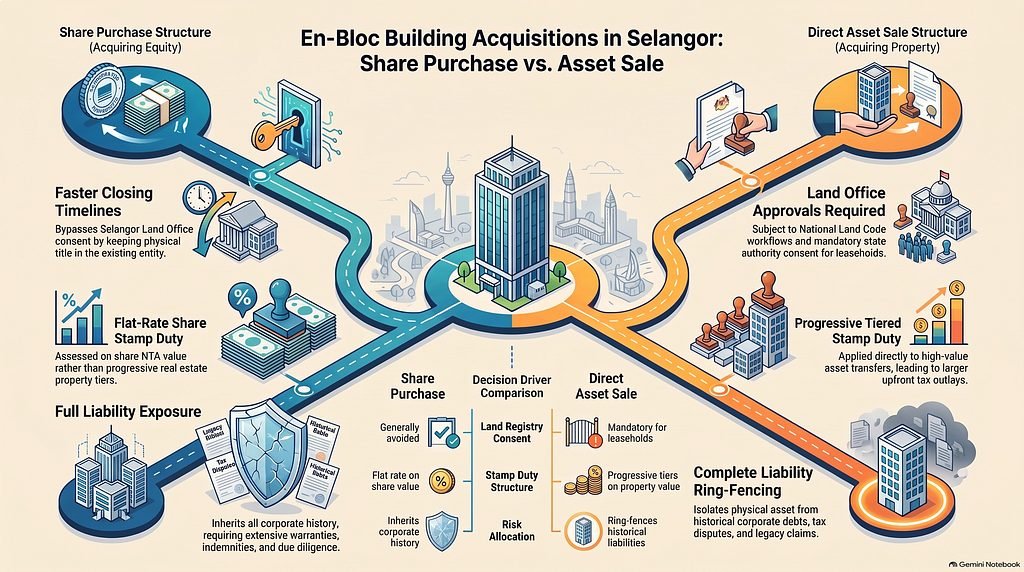
A share purchase involves the acquisition of the equity interest in the corporate vehicle that legally owns the real estate. If a target company’s sole purpose or primary holding is a standalone office tower in Petaling Jaya, buying the shares means acquiring the entire corporate entity — its corporate history, licenses, existing contracts, and its underlying real property. The physical building remains registered under the same corporate owner at the Selangor Land Office; only the share register at the Companies Commission of Malaysia changes, reflecting the new incoming shareholders.
Conversely, a direct asset sale involves the acquisition of the physical real estate property itself out of the vendor company. The buyer purchases the land and the en-bloc building as a discrete capital asset. This transaction requires formal conveyancing procedures, including executing a statutory Memorandum of Transfer, filing ad valorem stamp duty documents, and registering the title transfer directly at the relevant land registry. The corporate vendor remains an intact legal entity, retaining the cash proceeds from the sale while divesting the physical real estate asset from its balance sheet.
Conveyancing Timelines and Regulatory Approvals in Selangor
The mechanical execution and timeline of an en-bloc acquisition vary drastically depending on the chosen structure.
An asset sale follows standard Malaysian conveyancing workflows governed by the National Land Code. The process requires comprehensive title searches at the Selangor Land Office to verify leasehold or freehold statuses, encumbrances, and express conditions. If the en-bloc building is held under a leasehold title, the transfer is strictly conditional upon obtaining state authority consent, a procedural requirement that can add weeks or months to the transaction timeline. Furthermore, if the buyer is a foreign corporate entity, approvals from the Economic Planning Unit or state authorities may be mandatory.
A share purchase, by contrast, bypasses the traditional land office transfer mechanism entirely. Because the legal title of the building does not change hands at the land registry, state authority consent for land transfer is generally avoided, making the initial closing timeline significantly faster. However, the speed of a share purchase depends heavily on the thoroughness of corporate due diligence. Reviewing the target company’s constitution, checking for pre-emption rights or shareholder restrictions, and investigating historical corporate liabilities require meticulous legal auditing.
Tax Implications: RPGT, Corporate Tax, and Stamp Duty
Navigating Malaysian tax statutes — including provisions enforced by the Inland Revenue Board of Malaysia — is often the decisive factor when corporate finance teams choose between a share purchase and an asset sale.
Stamp duty mechanics differ significantly between the two options. In a share purchase, the transfer of unlisted shares in a Malaysian private limited company attracts ad valorem stamp duty calculated on the consideration price or the net tangible asset value of the shares, whichever is higher, typically assessed at a flat percentage rate on the instrument of transfer. In an asset sale, the transfer of real estate attracts tiered ad valorem stamp duty rates under the Stamp Act 1949, scaling progressively based on the property’s valuation tiers. For high-value en-bloc commercial towers worth tens or hundreds of millions of ringgit, the absolute stamp duty payable on a direct asset conveyance can represent a substantial capital outlay.
Tax liabilities on the disposal gains also diverge. In an asset sale, the vendor company records a capital gain or corporate income tax liability depending on whether the building constitutes a capital asset or trading stock, and whether capital allowances previously claimed are subject to clawbacks. In a share purchase, the individual or corporate shareholders selling the equity may be subject to Real Property Gains Tax (RPGT) if the target company qualifies as a “Real Property Company” — defined under Malaysian tax law as a company holding real property or shares in real property companies of a prescribed minimum value. Modeling these tax exposures against current statutory rates is essential before finalizing transaction terms.
Risk Allocation and Liability Ring-Fencing
For institutional buyers, the decision between buying shares or assets frequently boils down to risk management and liability exposure.
A share purchase means the buyer steps entirely into the shoes of the previous owners. This includes inheriting the entire operational history of the company. If the corporate entity carried historical tax audits, pending litigation, unrecorded employee claims, or latent environmental liabilities from past tenants, those legal risks transfer automatically with the shares. To protect against this, buyers must negotiate extensive contractual warranties, indemnities, and escrow holdbacks within the Share Purchase Agreement.
An asset sale offers superior risk mitigation through liability ring-fencing. By purchasing only the physical en-bloc building and clean title, the buyer leaves historical corporate liabilities, past tax disputes, and legacy debts trapped inside the vendor company. The buyer acquires a pristine asset with zero historical baggage. This clean separation is heavily favored by private equity funds and institutional investors who require unblemished balance sheets.
Strategic Verdict for Real Estate Investors
Structuring an en-bloc building acquisition in Selangor requires balancing speed, tax efficiency, and risk exposure. When a target company possesses a clean, unencumbered operating history and the primary goal is rapid closing with minimized land office bureaucracy, a share purchase offers an efficient structural vehicle. Conversely, when acquiring a high-value trophy asset where legacy liabilities are unknown or unacceptable, executing a direct asset sale provides essential risk protection and structural clarity. Partnering with experienced real estate advisors, tax specialists, and legal counsel ensures that every en-bloc transaction is engineered for maximum financial performance and long-term asset security.
Sources & Statutory Authorities
- Inland Revenue Board of Malaysia (LHDN): Real Property Gains Tax (RPGT) Rules and Stamp Act 1949 Provisions.
- National Property Information Centre (NAPIC), Valuation and Property Services Department (JPPH) Malaysia: Klang Valley Commercial Real Estate and En-Bloc Transaction Reports.
- Laws of Malaysia, National Land Code (Act 828): Provisions governing land registration, transfers, and state authority consents.
- Laws of Malaysia, Stamp Act 1949 (Act 378): Stamp duty assessment on share transfers and real estate conveyancing.
- Independent Malaysian Legal and Corporate Mergers & Acquisitions Advisory Frameworks.