Central Business District (CBD) Office Shifting: Why Firms Move from KLCC to Selangor?
Originally published on Medium: read it on Medium
In the dynamic commercial real estate landscape of Greater Kuala Lumpur, a quiet yet powerful structural shift is reshaping corporate workspace strategies. For decades, the Kuala Lumpur City Centre (KLCC) precinct stood as the undisputed epicenter of corporate prestige, commanding the highest rental premiums and housing the headquarters of multinational corporations, foreign banks, and legacy conglomerates. However, a growing number of corporate real estate directors and chief financial officers are re-evaluating the financial and operational viability of staying within the traditional CBD. Across major Selangor commercial hubs like Petaling Jaya, Damansara, and Cyberjaya, firms are executing strategic office relocations out of KLCC and into decentralized suburban enclaves.
Understanding why modern enterprises are trading central city zip codes for Selangor addresses requires examining the intersection of total occupancy cost pressures, modern transit infrastructure, talent demographics, and the evolution of sustainable workplace design.
The Financial Realities of KLCC Headquarter Operations
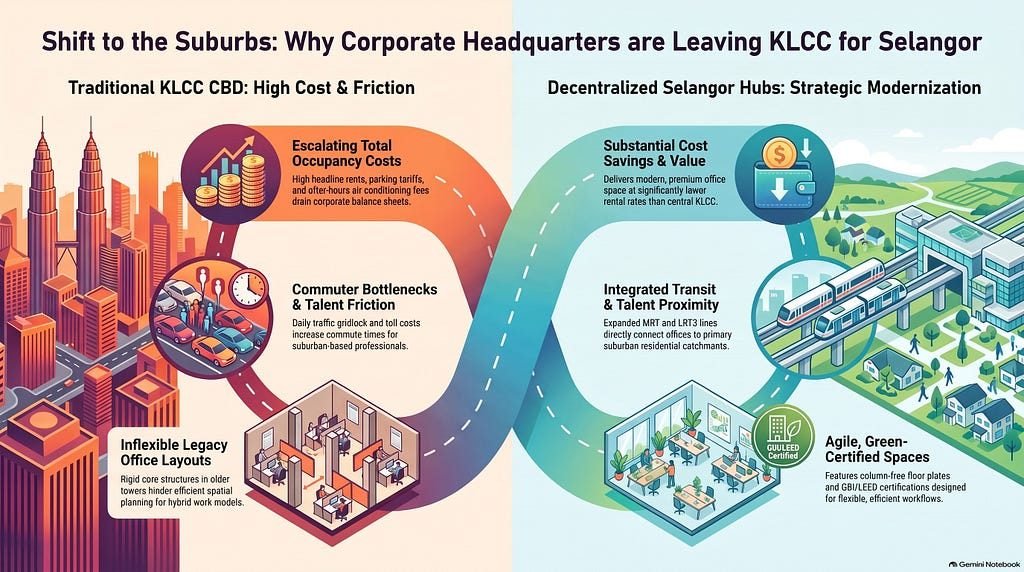
The primary catalyst driving firms out of the traditional CBD is the relentless upward pressure on operating overheads. Renting institutional-grade office space in premier KLCC towers demands top-tier financial commitments, with headline base rents frequently scaling past high market thresholds per square foot. When layering on auxiliary charges, mandatory service fees, higher parking tariffs, and costly after-hours air conditioning fees, the total cost of occupancy in the city center creates a heavy drain on corporate balance sheets.
In contrast, decentralized commercial corridors in Selangor — such as Petaling Jaya and Cyberjaya — offer equivalent or superior modern building specifications at more sustainable rental rates. Average asking rents in Selangor hover at significantly more accessible levels, allowing expanding enterprises to secure larger, more efficient floor plates, advanced technological infrastructure, and green-certified workspaces for a fraction of the capital required in KLCC. For cost-conscious organizations balancing hybrid work models and fluctuating headcounts, shedding expensive CBD square footage provides an immediate, measurable boost to net operating income.
The Evolution of Transit-Oriented Infrastructure in Selangor
Historically, a major argument for remaining anchored in KLCC was its central accessibility via the Kelana Jaya LRT line. However, the rapid expansion and maturation of the Klang Valley’s integrated rail network have systematically dismantled the CBD’s transit monopoly.
The extensive rollout and integration of Mass Rapid Transit (MRT) lines — such as the Kajang and Putrajaya lines — alongside the operationalization of the Light Rail Transit 3 (LRT3) Shah Alam Line, have completely transformed regional accessibility. Major Selangor commercial nodes are now seamlessly connected to the wider metropolitan grid. Employees commuting from diverse residential suburbs across the Klang Valley can travel directly to modern business hubs in Petaling Jaya, Bandar Utama, and Cyberjaya without enduring the grueling traffic bottlenecks and congestion typical of central KLCC approaches. This decentralized transit connectivity ensures that moving out of the CBD does not compromise workforce accessibility.
Talent Alignment and Demographic Shifts
Where a company locates its corporate office has a direct correlation with its ability to attract and retain top-tier professional talent. Over recent years, demographic patterns across Greater Kuala Lumpur show that a vast majority of the modern professional workforce — particularly technology specialists, finance professionals, and young families — resides in established suburban residential catchments across Petaling Jaya, Subang Jaya, Shah Alam, and the southern Klang Valley.
For these employees, commuting daily into the heart of KLCC involves battling severe highway gridlock, expensive parking tolls, and extended travel times. By relocating corporate headquarters from the CBD to decentralized Selangor hubs, companies position their offices closer to where their employees actually live. This reduction in daily commuting friction enhances employee satisfaction, lowers burnout rates, and gives relocating firms a distinct competitive edge in talent acquisition and retention.
Spatial Efficiency and the Flight-to-Quality
Corporate space planning has evolved dramatically. The post-pandemic shift toward hybrid work models means that traditional, rigid office layouts featuring oversized executive suites and assigned desks for one hundred percent simultaneous attendance are no longer financially justifiable.
Older office stock within the legacy CBD often features inflexible core geometries and structural constraints that make efficient space planning difficult. Conversely, modern corporate towers in Selangor — such as those in Damansara Uptown, Bandar Utama, and Cyberjaya — are designed with flexible, column-free floor plates, advanced smart building automation, and high-performance green certifications like the Green Building Index (GBI) or LEED standards. These modern developments empower businesses to optimize square footage per employee, implementing agile desk-sharing ratios and collaborative zones that align precisely with contemporary operational workflows.
Strategic Verdict for Corporate Real Estate Leaders
Relocating a corporate headquarters from KLCC to Selangor is no longer viewed as a geographical compromise; it is a calculated, forward-thinking business strategy. By migrating to decentralized commercial hubs that offer superior cost-efficiency, modern sustainable infrastructure, robust transit connectivity, and closer proximity to workforce talent catchments, enterprises can future-proof their operations. For corporate leaders seeking to balance financial governance with workspace excellence, the migration from the central business district to Selangor represents the definitive path forward in modern commercial real estate.
Sources & Statutory Authorities
- National Property Information Centre (NAPIC), Valuation and Property Services Department (JPPH) Malaysia: Klang Valley Commercial Real Estate and Rental Yield Reports.
- Knight Frank Malaysia: Kuala Lumpur and Selangor Office Market Monitoring Studies.
- Prasarana Malaysia & Land Public Transport Agency (APAD): Klang Valley Integrated Transit System Frameworks.
- Laws of Malaysia, Town and Country Planning Act 1976 (Act 172) and Street, Drainage and Building Act 1974 (Act 133).
- Independent Klang Valley Commercial Real Estate Market Research: CBD Decentralization and Corporate Relocation Trends in Greater Kuala Lumpur.