Legal Obligations for Commercial Office Fire Drills and DOSH Compliance in Malaysia
Originally published on Medium: read it on Medium
Navigating the operational frameworks of commercial office assets across Greater Kuala Lumpur — from the corporate towers of Petaling Jaya and Damansara to the high-tech business parks of Cyberjaya — requires strict adherence to statutory safety standards. While corporate real estate directors and tenant representatives frequently focus heavily on gross rental rates, lease incentives, and spatial layouts, legal compliance regarding workplace safety and emergency preparedness is non-negotiable. In Malaysia, failing to execute mandatory fire drills or disregarding safety mandates issued by regulatory authorities can expose building owners, management corporations, and corporate tenants to severe legal liabilities, crippling fines, and operational shutdowns.
Understanding the distinct statutory roles of the Malaysian Fire and Rescue Department (BOMBA) and the Department of Occupational Safety and Health (DOSH) is essential for corporate tenants and commercial property managers aiming to maintain full legal compliance under Malaysian law.
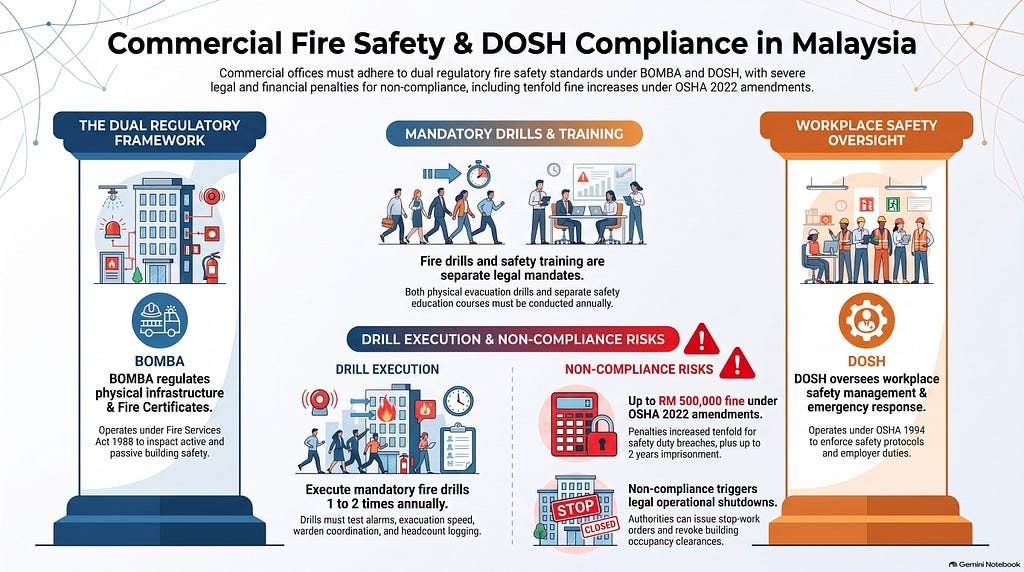
The Dual Regulatory Framework: BOMBA and DOSH Jurisdictions
Ensuring commercial office fire safety and emergency compliance involves navigating a coordinated framework enforced primarily by two key federal agencies.
The Fire Services Act 1988 (Act 341) empowers BOMBA to oversee active and passive fire protection systems, regulate fire prevention measures, inspect building safety infrastructure, and issue the critical Fire Certificate required for commercial premises. Every high-rise office building in Selangor must hold a valid, up-to-date Fire Certificate, which depends heavily on maintaining clear evacuation paths, functional sprinkler networks, and operational alarm systems.
Simultaneously, workplace safety and employer duties toward worker protection are governed by the Occupational Safety and Health Act 1994 (Act 514), enforced by the Department of Occupational Safety and Health. Following legislative enhancements under the Occupational Safety and Health (Amendment) Act 2022, which came into full effect, the statutory duties of employers to ensure a safe working environment have expanded significantly, backed by dramatically increased financial penalties. While BOMBA inspects physical fire installations and structural readiness, DOSH scrutinizes employer safety management systems, emergency response protocols, and worker training compliance.
Mandatory Fire Drill Obligations for Commercial Offices
Conducting regular, timed fire evacuation drills is a cornerstone legal requirement for commercial offices in Malaysia. Under standard regulatory guidelines and Fire Certificate renewal conditions, commercial office buildings and corporate workplaces are generally mandated to execute fire evacuation drills at least once to twice a year.
A legally compliant fire drill cannot be treated as a casual administrative formality; it must simulate real emergency conditions to test both human readiness and building infrastructure. During the exercise, building management and corporate safety wardens must evaluate multiple operational parameters:
- Alarm Activation and Response Time: Testing the response speed of the integrated fire detection and alarm systems, manual call points, and emergency broadcast mechanisms.
- Evacuation Efficiency: Monitoring whether building occupants successfully evacuate via designated stairwells without utilizing restricted elevators, following clear directional signage to designated assembly points.
- Floor Warden Coordination: Verifying that trained floor captains and fire wardens effectively guide personnel, sweep enclosed rooms, assist individuals requiring special mobility accommodations, and confirm complete floor clearance.
- Headcount and Debriefing: Executing accurate headcounts at safe assembly areas and conducting a post-drill evaluation to document total evacuation duration and identify any structural bottlenecks.
Maintaining comprehensive documentation of these exercises — including dates, participant headcounts, total evacuation times, and remedial action logs — is vital. When BOMBA or municipal officers audit a commercial property for Fire Certificate renewals, missing or incomplete fire drill records frequently serve as a primary catalyst for administrative delays and failed inspections.
The Role of Fire Safety Managers and Emergency Response Teams
For designated high-risk or large-scale commercial premises in Malaysia, statutory frameworks require the establishment of an organized Fire Safety Organization, often led by a certified Fire Safety Manager (FSM) and supported by designated Fire Safety Officers.
Under these operational requirements, designated commercial premises must ensure that emergency training courses and fire safety education programs are conducted for building occupants at least once a year. Crucially, regulatory bodies draw a strict legal distinction between a fire drill and fire safety training. A fire drill rehearses physical evacuation and route familiarity, whereas fire safety training educates personnel on hazard recognition, fire prevention, and the proper handling of portable fire extinguishers. Satisfying legal compliance mandates the documentation and execution of both distinct obligations annually.
Expanded Penalties and Enforcement Under OSHA Amendments
The legal gravity of maintaining workplace fire safety compliance escalated sharply following the enforcement of the Occupational Safety and Health (Amendment) Act 2022. The maximum fines for employers who breach general safety duties — endangering workers through neglected fire safety protocols, obstructed emergency exits, or unmaintained emergency lighting systems — were increased tenfold.
Under the current legal structure, corporate employers found guilty of severe safety and health violations face maximum fines of up to five hundred thousand ringgit, imprisonment terms of up to two years, or both. Furthermore, under the Uniform Building By-Laws 1984, local municipal councils and BOMBA retain the legal authority to issue stop-work orders, revoke occupancy clearances, or shut down commercial premises that fail to maintain minimum life-safety standards. For corporate directors and building owners, negligence is no longer merely a safety hazard; it represents a major existential corporate liability.
Strategic Risk Management for Corporate Tenants and Landlords
To insulate commercial operations against legal liabilities and regulatory penalties, corporate tenants and property managers in Selangor must adopt an uncompromising, proactive approach to safety compliance:
- Lease Agreement Review: Corporate tenants must verify their lease agreements to clearly delineate emergency maintenance responsibilities between landlord (common area safety systems, stairwell pressurization fans, and master alarm panels) and tenant (internal escape routes, office fire extinguishers, and internal warden designations).
- Scheduled Compliance Audits: Establish internal compliance calendars ensuring that fire drills and employee safety training sessions are conducted, recorded, and audited annually without exception.
- Liaison with Authorities: Maintain open communication channels with local BOMBA branch offices and building management corporations to coordinate large-scale multi-tenant drills smoothly.
By treating fire drills and DOSH compliance not as burdensome bureaucratic hurdles, but as fundamental pillars of corporate governance and human safety, commercial real estate stakeholders protect their people, secure their operational licenses, and uphold the highest standards of professional excellence across Malaysia’s commercial landscape.
Sources & Statutory Authorities
- Department of Occupational Safety and Health (DOSH) Malaysia: Occupational Safety and Health Act 1994 (Act 514) and 2022 Amendment Guidelines.
- Jabatan Bomba dan Penyelamat Malaysia (JBPM): Fire Services Act 1988 (Act 341) and Fire Certificate Issuance Directives.
- Laws of Malaysia, Uniform Building By-Laws 1984 (UBBL).
- National Property Information Centre (NAPIC), Valuation and Property Services Department (JPPH) Malaysia: Commercial Building Compliance and Safety Standards.
- Independent Malaysian Workplace Safety and Fire Protection Legal Compliance Frameworks.