Hybrid Work Impact: How Flexible Layouts Are Changing Selangor Office Absorption?
Originally published on Medium: read it on Medium
In the rapidly evolving commercial real estate ecosystem of Greater Kuala Lumpur, the traditional metrics used to gauge office market health are undergoing radical revision. Across major Selangor business districts — encompassing Petaling Jaya, Damansara Uptown, Bandar Utama, Subang Jaya, and Cyberjaya — the widespread adoption of hybrid work models has permanently altered corporate spatial strategies. For decades, office absorption rates were calculated on a simple linear projection: headcount growth directly equated to a proportional increase in square footage leased. Today, that direct correlation has been dismantled.
As corporate real estate directors balance remote flexibility with the need for collaborative physical hubs, flexible layouts have emerged as the defining catalyst influencing office absorption across Selangor. Understanding how these spatial shifts impact net absorption, vacancy dynamics, and landlord leasing strategies is essential for institutional investors, developers, and corporate tenants navigating the current market cycle.
The Paradigm Shift in Corporate Space Planning
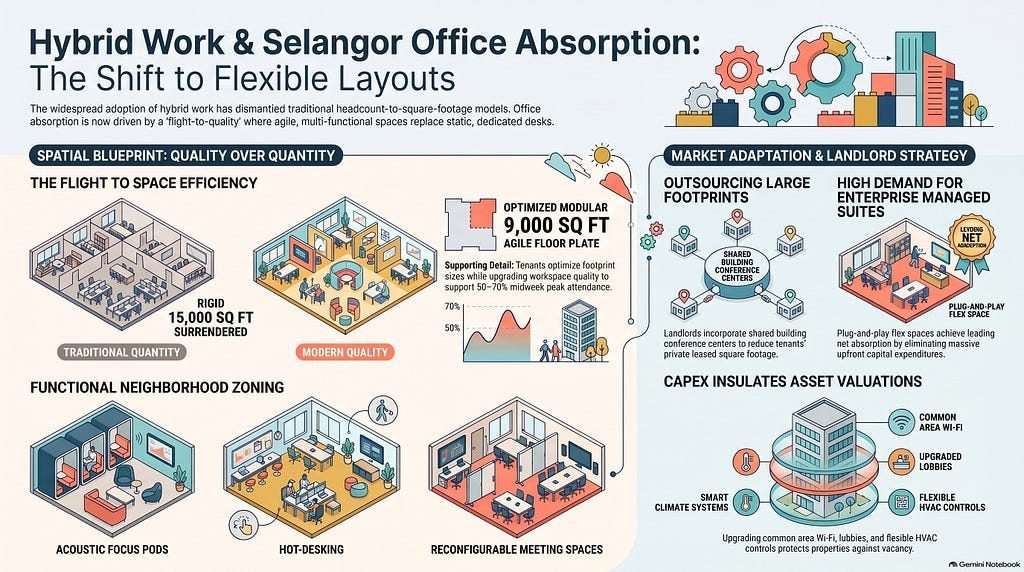
The post-pandemic normalization of hybrid work — where employees split their working hours between home and the corporate office — has fundamentally redefined the purpose of physical office space. Historically, corporate tenants leased large, fixed-desk floor plates designed to accommodate one hundred percent of their workforce simultaneously five days a week. In a modern hybrid environment, peak office attendance typically hovers between fifty and seventy percent on any given midweek day, leaving traditional, static floor plans underutilized and financially burdensome.
This behavioral transformation has triggered a profound shift in how enterprises approach leasing transactions in Selangor. Rather than expanding their total square footage to match headcount growth, growing firms are choosing to downsize their physical footprints while simultaneously upgrading the quality of their workspaces. This phenomenon, often referred to as the flight-to-quality, means that net absorption is no longer driven by raw space expansion, but by strategic relocations into buildings capable of supporting agile, multi-functional interior layouts.
Redefining Absorption: Quality Over Quantity in Selangor
Absorption metrics published by the National Property Information Centre and commercial property advisory firms indicate that office demand across Selangor is stabilizing, though with distinct qualitative nuances. While secondary, older office buildings with rigid layouts continue to struggle with sluggish absorption and rising vacancy rates, modern corporate towers featuring adaptable floor plates are experiencing steady tenant demand.
Flexible layouts change the math of office absorption because a smaller footprint, when engineered for multi-purpose use, can house the same or greater operational capacity as an outdated, oversized office. For instance, a technology firm scaling its team across Selangor might surrender a rigid, partitioned 15,000-square-foot office in favor of a modern 9,000-square-foot floor plate designed with modular workstations, hot-desking zones, acoustic focus pods, and reconfigurable collaboration areas. Consequently, gross absorption figures may appear modest, yet the qualitative efficiency of space utilization reaches record highs. Landlords who can offer warm-shell or fitted units adaptable to these agile layouts capture tenant absorption far quicker than those offering static, conventional spaces.
Spatial Anatomy of Flexible Office Layouts
To attract modern corporate tenants transitioning into hybrid structures, commercial architects and interior designers are transforming Selangor office towers through specific spatial innovations that directly impact absorption velocities.
The elimination of assigned, fixed desks for every employee is the most prominent structural change. Modern floor plates are zoned into distinct functional neighborhoods, balancing collaborative hubs with quiet focus areas. Open-plan bullpens are integrated with modular acoustic dividers, allowing teams to scale project war rooms up or down dynamically. Furthermore, boardrooms and conference facilities are increasingly equipped with movable acoustic operable walls, enabling a large training seminar room to transform instantly into three private meeting suites.
In parallel, building landlords are incorporating shared amenity spaces — such as multi-tenant conference centers, rooftop networking lounges, and executive cafeterias — directly into the building’s common areas. By outsourcing these large-footprint requirements to shared building amenities, corporate tenants can reduce their private leased square footage, lowering their monthly rental liabilities while still providing their workforce with an expansive, inspiring environment.
The Rise of Enterprise Managed Suites and Flex-Space Integration
The hybrid work era has also blurred the lines between traditional commercial leases and flexible workspace operations. Across Selangor commercial nodes like Petaling Jaya and Cyberjaya, corporate tenants increasingly demand lease flexibility that mirrors the agility of their business operations. Long-term, rigid tenancies spanning five to ten years without break options are encountering fierce resistance from corporate finance committees.
In response, progressive landlords are partnering with flexible workspace operators or dedicating portions of their institutional towers to enterprise managed suites. These plug-and-play spaces feature fully flexible layouts, short-term lease covenants, and modular partitioning that can expand or contract as tenant headcount fluctuates. This flexibility removes the massive upfront capital expenditure barriers associated with traditional fit-outs, encouraging regional enterprises and multinational branch offices to commit to Selangor addresses with confidence. As a result, flexible and managed office spaces consistently register some of the highest net absorption rates across the suburban Klang Valley.
Landlord Adaptation and Asset Valuation Resilience
For commercial property owners and real estate investment trusts in Selangor, adapting to the demands of hybrid work and flexible layouts is no longer optional; it is an existential requirement for asset survival. Buildings characterized by deep core floor plates, inflexible mechanical ducting, and archaic partitioning structures face prolonged vacancy cycles and declining asset valuations.
Conversely, asset managers who proactively invest in capital expenditure upgrades — redesigning central lobbies, upgrading Wi-Fi infrastructure throughout common areas, installing versatile HVAC zoning controls, and offering customizable fit-out packages — are successfully driving positive absorption. When landlords position their properties as agile ecosystems capable of supporting evolving hybrid workflows, they insulate their portfolios against market volatility and secure high-credit corporate tenants on stable lease terms.
Strategic Verdict for the Selangor Office Market
The impact of hybrid work on Selangor office absorption is a testament to the resilience and adaptability of the region’s commercial real estate sector. While the era of indiscriminate, volume-driven space expansion has passed, a new era defined by spatial efficiency, technological integration, and architectural agility has taken its place. For corporate real estate leaders, embracing flexible layouts optimizes occupancy costs and empowers workforce productivity. For property developers and landlords, designing buildings that anticipate shifting hybrid demands ensures robust absorption, sustained rental yields, and enduring market leadership across Selangor’s premier business corridors.
Sources & Statutory Authorities
- National Property Information Centre (NAPIC), Valuation and Property Services Department (JPPH) Malaysia: Klang Valley Commercial Property Market and Purpose-Built Office Reports.
- Knight Frank Malaysia: Klang Valley Office Monitor and Market Real Estate Research.
- Laws of Malaysia, Town and Country Planning Act 1976 (Act 172) and Street, Drainage and Building Act 1974 (Act 133).
- Independent Klang Valley Commercial Real Estate Market Research: Hybrid Work Adoption and Space Utilization Trends in Selangor.