Malaysia's 8% Stamp Duty for Foreign Home Buyers: What It Costs in KL and Selangor in 2026
Since 1 January 2026, foreigners pay a flat 8% on the transfer of a home, double the 2024 rate. Here is who it applies to, how it sits with state price floors, and what it means at RM1mil, RM1.5mil and RM3mil.
Originally published on Medium: read it on Medium

If you are not a Malaysian citizen and you are buying a home in Kuala Lumpur or Selangor, stamp duty is now one of the biggest numbers on your purchase budget. Since 1 January 2026, the duty on the transfer of a residential property to a foreign buyer is a flat 8% of the price or market value. On a RM1.5 million condo, that is RM120,000, compared with RM44,000 for a Malaysian buyer.
This article explains what changed, who counts as a foreign buyer, how the rule fits with the state consent rules and minimum prices in KL and Selangor, and what it costs in ringgit. It ends with a practical checklist.
Not legal or tax advice: this is general information from public sources as at October 2026. It is not legal, tax or financial advice. Rules and state policies change, and your lawyer should confirm how they apply to your purchase before you sign.
The rule in one paragraph
The Finance Act 2025 added a new item 32(ab) to the First Schedule of the Stamp Act 1949. It charges RM8 for every RM100 (8%) on the sale of any residential property from 1 January 2026 to a foreign company, or to a person who is not a citizen and not a permanent resident of Malaysia. The duty is calculated on the purchase price or the market value of the property, whichever is higher.
The Act also added a definition. "Residential property" means a house, condominium, apartment, flat, service apartment or small office home office (SOHO) solely to be used as a dwelling house.
The buyer pays. Under the Third Schedule of the Stamp Act, duty on a transfer is payable by the purchaser or transferee, as LHDN's stamp duty guideline confirms.
What it replaced: from the scale, to 4%, to 8%
The foreign-buyer rate has changed twice in three years.
Before 1 January 2024: the same scale as Malaysians. Foreign buyers paid duty on the standard scale in item 32(a), which every buyer still uses today unless a special rate applies:
- 1% on the first RM100,000
- 2% on the next RM400,000 (RM100,001 to RM500,000)
- 3% on the next RM500,000 (RM500,001 to RM1 million)
- 4% on anything above RM1 million
From 1 January 2024: a flat 4%. Budget 2024 introduced item 32(aa) through the Finance (No. 2) Act 2023. It set a flat 4% on the sale of any property to a foreign company or a non-citizen who is not a permanent resident. At that time, the 4% covered homes as well as shops, offices and factories (shares and certain receivables were excluded).
From 1 January 2026: 8% for homes. In Budget 2026, tabled on 10 October 2025, the Prime Minister said the government would raise the flat rate "from four to eight percent" on the transfer of residential properties bought by non-citizens and foreign companies, except permanent residents. The Budget's tax appendix described it as a measure "to further strengthen the stamp duty structure and as a real property price control mechanism". The Finance Act 2025 then:
- carved residential property out of item 32(aa), so the 4% now applies only to non-residential property, and
- created item 32(ab) at 8% for residential property.
So for a foreign buyer today:
- Residential property: flat 8%
- Commercial, industrial and other non-residential property: flat 4%
- Malaysian citizens and permanent residents: the 1% to 4% scale, for any property
Budget 2027, tabled on 9 October 2026, did not propose any change to these rates in its tax measures.
When the 8% applies: the SPA date
The law says "from 1 January 2026", which raised an obvious question. What if the sale and purchase agreement (SPA) was signed in 2025 and the memorandum of transfer (MOT) in 2026?
Malaysia's tax professional bodies put exactly that example to LHDN in their joint memorandum on Budget 2026: an SPA signed on 20 December 2025 and an MOT signed on 5 January 2026. LHDN's written reply was that item 32(ab) applies to sale and purchase agreements signed from 1 January 2026. In other words, it is the SPA date that counts, not the date the MOT is signed or stamped.
If you signed your SPA before 2026, the earlier 4% rate should apply. Keep your stamped SPA safe and make sure your lawyer reflects the correct date when the transfer is submitted for stamping.
Who counts as a foreign buyer?
Individuals
The 8% applies to a person who is not a citizen and not a permanent resident. Two points follow from the wording:
- Permanent residents (PRs) are excluded. A PR pays the same 1% to 4% scale as a citizen. This is written into the item itself and was repeated in the Budget speech.
- Other immigration status does not help. The law has no carve-out for long-term visas, work passes or Malaysia My Second Home (MM2H) participants. An MM2H pass is not permanent residence, so the statutory wording points to 8%.
Joint buyers
Many couples buy together where one spouse is Malaysian and the other is not. LHDN has said that for jointly owned residential property, the duty is charged separately on each owner's share. The citizen's or PR's share is charged on the 1% to 4% scale, and the foreign owner's share at 8%.
Companies
For stamp duty, LHDN has confirmed that "foreign company" has the same meaning as in the Companies Act 2016: a company, corporation, society, association or other body incorporated outside Malaysia.
This is narrower than the definition used for land ownership. Under section 433A of the National Land Code (NLC), a "foreign company" also includes a Malaysian-incorporated company in which non-citizens or foreign companies hold 50% or more of the voting shares, and certain companies controlled by such companies. Those companies still need state consent to buy land.
So a Malaysian-incorporated company with foreign shareholders may be treated differently for stamp duty and for state consent. Some law firms, such as CK Lim & Partners, caution buyers not to assume that buying through a local company avoids the higher rate. Get your lawyer's written view on your actual structure before you rely on it.
What counts as "residential", and what is excluded
Serviced apartments and SOHOs
Service apartments and SOHOs are named in the new definition, but only where they are "solely to be used as a dwelling house". When the tax bodies asked how mixed-use property would be treated, LHDN replied that duty depends on the section 2 definition, and that a property not used solely as a dwelling does not meet it.
In practice, your lawyer will need to establish how the unit is to be used, and LHDN can assess the duty. Do not assume a rate based on what the brochure calls the unit.
Non-residential property
Shops, offices, factories and other non-residential property bought by a foreign buyer stay at the flat 4% under item 32(aa).
Transfers that are not a sale
Item 32(ab) applies "on sale". Gifts, inheritances and other transfers that are not sales fall under different items and exemption orders, each with its own conditions. If you are receiving property this way, get specific advice.
No first-home exemption
The stamp duty exemption for a first home (full exemption on the transfer and loan agreement for homes up to RM500,000, for SPAs signed from 1 January 2021 to 31 December 2027) is for Malaysian citizens only. Foreign buyers and PRs cannot use it.
The loan agreement
If you finance the purchase, the loan or financing agreement is stamped separately. The rate for a ringgit home loan is RM5 for every RM1,000 of the loan, which is 0.5%. There is no foreign-buyer surcharge on the loan agreement.
For example:
- RM500,000 loan: RM2,500
- RM1 million loan: RM5,000
Two points for foreign buyers:
- Loans in foreign currency are also charged at 0.5%. Budget 2027 proposes a cap on the duty for foreign currency loan or financing agreements from banks in Malaysia: RM2,000 for financing up to RM100 million, and RM5,000 above that, for agreements executed from 1 January 2027.
- How much you can borrow is set by each bank's own policy for non-resident or foreign borrowers. Get a written offer before you sign the SPA, because the stamp duty and the balance of the price must still be paid in cash.
Worked examples in ringgit
The figures below show the duty on the instrument of transfer for a residential property, assuming the price is also the market value.
RM1.0 million
- Citizen or PR (1%–4% scale): RM24,000
- Foreign buyer, 2024–2025 (4%): RM40,000
- Foreign buyer, SPA from 2026 (8%): RM80,000, which is RM56,000 more than a citizen
RM1.5 million
- Citizen or PR: RM44,000
- Foreign buyer, 2024–2025: RM60,000
- Foreign buyer, SPA from 2026: RM120,000, which is RM76,000 more
RM2.0 million
- Citizen or PR: RM64,000
- Foreign buyer, 2024–2025: RM80,000
- Foreign buyer, SPA from 2026: RM160,000, which is RM96,000 more
RM3.0 million
- Citizen or PR: RM104,000
- Foreign buyer, 2024–2025: RM120,000
- Foreign buyer, SPA from 2026: RM240,000, which is RM136,000 more
How the citizen figure works at RM1.5 million:
- First RM100,000 at 1%: RM1,000
- Next RM400,000 at 2%: RM8,000
- Next RM500,000 at 3%: RM15,000
- Remaining RM500,000 at 4%: RM20,000
- Total: RM44,000 (about 2.9% of the price)
The foreign buyer at 8%: RM1,500,000 × 8% = RM120,000.
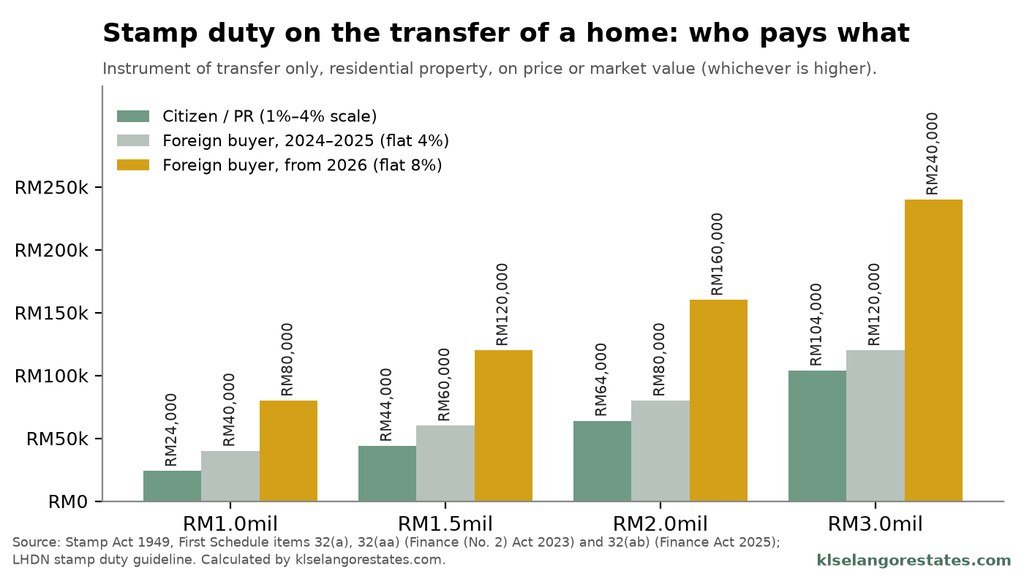
Because the citizen scale is tiered, a Malaysian buyer's effective rate creeps up towards 4% but never reaches it. At RM1 million it is 2.4%, at RM3 million about 3.5% and at RM5 million about 3.7%. A foreign buyer of a home pays 8% from the first ringgit. The gap in ringgit therefore widens as the price rises.

For the same RM1.5 million condo, a foreign buyer's transfer duty has gone from RM44,000 before 2024, to RM60,000 in 2024 and 2025, to RM120,000 for SPAs signed from 2026.

A total-cost example
Take a foreign individual buying a RM1.5 million condo in KL with a RM750,000 ringgit loan:
- Transfer duty at 8%: RM120,000
- Loan agreement duty at 0.5%: RM3,750
- Stamp duty total: RM123,750
A Malaysian buyer with the same price and loan would pay RM44,000 plus RM3,750, or RM47,750. On top of stamp duty, every buyer pays legal fees and disbursements, and a foreign buyer also pays the state consent fee and any state levy. Ask your lawyer for a written breakdown.
Stamp duty is only half the story: state consent and price floors
Stamp duty is federal. Whether a foreigner can buy a particular property, and at what minimum price, is decided by each state under Part 33A of the National Land Code.
Section 433B of the NLC says a non-citizen or foreign company can acquire land, or have a dealing such as a transfer registered in its favour, only after obtaining the prior approval of the State Authority. A dealing that breaches this rule is void under section 433C. Under section 433A, "non-citizen" simply means a person who is not a Malaysian citizen, so for land consent purposes PRs are non-citizens too. Selangor's Land and Mines Office lists permanent residents among the applicants who must apply for consent. In other words, a PR may pay the citizen stamp duty scale but still needs state consent.
There is also a federal guideline. The Malaysian Bar's Conveyancing Practice Committee summarises the Ministry of Economy (formerly EPU) guideline as saying foreign interests are not allowed to acquire:
- real estate valued at less than RM1,000,000 per unit,
- residential units in the low-cost and medium-low-cost categories,
- properties on Malay Reserve Land, and
- units allocated to Bumiputera interests in a development.
The Bar's table of state thresholds (Circular No 444/2024, information as at October 2024) shows:
Kuala Lumpur, Putrajaya and Labuan
- Residential: RM1,000,000 minimum
- Commercial and industrial: RM1,000,000, restricted to foreign companies incorporated in Malaysia
Selangor (residential: strata and landed strata titles only; landed individual titles are not permitted)
- Zone 1 (Petaling, Gombak, Hulu Langat, Sepang and Klang): RM2,000,000
- Zone 2 (Kuala Selangor and Kuala Langat): RM2,000,000
- Zone 3 (Hulu Selangor and Sabak Bernam): RM1,000,000
- Commercial and industrial: RM3,000,000 (industrial requires a MITI manufacturing licence)
- Agricultural land and properties sold by auction: not permitted
The Bar states that the table is for information only and that buyers should check with the state authority, because thresholds and conditions change. Selangor's Land and Mines Office currently lists a consent application fee of RM200 per title for a first application and RM1,000 per title for an appeal.
What the two rules mean together
Put the price floors and the 8% rate side by side and you get a minimum transfer duty for a foreign home buyer:
- KL residential at the RM1 million floor: at least RM80,000
- Selangor Zone 1 or 2 residential at the RM2 million floor: at least RM160,000
One more point: duty is charged on the price or market value, whichever is higher. If a unit is priced above its market value to meet a state floor, duty is still charged on the full price. A bank, however, will lend based on its own valuation, so the difference has to be paid in cash as well.
On exit: RPGT
When you sell, the Real Property Gains Tax rates for non-citizens are higher than for citizens. The Bar's circular lists 30% on gains for disposals in the first five years and 10% from the sixth year onwards. Factor this into your holding period before you buy.
What it means for the market
The government's stated aim is to keep the market competitive and help control rising house prices for Malaysians. A few practical effects follow:
- Higher entry cost for foreign buyers. At 8%, the stamp duty alone is a meaningful slice of the deposit. On a RM2 million Selangor condo it is RM160,000 before legal fees.
- A wider gap with local buyers. At RM1.5 million, a foreign buyer now pays almost three times a Malaysian buyer's transfer duty (RM120,000 against RM44,000).
- Concern from developers. When the measure was announced, the Real Estate and Housing Developers' Association (Rehda) warned that it "could deter foreign investors and contradict the government's aspirations to attract more international investments", as reported by The Edge.
- Most exposure at the top end. The thresholds already restrict foreign buyers to the upper end of the market: RM1 million and above in KL, and RM2 million and above in most of the Klang Valley parts of Selangor. The new rate mainly affects that segment, not the mass market most Malaysians buy in.
- Non-residential is relatively cheaper for foreigners. With homes at 8% and commercial property at 4%, foreign investors comparing the two will see a bigger tax difference than before. Commercial property comes with its own state thresholds, rules and risks.
For Malaysian buyers, the change has little direct effect. Your rate is still the 1% to 4% scale, and the first-home exemption remains for eligible citizens.
Practical checklist for foreign buyers
- Confirm your status. Are you a citizen, a PR or neither? If you are buying through a company, where is it incorporated and who holds the voting shares?
- Check the SPA date. For residential property, the 8% applies to SPAs signed from 1 January 2026.
- Confirm the property type and its intended use with your lawyer: residential (8%) or non-residential (4%).
- Check the state rules first. Confirm the current minimum price, the property types you may buy, and any levy with the state land office, before you pay anything substantial.
- Make the SPA conditional on obtaining state consent, and ask your lawyer how long consent usually takes.
- Budget for duty on the higher of price and market value. Do not assume the price is the figure that will be stamped.
- Get a written financing offer from the bank before you sign, and plan for the cash gap between the loan and the price plus costs.
- Ask for a written cost breakdown: transfer duty, loan agreement duty, legal fees, consent fee, any state levy and disbursements.
- Joint purchase with a Malaysian spouse? Agree the ownership shares in writing; each share is charged at its own rate.
- Plan your exit. Note the RPGT rates for non-citizens and your expected holding period.
Sources
- Finance Act 2025 (Act 874), Chapter IV, amendments to the Stamp Act 1949 (s 25 to s 30): https://lawplayer.com/my/act/act-874/section/chapter-4
- Finance Act 2025, section 29 (official text from Laws of Malaysia Online): https://mylaw.my/legislation/akta-kewangan-2025/section-29
- Finance (No. 2) Act 2023, section 68 (new item 32(aa), 4% from 1 January 2024): https://mylaw.my/legislation/akta-kewangan-no-2-2023/section-68
- Ministry of Finance, Budget 2026 Speech (10 October 2025), paragraph 218: https://belanjawan.mof.gov.my/pdf/belanjawan2026/ucapan/bs26.pdf
- Ministry of Finance, Budget 2026 Tax Measures, Appendix 14 (Review of stamp duty on property ownership by non-citizens) and Appendix 15: https://belanjawan.mof.gov.my/pdf/belanjawan2026/ucapan/tax-measures.pdf
- Ministry of Finance, Budget 2027 Tax Measures, Appendix 19 (stamp duty on foreign currency loans): https://belanjawan.mof.gov.my/pdf/belanjawan2027/ucapan/tax-measures.pdf
- LHDN, Garis Panduan Pengenaan Duti Setem bagi Surat Cara yang Tertakluk kepada Jadual Pertama Akta Setem 1949 (items 32(a), 32(aa), 32(ab)): https://www.hasil.gov.my/wp-content/uploads/garis-panduan-pengenaan-duti-setem-jadual-pertama-as-1949.pdf
- LHDN responses to the CTIM, MIA, MICPA and MAICSA Joint Memorandum on Issues Arising from the 2026 Budget Speech and Tax Bills 2025 (item 2.7): https://www.hasil.gov.my/wp-content/uploads/maklum-balas-joint-memorandum-on-issues-arising-from-the-budget-2026-and-tax-bills-2025.pdf
- Malaysian Bar, Circular No 444/2024, "Restrictions in Respect of Non-Citizens and Foreign Companies pursuant to Part 33A of the National Land Code" (23 December 2024): https://www.malaysianbar.org.my/cms/upload_files/document/Circular%20No%20444-2024.pdf
- Pejabat Tanah dan Galian Selangor, Garis Panduan Perolehan Hartanah oleh Kepentingan Asing (Seksyen 433B KTN): https://ptg.selangor.gov.my/index.php/pages/view/268
- CK Lim & Partners, "Foreigner Stamp Duty Malaysia 2026": https://www.cklimpartners.com/foreigner-stamp-duty-malaysia/
- Skrine, "Proposed Amendments to the Stamp Act" (November 2025): http://www.skrine.com/insights/alerts/november-2025/proposed-amendments-to-the-stamp-act
- PwC Malaysia, Malaysian Tax Booklet 2026/2027, Stamp duty: https://www.pwc.com/my/en/publications/mtb/stamp-duty.html
- The Star, "Budget 2026: Stamp duty exemption extended for first-time homebuyers" (10 October 2025): https://www.thestar.com.my/business/business-news/2025/10/10/budget-2026-stamp-duty-exemption-extended-for-first-time-homebuyers
- The Edge Malaysia, "Budget 2026: Property players react to latest policy measures" (10 October 2025): https://theedgemalaysia.com/node/773627
About the author
Jessica Leong is a Registered Estate Agent (E3208) with PropNex Realty Sdn Bhd (E (1) 1800/1), KLCC branch. She covers new launch condos in Kuala Lumpur and Petaling Jaya, industrial property in Selangor, bank auction (lelong) properties, and PJ/Selangor offices, shophouses and en-bloc deals.
PropNex Realty Sdn Bhd, A-G-03, Marc Residence, No. 3, Jalan Pinang, 50400 Kuala Lumpur
Office: 03-2161 8608 · Call/WhatsApp: 010-464 6088
Website: klselangorestates.com
This article is general information based on public sources as at 23 October 2026. It is not legal, tax or financial advice. Rates and state rules may change, and LHDN may assess duty differently on the facts of your purchase. Please consult your own lawyer, banker and tax adviser before buying.