Stamp Duty Self-Assessment From 1 January 2027: What Changes When You Buy, Sell or Rent Property in KL and Selangor
From 2027, most property purchases move to LHDN's self-assessment system. You declare and pay the duty on MyTax, and any mistake is yours. Here is what is covered, the deadlines, the penalties, and the arithmetic.
Originally published on Medium: read it on Medium

For decades, stamping a property transfer in Malaysia worked the same way. Your lawyer submitted the documents, LHDN worked out the duty and sent a notice, and you paid it.
From 1 January 2027, that changes for most home purchases. Under LHDN's Stamp Duty Self-Assessment System (Sistem Taksir Sendiri Duti Setem, or STSDS), the transfer of a property bought through a sale and purchase agreement (SPA) or at a public auction will be self-assessed. The duty payer, or the lawyer acting for them, works out the duty, declares it on MyTax and pays. LHDN can check it later, and if the figure is wrong, the shortfall and penalty fall on the duty payer.
Tenancy agreements and loan agreements have already worked this way since 1 January 2026. This article explains what changes in 2027, who is responsible, the deadlines and penalties, and how it fits with the Budget 2027 first-home exemption and the 8% rate for foreign buyers. I have worked through the arithmetic using the published rates in the Stamp Act 1949.
Not advice. This is general information from official sources as at 24 October 2026. Your lawyer will usually handle the stamping, but you remain the person liable for the duty. Please check your own case with your lawyer.
What STSDS is, in one paragraph
You (or your appointed agent, usually your lawyer) log in to MyTax, upload the document, fill in the stamp duty return (Borang Nyata Duti Setem, or BNDS), work out the duty, and pay. The moment the return is submitted, it is deemed to be an assessment by the Collector of Stamp Duties. There is no longer a wait for LHDN to issue a notice. LHDN's STSDS page lists seven steps, and the last is easy to overlook: keep the stamped document and all related records for seven years from the date the duty was paid.
The old STAMPS portal closed on 31 December 2025. Since 1 January 2026, every stamping application, self-assessed or not, has had to be filed electronically through e-Duti Setem on MyTax. Everyone involved needs a Tax Identification Number (TIN). If you don't have one, you can register through e-Daftar on MyTax.
The three phases, and where property documents fall
LHDN is bringing STSDS in by type of document:

- Phase 1, from 1 January 2026: tenancy and lease agreements, security documents (which include loan and facility agreements), and general stamping. LHDN's guideline lists a house SPA as an example of general stamping.
- Phase 2, from 1 January 2027: transfer of real property not involving a JPPH valuation. At a November 2025 seminar organised by the Bar Council, LHDN explained that this means a purchase made through an SPA or at a public auction.
- Phase 3, from 1 January 2028: everything else. Until then, LHDN's guideline says Phase 2 and Phase 3 documents stay on formal assessment, where LHDN assesses and issues a notice.
Put simply, for a typical purchase in KL or Selangor:
| Document | Who is liable for the duty (Stamp Act, Third Schedule) | How it is stamped |
|---|---|---|
| SPA | Fixed RM10 duty (Item 4) | Self-assessed since 1 Jan 2026 (general stamping) |
| Loan or facility agreement | The borrower (chargor or obligor) | Self-assessed since 1 Jan 2026 |
| Transfer (MOT), bought by SPA or at auction | The buyer (transferee) | Self-assessed from 1 Jan 2027 |
| Transfer that needs a JPPH valuation | The transferee | Formal assessment until Phase 3 (1 Jan 2028) |
| Tenancy agreement | The tenant (lessee) | Self-assessed since 1 Jan 2026 |
| Any document claiming an exemption or remission | As above | Formal assessment, even if it falls in a self-assessed category |
The last row matters for first-time buyers, and I come back to it below.
The rates you will be applying
Self-assessment does not change how much duty is due. It changes who calculates it. These are the rates in the First Schedule of the Stamp Act 1949:
Transfer (MOT), Item 32(a). Duty is charged on the price or the market value of the property, whichever is higher:
| Portion of the value | Rate |
|---|---|
| First RM100,000 | 1% |
| RM100,001 to RM500,000 | 2% |
| RM500,001 to RM1,000,000 | 3% |
| Above RM1,000,000 | 4% |
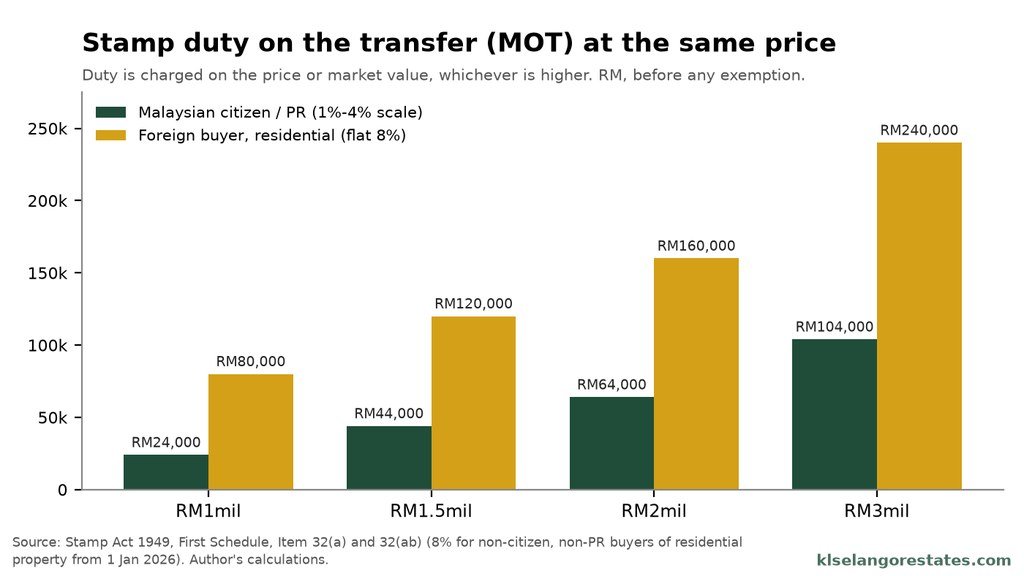
Foreign buyers, Item 32(ab). From 1 January 2026, residential property sold to a foreign company or to someone who is neither a citizen nor a permanent resident is charged a flat 8% on the price or market value, whichever is higher.
Loan agreement, Item 27. For an ordinary ringgit home loan, the rate is RM5 for every RM1,000, which is 0.5% of the loan.
Tenancy agreement, Item 49(a), as amended by the Finance Act 2024. For every RM250 of a year's rent, or part of RM250, the duty is:
| Lease term | Duty per RM250 |
|---|---|
| Up to 1 year | RM1 |
| Over 1 year, up to 3 years | RM3 |
| Over 3 years, up to 5 years | RM5 |
| Over 5 years | RM7 |
Every document pays at least RM10 (section 36CB).
Worked examples
Example 1: a RM600,000 resale condo in PJ, bought by a Malaysian with a 90% loan (not a first home)
Transfer: 1% × RM100,000 = RM1,000, plus 2% × RM400,000 = RM8,000, plus 3% × RM100,000 = RM3,000. Total: RM12,000.
Loan agreement: RM540,000 × 0.5% = RM2,700.
SPA: fixed duty of RM10 under Item 4 (agreements not otherwise charged).
If the transfer falls under STSDS in 2027, the buyer's side self-assesses the RM12,000 on MyTax. The return must be filed within 30 days of signing (section 47), and the duty paid within 30 days of filing (section 36(2)). The payment deadline appears on the acknowledgement slip.
Example 2: the cost of paying late
On the same RM12,000 transfer, the late-stamping penalty under section 47A is:
- within three months of the deadline: RM50 or 10% of the unpaid duty, whichever is higher, which here is RM1,200;
- after that: RM100 or 20%, which here is RM2,400.
Example 3: the cost of getting the rate wrong
A foreign buyer purchases a RM1.5 million condo in KL. The correct rate is 8%, so the duty is RM120,000. Suppose the return is filed at 4% instead, which is the separate foreign rate for non-residential property under Item 32(aa). That gives RM60,000.
- Shortfall: RM60,000, which LHDN can collect through an additional assessment (section 36CA).
- Penalty for an incorrect return, if LHDN does not prosecute: up to the amount undercharged, so up to another RM60,000 (section 72D(2)). The Collector may reduce or remit it.
- A late-stamping penalty may also apply to the unpaid portion.
Under self-assessment, a mistake like this does not go away when the return is accepted. LHDN has five years after the duty was paid, or would have been paid, to raise an additional assessment. Where there is fraud, wilful default or negligence, there is no time limit.
Example 4: a two-year tenancy at RM3,000 a month
A year's rent is RM36,000. That is 144 units of RM250. 144 × RM3 = RM432. The tenant is the liable party under the Third Schedule, and this has been self-assessed since 1 January 2026.
Deadlines and penalties at a glance
| What | Rule | Section |
|---|---|---|
| File the return (BNDS) on MyTax | Within 30 days of signing (or of first receipt in Malaysia, if signed overseas) | s47 |
| Pay self-assessed duty | Within 30 days of filing (the deemed assessment date) | s36(2) |
| Pay a formal assessment (e.g. an exemption claim) | Within 14 days of the notice | s40 |
| Late stamping | RM50 or 10%, whichever is higher, within 3 months; RM100 or 20% after that | s47A |
| Not filing a return | If prosecuted, a fine of up to RM10,000. If not, a penalty of RM200 to RM2,000 | s72C |
| Incorrect return | If prosecuted, a fine of RM1,000 to RM10,000 plus a special penalty equal to the shortfall. If not, a penalty equal to the shortfall | s72D |
| Additional assessment | Within 5 years; no limit for fraud, wilful default or negligence | s36CA |
| Keep records | 7 years from payment | s35B |
| Object to an assessment | Within 30 days | s38A |
| Appeal to the High Court | Within 21 days, after paying the duty | s39 |
About the 2026 "grace period". The Ministry of Finance agreed not to impose the incorrect-return penalty under section 72D(2) on returns filed from 1 January to 31 December 2026. LHDN's guideline is explicit that this remission covers only Phase 1 documents: tenancies and leases, security documents and general stamping. It does not cover property transfers or applications claiming an exemption. Even in 2026, any duty underpaid and any late-stamping penalty still have to be paid. I could not find any announcement of a similar concession for property transfers in 2027, including in the Budget 2027 tax measures, as at 24 October 2026. Plan on the full penalty regime applying from day one.
Audits: what LHDN can check
LHDN describes stamp duty audits as a core part of its compliance work. Anyone who pays duty, or acts as an agent for someone who does, can be selected at any time. Being selected does not mean you have done anything wrong. There are two kinds of review:
- a general review at an LHDN office, of the documents uploaded with the application; and
- a comprehensive review at your premises, an LHDN office or another agreed place, covering all the signed documents in your keeping.
For individual buyers and landlords, the practical point is simple: keep a complete copy of everything for seven years. That means the SPA, the transfer, the loan agreement, the tenancy agreement, the e-stamp certificates and the payment receipts. Your lawyer will hold the file, but it is your liability.
How this fits with the first-home exemption
Budget 2027, tabled on 9 October 2026, proposes a revised exemption for Malaysian citizens buying their first home, on loan agreements and transfers under SPAs signed from 1 January 2027 to 31 December 2030:
- home priced up to RM500,000: 100% exemption;
- home priced up to RM750,000: 100% exemption on the first RM500,000 and 50% on the balance.
The current exemption (100% up to RM500,000) covers SPAs signed up to 31 December 2027. I compared signing in late 2026 with signing in 2027 in my Budget 2027 first-home article.
Here is the STSDS point. LHDN's operational guideline and its December 2025 media release both say that documents claiming an exemption or remission are assessed formally, even if they fall in a self-assessed category. At the Bar Council seminar, LHDN also said it will not apply an exemption automatically: the duty payer has to claim it. So a first-time buyer's transfer will not simply be self-assessed at RM0. The exemption has to be claimed, LHDN assesses it, and any balance is due within 14 days of the notice.
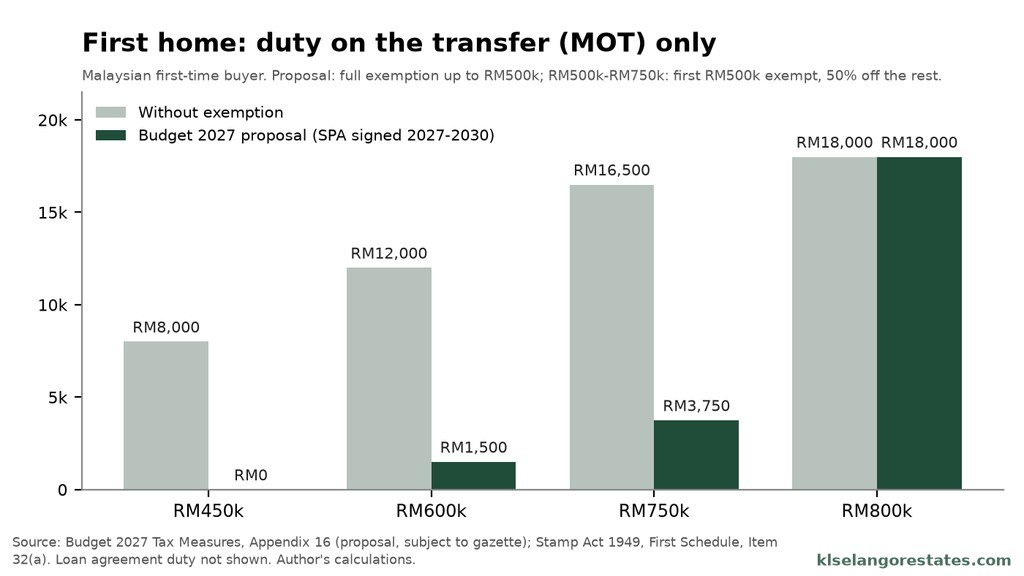
At RM750,000, the transfer duty would fall from RM16,500 to RM3,750: duty on the first RM500,000 (RM9,000) is exempt, and half of the remaining RM7,500 is payable. At RM800,000, as the proposal is worded, there is no relief at all. The Budget 2027 measures remain proposals until the exemption order is gazetted.
How this fits with the 8% foreign buyer rate
STSDS does not change the 8% rate. It changes who applies it. On a self-assessed transfer, the return itself has to identify the buyer correctly as a foreign buyer of residential property. As Example 3 shows, a wrong category is expensive. Foreign buyers also face state minimum price rules and state consent, which I covered in my article on the 8% stamp duty for foreign buyers.
What to do: a short checklist
Buyers
- Get a TIN for every buyer named on the documents, if you don't have one, through e-Daftar on MyTax.
- Ask your lawyer to show you the calculation before the return is filed: the value used, the rate band, and whether you are a citizen, PR or foreign buyer.
- Remember the value test. Duty is on the price or the market value, whichever is higher. If you are buying below market value, for example from a relative, discuss it with your lawyer first.
- If you are claiming the first-home exemption, expect formal assessment and a 14-day payment window after the notice. Check that the SPA date falls inside the period that applies to you.
- Auction buyers: a public auction purchase is in Phase 2, so the transfer is self-assessed from 2027. My bank lelong guide covers the rest of the process.
- Keep copies of every stamped document, certificate and receipt for seven years.
Sellers
- The transfer duty is the buyer's liability under the Third Schedule. You still need a TIN, because every party to the document must have one.
- Your Real Property Gains Tax (RPGT) filings are a separate process on MyTax.
Landlords and tenants
- Tenancy agreements have been self-assessed since 1 January 2026, using the Finance Act 2024 rates above, and the 2026 penalty concession ends on 31 December 2026.
- If you renew in 2027, recalculate the duty on the new rent and term.
Investors
- If you buy several units, each transfer and loan agreement is a separate return, with its own deadlines.
- Mistakes can be corrected through an application to amend the information. Under the five-year additional assessment window, it is better to fix them early.
What is still not confirmed
- The exact trigger date. LHDN gives 1 January 2027 as the Phase 2 start date. I have not found an official statement on whether that turns on the date the transfer is signed or the date the return is filed. Ask your lawyer if your transfer is signed in late December 2026.
- Any 2027 penalty concession for transfers. None had been announced as at 24 October 2026.
- The Budget 2027 exemption details, including how the partial exemption is calculated on the loan agreement, until the exemption order is gazetted.
- The full list of transfers that "involve a JPPH valuation." LHDN has explained what is in Phase 2 (SPA and auction purchases), but I have not found an exhaustive official list of what is outside it.
Sources
- LHDN, Garis Panduan Operasi: Permohonan Penyeteman Melalui Sistem Taksir Sendiri Duti Setem (STSDS), dated 26 December 2025: https://www.hasil.gov.my/wp-content/uploads/20251226-garis-panduan-operasi-permohonan-penyeteman-melalui-sistem-taksir-sendiri-duti-setem.pdf
- LHDN, Stamp Duty Self-Assessment System (STSDS) page (last updated 28 August 2026): https://www.hasil.gov.my/en/duti-setem/sistem-taksir-sendiri-duti-setem-stsds/
- LHDN, Pengenalan Duti Setem di Bawah Akta Setem 1949 (29 December 2025): https://www.hasil.gov.my/wp-content/uploads/20251229-pengenalan-duti-setem-di-bawah-akta-setem-1949.pdf
- LHDN, media release "Sistem e-Duti Setem kini boleh diakses lebih awal melalui portal MyTax mulai 17 Disember 2025" (17 December 2025)
- Stamp Act 1949 (Act 378), updated text as at 1 January 2026, sections 35A, 35B, 36, 36CA, 36CB, 38A, 39, 40, 47, 47A, 72C and 72D, First Schedule (Items 4, 27, 32, 49) and Third Schedule: https://mylaw.my/legislation/stamp-act-1949/section-36
- Finance Act 2024, section 27 (amendment of First Schedule, Item 49): https://mylaw.my/legislation/akta-kewangan-2024/section-27
- Malaysian Bar, Circular No 461/2025, Q&A with LHDN on RPGT and stamp duty self-assessment (22 December 2025): https://www.malaysianbar.org.my/cms/upload_files/document/Circular%20No%20461-2025.pdf
- Malaysian Bar, Circular No 011/2026: https://www.malaysianbar.org.my/cms/upload_files/document/Circular%20No%20011-2026.pdf
- Ministry of Finance, Budget 2027 Tax Measures, Appendix 16: https://belanjawan.mof.gov.my/pdf/belanjawan2027/ucapan/tax-measures.pdf
- Malay Mail, "Budget 2027: Stamp duty exemption proposed for first homes up to RM500,000" (9 October 2026): https://www.malaymail.com/news/malaysia/2026/10/09/budget-2027-stamp-duty-exemption-proposed-for-first-homes-up-to-rm500000/238432
- JPPH, Stamp duty valuation services: https://www.jpph.gov.my/v3/en/jpph-business/valuation-and-property-services-activity/stamp-duty/1000/
- Azman Davidson & Co, "Implementation of the Self-Assessment System for Stamp Duty in 2026": https://azmandavidson.com.my/implementation-of-the-self-assessment-system-for-stamp-duty-in-2026/
About the author
Jessica Leong | Registered Estate Agent E3208
PropNex Realty Sdn Bhd (E (1) 1800/1), KLCC branch. Jessica covers new launch condos in Kuala Lumpur and Petaling Jaya, industrial property in Selangor, bank auction (lelong) properties, and PJ/Selangor offices, shophouses and en-bloc deals.
PropNex Realty Sdn Bhd, A-G-03, Marc Residence, No. 3, Jalan Pinang, 50400 Kuala Lumpur
Office: 03-2161 8608 · Call/WhatsApp: 010-464 6088
Website: klselangorestates.com
This article is general information based on public sources as at 24 October 2026. It is not legal, tax or financial advice. Budget 2027 measures are proposals until legislated or gazetted, and LHDN may update its guidelines. Please consult your own lawyer and tax adviser before you sign or file.