Renting Out a Shop, Office or Factory in KL or Selangor: Who Issues the e-Invoice, Who Pays 6% Service Tax, and What Changed in 2026
LHDN raised the e-invoice exemption threshold to RM3 million from 1 September 2026, and service tax on commercial rent has been 6% since 1 January 2026. Here is who issues the e-invoice when an individual owns the unit, who is exempt from service tax on rent, what to put in the tenancy agreement, and what the official sources still leave open.
Originally published on Medium: read it on Medium

Many shophouses, office suites and factory units in Kuala Lumpur and Selangor are owned by individuals and let to companies. In the last 16 months, two separate tax systems have changed how those leases work:
- e-Invoicing (LHDN). From 1 September 2026, businesses with annual turnover or revenue below RM3 million no longer have to issue e-invoices, if they meet LHDN’s conditions. The threshold was RM1 million before.
- Service tax on rent (Royal Malaysian Customs Department). Rental and leasing became a taxable service on 1 July 2025 at 8%. The rate has been 6% since 1 January 2026, and more small business tenants are now exempt.
This guide is for owners who let a shop, office or factory unit to a business, and for business tenants. It covers who issues the e-invoice for the rent, especially when the landlord is an individual, who has to charge service tax and who is exempt, what to put in the tenancy agreement, and what the official guidance does not settle.
Not advice. This is general information from LHDN, the Ministry of Finance and the Royal Malaysian Customs Department, as at 31 October 2026. Tax rules and guidelines change often, and several points below depend on facts about your own situation, especially whether you are “conducting a business”. Please confirm your own position with LHDN, Customs or a licensed tax adviser, and have your lawyer review any lease. This article does not discuss or recommend any particular building or development.
What changed, in one minute
- 1 July 2025: rental or leasing services became taxable under Group K of the Service Tax Regulations 2018, at 8%. A landlord must register once its taxable rental exceeds RM1 million in 12 months. Homes are outside the tax.
- 1 January 2026: the service tax rate on rent fell to 6%. Micro, small and medium enterprise (MSME) tenants with annual sales up to RM1.5 million (previously RM1 million) became exempt from paying it, if they register on Customs’ MyPMK system. Newly set-up MSMEs get a one-year exemption.
- 1 September 2026: LHDN’s e-invoice exemption threshold rose from RM1 million to RM3 million in annual turnover or revenue. LHDN said the change benefits more than 1.1 million traders.
- Budget 2027: MOF’s Budget 2027 tax measures document does not change service tax on rent or e-invoicing (details below).
Three things this article is not about
- Stamp duty. Stamping the tenancy agreement is a separate obligation, with its own rates and deadlines. There is a short section on it near the end.
- Residential lettings. Renting out a home is outside service tax. Customs lists terraced houses, bungalows, condominiums, serviced apartments, SOHOs and similar homes as residential. For residential tenancies, see my article on the Residential Tenancy Act.
- Income tax on rent. How rental income is taxed is a separate question. It is mentioned here only where it overlaps with e-invoicing.
Part 1: e-Invoicing on commercial rent
Who has to e-invoice at all
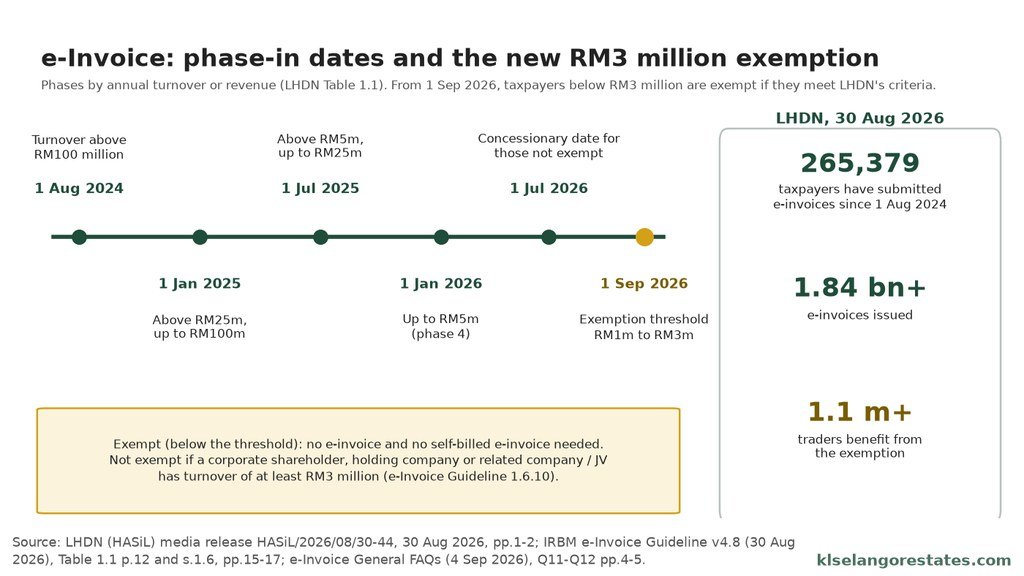
LHDN rolled out e-invoicing in phases, based on annual turnover or revenue (e-Invoice Guideline, Table 1.1):
- 1 August 2024: above RM100 million
- 1 January 2025: above RM25 million, up to RM100 million
- 1 July 2025: above RM5 million, up to RM25 million
- 1 January 2026: up to RM5 million
LHDN’s FAQs (updated 4 September 2026) also describe 1 July 2026 as a “concessionary” start date for smaller taxpayers that do not qualify for the exemption.
On 30 August 2026, LHDN announced that the exemption threshold would rise from RM1 million to RM3 million from 1 September 2026. MSMEs with annual income or sales below RM3 million are not required to implement e-invoicing, although LHDN encourages them to take part voluntarily. In the same release, LHDN said 265,379 taxpayers had submitted e-invoices since 1 August 2024, issuing more than 1.84 billion e-invoices.
Three details matter for landlords and tenants:
- The exemption covers all kinds of taxpayers, including individuals, partnerships and companies (e-Invoice Guideline, s.1.6.10).
- It does not apply if the taxpayer has a corporate (non-individual) shareholder with turnover of at least RM3 million, is a subsidiary of a holding company with turnover of at least RM3 million, or has a related company or joint venture with turnover of at least RM3 million. So a small company in a larger group may still have to e-invoice.
- Once turnover reaches RM3 million, e-invoicing starts on 1 January of the second year after that year of assessment (FAQ Q100). LHDN’s example: a company that passed RM3 million in 2026 starts on 1 January 2028. Once a business has been required to implement e-invoicing, it does not become exempt again if turnover later falls (FAQ Q104).
Who issues the e-invoice for the rent
LHDN’s FAQ Q62 answers the question directly for individual landlords:
“Where the individual landlord is conducting a business, an e-Invoice is required to be issued to the tenant. Where the individual landlord is not conducting a business, the tenant (if they are a business) would be required to issue a self-billed e-Invoice for the rental of property.”
Putting that together with the exemption, there are four common cases:
- The landlord is a company, or an individual conducting a business, and is required to e-invoice. The landlord issues the e-invoice to the tenant.
- The landlord is conducting a business but is exempt (below RM3 million and meeting LHDN’s conditions). No e-invoice is required. LHDN says receipts or other existing documents issued by exempt persons are used as proof of expense (e-Invoice Guideline, s.1.6.2).
- The landlord is an individual who is not conducting a business, and the tenant is required to e-invoice. The tenant issues a self-billed e-invoice for the rent. The Specific Guideline lists “transactions with individuals (who are not conducting a business)” as a self-billed case (s.8.3(f)).
- The landlord is an individual not conducting a business, and the tenant is itself exempt (below RM3 million and meeting the conditions). LHDN says exempt taxpayers are not required to issue self-billed e-invoices (FAQ Q105; Guideline s.1.6.2).
LHDN’s own worked examples include two rental cases. In one, a teacher who inherited vacant land rents it to a business and does not provide maintenance or support services, so the business tenant issues a self-billed e-invoice to her (Specific Guideline, Example 12). In the other, a company rents an office owned by three individuals who do not conduct a business, so it issues separate self-billed e-invoices to each owner, based on their agreed proportion (Example 14).
When a tenant issues a self-billed e-invoice, the tenant takes on the supplier’s role. It must share the validated self-billed e-invoice, or a visual representation of it, with the landlord (Specific Guideline, s.8.5). The tenant will therefore need the landlord’s details, such as name, tax identification number (TIN) or MyKad number, address and contact number. Section 8.8 explains what to fill in if the individual gives only one of the TIN or MyKad number.
Utilities and deposits
- Utilities in the landlord’s name. If the tenant cannot get the utility bills issued in its own name, LHDN says the utilities the tenant pays should be included in the landlord’s e-invoice (if the landlord is conducting a business) or in the tenant’s self-billed e-invoice (if the landlord is not) (FAQ Q63).
- Deposits. A refundable deposit does not need an e-invoice. A non-refundable deposit does (FAQ Q57).
The big open question: are you “conducting a business”?
Everything above turns on whether the individual landlord is “conducting a business”. LHDN’s e-invoice FAQs and guidelines do not define this for rentals. The only hints are in the examples: the teacher in Example 12 “does not provide maintenance or support services”, and in Example 14 the tenant relies on what it “understands” from discussions with the landlords.
An owner of one shophouse let on a simple lease may see things differently from an owner of several units who also provides services, a manager and staff. If you are a landlord, decide your position with your tax adviser and tell the tenant in writing. If you are a tenant, ask the landlord to confirm in writing which case applies, and ask LHDN or your tax adviser if you are unsure.
Part 2: Service tax on commercial rent
What is taxable
From 1 July 2025, rental or leasing services became taxable under Group K, First Schedule, Service Tax Regulations 2018, according to Customs’ rental and leasing guide (version 2, updated to 14 May 2026). It covers the right to use a tangible asset in Malaysia for a period, under a written or verbal agreement. Customs’ examples include renting commercial building space as an office and renting a SOFO unit as a management office.
Not taxable under this group:
- rental of residential homes, which Customs says include terraced houses, bungalows, flats, condominiums, serviced apartments, SOHOs, service suites and residential suites (the list is not exhaustive)
- rental of reading materials
- assets located outside Malaysia
- finance leases, where ownership passes to the lessee at the end
The rate: 8%, then 6%
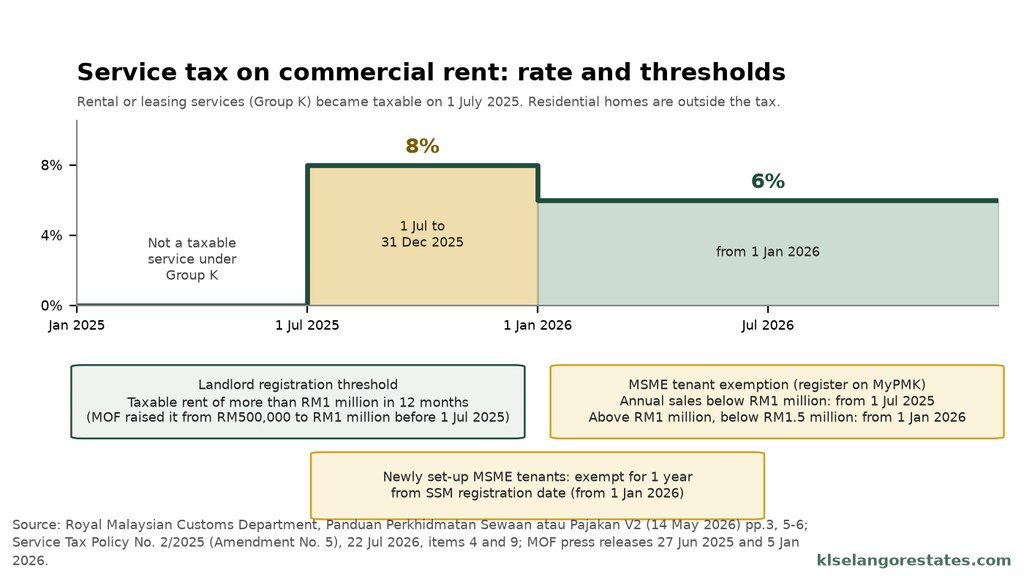
Customs sets the rate as 8% from 1 July to 31 December 2025 and 6% from 1 January 2026. The 6% rate was first given effect as a 2% exemption. Customs’ Service Tax Policy No. 2/2025 (Amendment No. 5) notes that the Service Tax (Rate of Tax) (Amendment) Order 2026, P.U. (A) 125, was gazetted on 13 March 2026, fixing the rate on rental or leasing at 6% from 1 January 2026.
The rate depends on when the service is provided, not when the lease was signed. Customs’ FAQ gives the example of a three-year shop lease that started on 1 October 2025: rent for periods from 1 January 2026 is taxed at 6% (FAQ Q4).
Who has to register and charge it: the landlord, above RM1 million
Service tax is charged by a registered person. A tenant only pays service tax on rent if the landlord is registered and no exemption applies.
The registration threshold for rental or leasing is more than RM1 million of taxable services in 12 months, according to Customs’ guide (paras 19–20) and its FAQ (Q2). The Ministry of Finance raised this threshold for rental or leasing from RM500,000 to RM1 million before the tax began on 1 July 2025. The RM500,000 figure you may see elsewhere is not the threshold for rental or leasing.
How the threshold works, according to Customs’ guide:
- The total covers all rental or leasing of tangible assets, including other services that form part of the rental. Residential homes and the other excluded items are left out.
- Rentals that the Minister has exempted still count towards the threshold (para 21).
- A landlord works out the taxable value for the current month plus the next eleven months. If it exceeds RM1 million, the landlord must apply to register by the last day of the following month (para 30). In Customs’ example, a landlord that reached the threshold in August 2025 had to apply during September 2025, with registration and tax starting on 1 October 2025 (para 31).
- A registered landlord must charge the tax, issue invoices as required by the law, file SST-02 returns and pay on time, and keep records for seven years (para 35).
What this means in practice (calc). RM1 million a year is about RM83,333 a month of taxable rent. Many individual owners of one or two shophouses or factory units will be well below that, so they will not be charging service tax. Larger owners and companies with several commercial units may be above it.
Individual landlords. Customs’ guide describes the registration duty in terms of a person “conducting a business” who provides taxable services above the threshold (para 4), and elsewhere as any person providing rental or leasing services above RM1 million (para 19). It does not separately discuss an individual who owns commercial units as an investment. If your commercial rents are approaching RM1 million a year, ask Customs or your tax adviser directly.
Co-owned property. Customs’ Service Tax Policy No. 4/2026 (22 July 2026) says that persons who jointly provide rental under a single agreement are treated as separate service providers. Each one registers based on its own total taxable services and invoices its own portion. If one party issues a single invoice for the whole rental with no breakdown, that party is treated as the service provider and must register if it meets the threshold.
Who is exempt from paying it: tenants
The main exemptions for tenants are in Customs’ Service Tax Policy No. 2/2025 (Amendment No. 5, 22 July 2026):
- MSME tenants. The tenant must register and declare its MSME status on Customs’ MyPMK system. Eligibility is based on the annual sales declared to LHDN for the latest year of assessment: below RM1 million is eligible from 1 July 2025, and above RM1 million but below RM1.5 million from 1 January 2026. MSMEs registered on MyPMK up to 31 December 2026 can enjoy the exemption from those dates. The MSME must have paid-up ordinary share capital of not more than RM2.5 million. If it was set up by a company in a group, that company’s shareholding must not exceed 20%. The annual sales figure must be updated on MyPMK every year. If a declaration is false, Customs may recover the tax.
- Newly set-up MSMEs. From 1 January 2026, a new MSME tenant is exempt for one year from its SSM registration date, subject to similar conditions, including registering on MyPMK.
- Group relief. Rental between companies in the same group is exempt, subject to Customs’ control tests.
- Governments. The Federal Government and State Governments are exempt.
The exemption is for business use. Customs’ FAQ says an MSME with a MyPMK certificate cannot use it for a hall rented for personal use, such as a wedding (FAQ Q19). Customs’ FAQ also gives the example of a small printing business with annual sales of RM450,000 renting a shop from a registered landlord: the rent is taxable, but the tenant can be exempt through MyPMK, and the tenant must make the application (FAQ Q17).
Utilities, inclusive rents, deposits and late fees
Customs’ FAQ is practical on this (Q13, Q16, Q26–Q31):
- Utilities paid directly by the tenant to the utility company are not subject to service tax, even if the bill is in the landlord’s name, as long as the landlord does not recharge or resupply them.
- Utilities recharged by the landlord are part of the rental service and are taxable, even at cost, and including any management mark-up.
- An all-in rent that covers electricity, water, internet or cleaning without separate charges is taxable in full.
- A refundable security deposit is not taxable. A deposit that is part of the payment for the service is.
- A late-payment penalty is not a taxable service.
An illustration
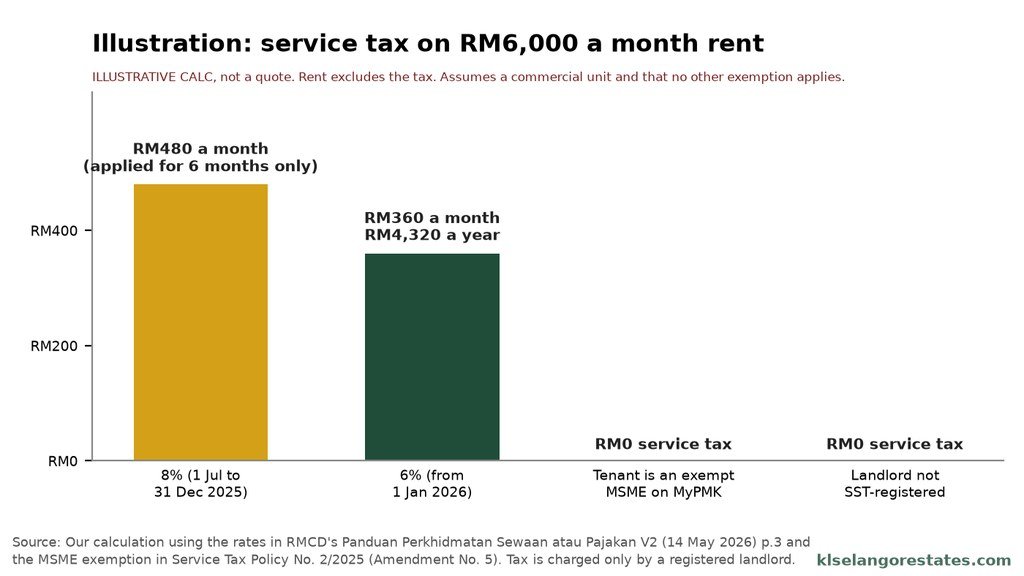
Example (illustrative calc). An office or factory unit is let at RM6,000 a month, excluding tax. If the landlord is registered for service tax and the tenant is not exempt, service tax at 6% is RM360 a month, or RM4,320 a year. At the 8% rate that applied from July to December 2025, it would have been RM480 a month. If the tenant is an MSME exempt through MyPMK, or the landlord is not registered, no service tax is charged on that rent. Customs’ own FAQ example: a warehouse let at RM20,000 a month carries RM1,200 of service tax (Q10).
Budget 2027: no change to either system
I read MOF’s Budget 2027 tax measures document in full. It sets out 36 measures. None of them changes service tax on rental or leasing, and none changes e-invoicing. The only service tax measure is a new treatment for elderly care services. Rules can still change through MOF announcements, Customs policies or LHDN guidelines, so check again before you sign or renew.
What to put in the tenancy agreement
Ask your lawyer to draft these points. The aim is to agree in writing who does what, before the first invoice:
- Rent is stated exclusive of service tax. If the landlord is or becomes registered, the tenant pays service tax at the rate in force when the service is provided, against a proper invoice.
- The landlord’s SST status. The landlord states whether it is registered (with its registration number) and agrees to tell the tenant if that changes.
- The tenant’s exemption. If the tenant relies on the MSME exemption, it provides its MyPMK details and tells the landlord if it stops qualifying. Agree who bears any tax later recovered by Customs if a declaration proves to be wrong.
- e-Invoice cooperation. The landlord states in writing whether it is conducting a business. If the tenant must issue self-billed e-invoices, the landlord provides its name, TIN or MyKad number, address and contact details. Co-owners state their agreed shares. The tenant agrees to share each validated self-billed e-invoice with the landlord.
- Utilities. State whether bills will be in the tenant’s name, paid directly, or recharged by the landlord, because this changes both the e-invoice and the service tax treatment.
- Deposits. Say clearly that the security and utility deposits are refundable, and when they are returned.
- Changes in the law. Add a clause for future changes in the rate, the thresholds or e-invoicing rules.
Checklist for landlords
- Work out your total commercial rent for the next 12 months. Above RM1 million? Talk to Customs or your tax adviser about registering.
- Decide with your tax adviser whether you are “conducting a business” for e-invoicing, and put it in writing to your tenants.
- If you are conducting a business, check whether you are within the RM3 million exemption and its conditions, including any corporate shareholders or related companies.
- If you are not conducting a business, expect business tenants that are not exempt to send you self-billed e-invoices. Give them your details and keep the e-invoices they share with you.
- Co-owners: agree your shares and how invoices will be issued.
- Do not add service tax to the rent unless you are registered.
- Review utility arrangements, since recharges can become part of a taxable rental.
- Keep records of rent received, deposits and invoices.
Checklist for business tenants
- Ask whether the landlord is SST-registered. If not, there should be no service tax on the rent.
- Check whether you qualify as an MSME (sales below RM1.5 million, paid-up capital not more than RM2.5 million, group conditions) and register on MyPMK. Update it every year.
- New company? Check the one-year exemption from your SSM registration date.
- Check your own e-invoice status against the RM3 million threshold and its conditions.
- If your landlord is an individual not conducting a business and you are not exempt from e-invoicing, issue self-billed e-invoices for the rent, one per owner where there are co-owners, and share them with the landlord.
- Utilities in the landlord’s name? Include them in the correct e-invoice, and check whether a recharge carries service tax.
- Check every invoice for the right rate: 6% for periods from 1 January 2026.
Stamp duty: separate, and still payable
Stamp duty on the tenancy agreement is a separate obligation from both e-invoicing and service tax. Under Item 49(a) of the First Schedule to the Stamp Act 1949, as amended by the Finance Act 2024, duty is charged on a year’s rent, for every RM250 or part of RM250:
- Lease up to 1 year: RM1
- Over 1 year, up to 3 years: RM3
- Over 3 years, up to 5 years: RM5
- Over 5 years, or indefinite: RM7
Example (calc). A three-year lease at RM6,000 a month has a year’s rent of RM72,000. That is 288 units of RM250, so the duty is 288 × RM3 = RM864. For how and when to stamp under LHDN’s self-assessment system, see my stamp duty self-assessment article.
What the sources do not settle
- “Conducting a business.” Neither LHDN’s e-invoice FAQs and guidelines nor Customs’ rental guide sets a test for when an individual who lets commercial property is conducting a business. This decides who issues the e-invoice, and it may matter for service tax. Get advice on your own facts.
- Individual landlords and SST registration. Customs’ guide does not separately discuss an individual investor whose commercial rents exceed RM1 million a year.
- Who bears the tax under existing leases. The tax rules say who must charge and pay service tax. They do not decide whether a lease signed before July 2025 lets the landlord add it to the rent. That depends on the lease wording, so ask your lawyer.
- Service charges and other payments. This article does not cover charges paid to a management body, or other payments that are not rent under your lease. Check their treatment separately.
- Future changes. The FAQs and policies are updated often. The versions used here are LHDN’s FAQs of 4 September 2026, its guidelines of 30 August and 7 September 2026, and Customs’ guide of 14 May 2026 and policies of 22 July 2026.
What to watch next
- New versions of LHDN’s e-invoice FAQs and guidelines, especially anything on individual landlords.
- Customs’ updates to the rental or leasing guide and Service Tax Policy No. 2/2025.
- The MyPMK registration window, which in the current policy runs up to 31 December 2026 for exemptions dated back to 1 July 2025 or 1 January 2026.
- Any change to service tax on rent in future MOF announcements.
Related reading
- Klang Valley shophouse prices: what NAPIC’s shop price index shows
- Selangor SME factories: buy or rent?
- Stamp duty self-assessment in Malaysia from 2027
- Malaysia’s Residential Tenancy Act: what is proposed and what protects landlords and tenants today
Sources
All accessed 31 October 2026.
- LHDN (HASiL), media release HASiL/2026/08/30-44, “Ambang Pengecualian Pelaksanaan e-Invois Dinaikkan”, 30 August 2026, pp.1–2: https://www.hasil.gov.my/wp-content/uploads/20260830-Kenyataan-Media-HASiL_AMBANG-PENGECUALIAN-E_INVOIS-DINAIKKAN.pdf
- LHDN (IRBM), Implementation of e-Invoice in Malaysia: Frequently Asked Questions (updated 4 September 2026), Q11–Q12 (pp.4–5), Q57 and Q62 (p.22), Q63 (p.23), Q98–Q100 (pp.38–41), Q104–Q105 (p.48): https://www.hasil.gov.my/wp-content/uploads/lhdnm-e-invoice-general-faqs.pdf
- LHDN (IRBM), e-Invoice Guideline, Version 4.8 (30 August 2026), s.1.5 Table 1.1 (p.12) and s.1.6 (pp.15–17): https://www.hasil.gov.my/wp-content/uploads/IRBM-e-Invoice-Guideline.pdf
- LHDN (IRBM), e-Invoice Specific Guideline, Version 4.9 (7 September 2026), s.8.3(f) (p.63), Examples 12 and 14 (pp.65–66), s.8.5 (p.69), s.8.8 (p.71): https://www.hasil.gov.my/wp-content/uploads/IRBM-e-Invoice-Specific-Guideline.pdf
- Royal Malaysian Customs Department, Panduan Perkhidmatan Sewaan atau Pajakan, Versi 2 (sehingga 14 Mei 2026), paras 4, 8–9, 16–22, 29–31, 35 (pp.2–7, 23–26) and FAQ Q2, Q4, Q10, Q13, Q16, Q17, Q19, Q26–Q31 (pp.28–38): https://pub-359af8e1f79c472292a7e44ec60f3027.r2.dev/Industry%20Guides/MS/PANDUAN%20PERKHIDMATAN%20SEWAAN%20ATAU%20PAJAKAN_VERSI%202%401452026.pdf (listed at https://mysst.customs.gov.my/industry-guides/)
- Royal Malaysian Customs Department, Service Tax Policy No. 2/2025 (Amendment No. 5), Rental or Leasing Services, 22 July 2026, items 1–9 (pp.1–5): https://pub-359af8e1f79c472292a7e44ec60f3027.r2.dev/Service%20Tax%20Policy/EN/STP%202-2025%20%28Rental%20or%20Leasing%29%20%28Amnd%20No.5%29%20220726.pdf (listed at https://mysst.customs.gov.my/service-tax-policy/)
- Royal Malaysian Customs Department, Service Tax Policy No. 4/2026, 22 July 2026: https://pub-359af8e1f79c472292a7e44ec60f3027.r2.dev/Service%20Tax%20Policy/EN/STP%20No.4-2026%20(Rental%20or%20Leasing)%20220726.pdf
- Ministry of Finance, “Revision to The Expanded Sales Tax and Service Tax Take Into Account Public and Industry Feedback”, press release, 27 June 2025: https://www.mof.gov.my/portal/en/news/press-release/revision-to-the-expanded-sales-tax-and-service-tax-take-into-account-public-and-industry-feedback
- Ministry of Finance (Bernama), “SST Perkhidmatan Sewaan Diturunkan Kepada 6 Peratus, PMKS Terima Pelepasan Baharu”, 5 January 2026: https://mof.gov.my/portal/ms/berita/akhbar/sst-perkhidmatan-sewaan-diturunkan-kepada-6-peratus-pmks-terima-pelepasan-baharu
- Ministry of Finance, Budget 2027 Tax Measures (36 appendices; Appendix 34 is the only service tax measure): https://belanjawan.mof.gov.my/pdf/belanjawan2027/ucapan/tax-measures.pdf
- Finance Act 2024, section 27 (amendment of the First Schedule to the Stamp Act 1949, Item 49): https://mylaw.my/legislation/akta-kewangan-2024/section-27
About the author
Jessica Leong | Registered Estate Agent E3208
PropNex Realty Sdn Bhd (E (1) 1800/1)
KLCC branch, Marc Residence, Jalan Pinang, Kuala Lumpur
010-464 6088 (call/WhatsApp) · Office: 03-2161 8608
Website: klselangorestates.com
Jessica covers new launch condos in Kuala Lumpur and Petaling Jaya, industrial property in Selangor, bank auction (lelong) properties, and PJ/Selangor offices, shophouses and en-bloc deals. See her new launch pages for Kuala Lumpur, KLCC, Petaling Jaya and Selangor.
This article is general information based on public sources as at 31 October 2026. It is not legal, tax, financial or investment advice. e-Invoicing and service tax rules are updated often, and how they apply to you depends on your own facts, including whether you are conducting a business. Please confirm your position with LHDN, the Royal Malaysian Customs Department or a licensed tax adviser, and have your own lawyer review any tenancy agreement. This article does not promote or assess any particular building or development.