Buying or Renting a Small Factory in Selangor in 2026: What NAPIC's Data Shows and What SMEs Should Check First
Selangor has a third of Malaysia's factories, and two-thirds of them are terrace units. Here is where the stock is, what is being built, what recent deals show, and the approvals, power and tax points to check before you buy or rent.
Originally published on Medium: read it on Medium

If you run a workshop, a light manufacturing line or a trading business with stock to store, your next premises may well be a small factory in Selangor. The state has more industrial units than any other: 44,019 at the end of June 2026, about a third of Malaysia’s total, according to NAPIC, the government’s National Property Information Centre. Two in every three are terrace factories, the one-and-a-half and two-storey units found in industrial parks from Shah Alam and Puchong to Klang, Rawang and Semenyih.
This guide is for SME owners and investors deciding whether to buy or rent one. For the big land deals, see my article on data centres and SME factories.
Not advice. This is general information from NAPIC and other official sources as at 26 October 2026. Approval requirements vary by council and by business activity. Please speak to your lawyer, banker, tax adviser and, for power and building matters, a qualified engineer about your own case.
What Selangor’s factory stock looks like
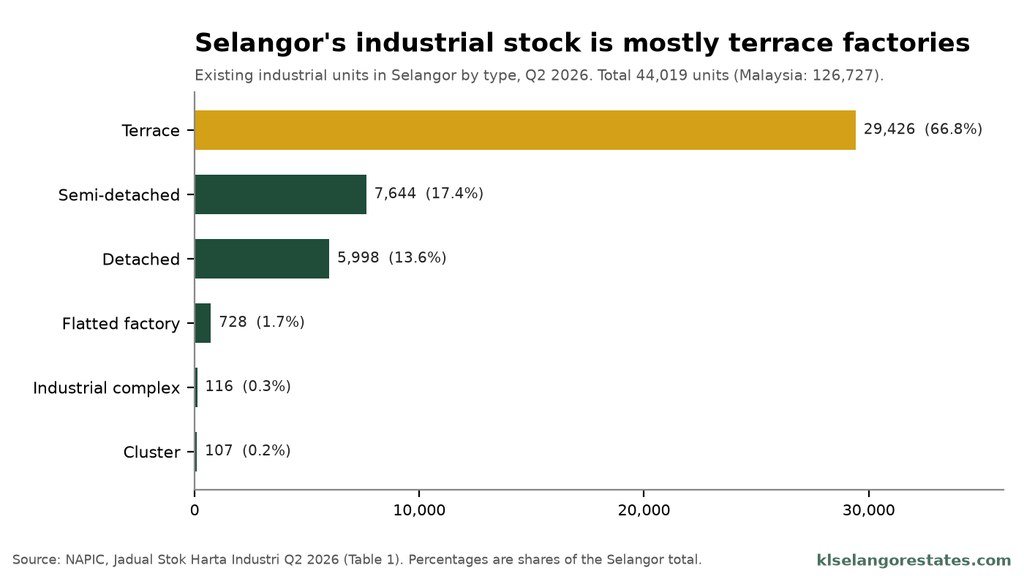
| Type | Existing units | Share of Selangor |
|---|---|---|
| Terrace | 29,426 | 66.8% |
| Semi-detached | 7,644 | 17.4% |
| Detached | 5,998 | 13.6% |
| Flatted factory | 728 | 1.7% |
| Industrial complex | 116 | 0.3% |
| Cluster | 107 | 0.2% |
| Total | 44,019 | 100% |
Selangor’s 44,019 units are 34.7% of Malaysia’s 126,727. Nationally, terrace units are also the largest group, at just over half of the stock. For an SME, that means choice: there are far more terrace units to compare than semi-D or detached ones, which are usually larger, with side yards and better truck access.
By district: Petaling and Klang dominate
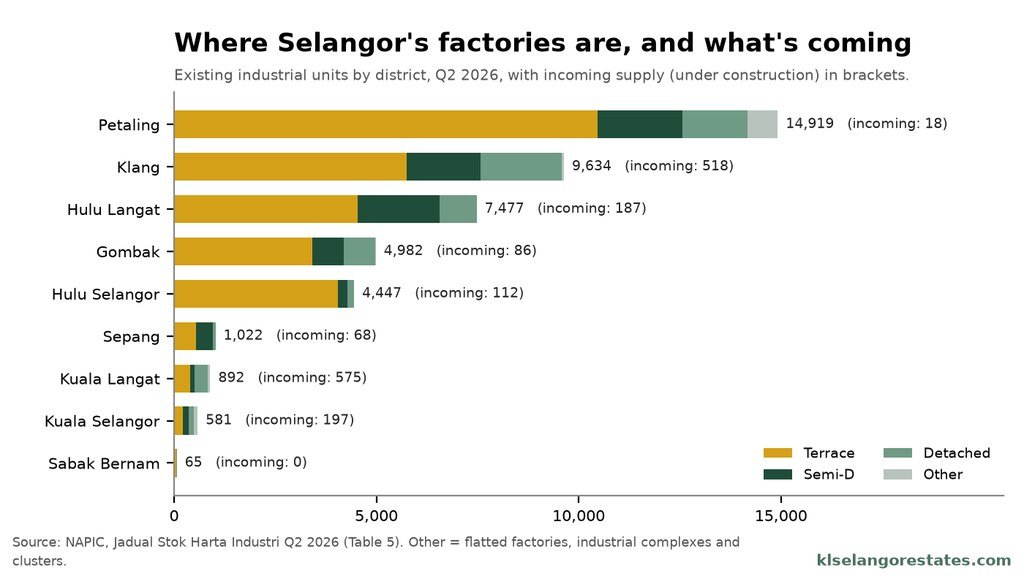
NAPIC reports by district, not town. Roughly, Shah Alam, Puchong, Subang and Sungai Buloh are in Petaling; Kapar and Port Klang in Klang; Rawang in Gombak; Kajang, Bangi and Semenyih in Hulu Langat; and Banting in Kuala Langat. Check the district on the title, because council areas do not always follow the town name.
| District | Existing units | Of which terrace | Incoming supply | Planned supply |
|---|---|---|---|---|
| Petaling | 14,919 | 10,468 | 18 | 48 |
| Klang | 9,634 | 5,740 | 518 | 848 |
| Hulu Langat | 7,477 | 4,533 | 187 | 91 |
| Gombak | 4,982 | 3,424 | 86 | 143 |
| Hulu Selangor | 4,447 | 4,042 | 112 | 0 |
| Sepang | 1,022 | 551 | 68 | 5 |
| Kuala Langat | 892 | 390 | 575 | 23 |
| Kuala Selangor | 581 | 216 | 197 | 223 |
| Sabak Bernam | 65 | 62 | 0 | 0 |
- Petaling is the biggest market but is almost full. It has a third of Selangor’s industrial units, including all 728 flatted factories, but only 18 units under construction. In Shah Alam, Puchong or Subang, you will mostly be choosing from existing buildings.
- New supply is moving to Klang and Kuala Langat. Together they account for 1,093 of Selangor’s 1,761 incoming units. Klang also has 848 units planned, including 346 flatted factory units newly planned in the first half of 2026.
- The new units are bigger. Selangor’s incoming supply has 859 semi-D units against 382 terraces, plus 368 cluster units. Nationally, semi-D units make up 49.1% of incoming industrial supply. For a small terrace unit, most of the choice is in existing stock.
Transactions and prices: what NAPIC reports
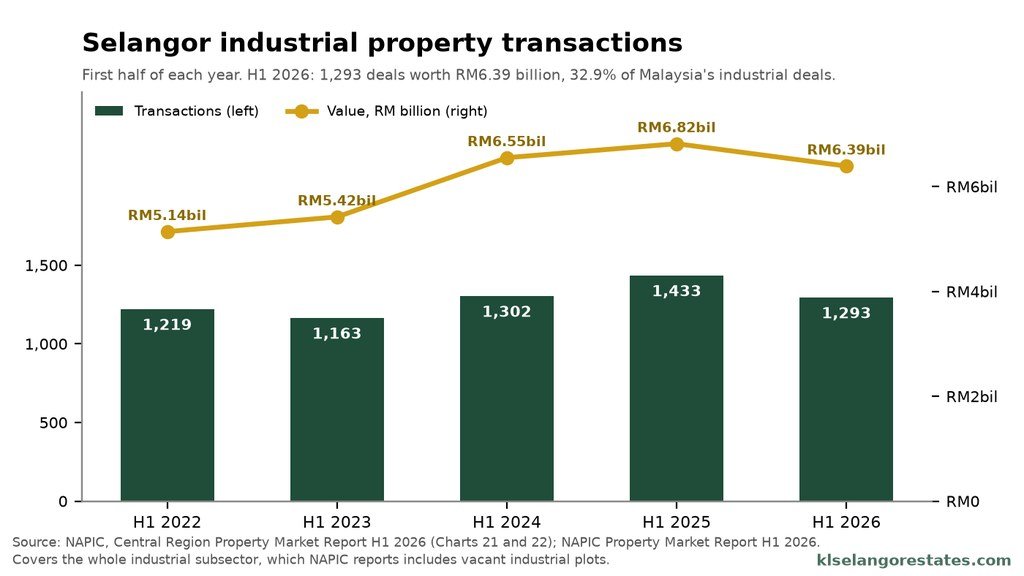
- Selangor led Malaysia. In H1 2026, NAPIC recorded 1,293 industrial transactions in Selangor worth RM6.39 billion, 32.9% of the national total of 3,932. Johor was second, with 669.
- Slightly down on 2025. That was 9.8% fewer deals than in H1 2025 (1,433) and 6.3% lower in value (RM6.82 billion), but both were higher than in H1 2022 and H1 2023.
- Terrace factories lead nationally, at 34.1% of industrial deals (1,339), followed by vacant industrial plots at 27.7% (1,088). NAPIC links demand for terrace factories, warehouses and industrial land in Selangor and Johor to the electrical and electronics sector, AI-related demand and data centre expansion.
- Mostly company buyers. Of Selangor’s 1,293 transactions, 790 were by companies and other entities, 502 by Malaysian individuals and one by a non-citizen.
NAPIC does not publish an industrial price index, but gives two Selangor examples:
- One-and-a-half-storey terrace factories in Subang Hilir Industrial Park rose 6.6%, with transactions between RM1.64 million and RM1.86 million.
- Several industrial schemes in the Klang district rose between 2.3% and 3.7%, with transacted prices reaching around RM1.19 million.
These are examples, not Selangor averages. Values depend heavily on land size, built-up area, tenure, specification and access, so use recent transactions in the same park as your main guide.
Unsold stock is low: only 41 completed industrial units were unsold in Selangor at the end of June 2026, plus 189 under construction and unsold. Developers are mostly selling what they build, so there are few completed new units to choose from at any one time.
NAPIC does not publish a factory rental index, so I have not quoted rents or estimated yields. Compare several units in the same park, and if you are buying a tenanted unit, ask for the tenancy and rent history.
Buy or rent?
| Buying | Renting | |
|---|---|---|
| Upfront cash | Down payment, stamp duty, legal fees | Deposit and advance rent, plus stamp duty on the tenancy |
| Control | Renovate or upgrade power, subject to approvals | Changes need the landlord’s consent |
| Flexibility | Harder to move if you outgrow the unit | Easier to move at the end of the term |
| Cost over time | Loan repayments; you carry assessment, quit rent and repairs | Rent can rise at renewal; landlord carries the building |
| On exit | You may gain or lose; RPGT may apply | Nothing to sell |
A common pattern is to rent first while a new line proves itself, then buy once your space and power needs are clear.
Approvals, in order
Owning or leasing a unit does not by itself mean you can run your business there.
- Land category and express condition. Under the National Land Code, the title should be in the industry category, with an express condition that allows your use. Some titles restrict the type of industry or need state consent to transfer, charge or lease. Changing the category or condition needs a section 124 application through PTG Selangor, and your lawyer’s land search will show what is on the title.
- Planning permission (kebenaran merancang) from the council, under the Town and Country Planning Act 1976. In an established park this was normally obtained when the park was built, but check that your activity fits the approved use. Kuala Langat’s council, for example, asks for the planning permission letter for factory premises when you apply for a business licence.
- CCC, or CF for older buildings. The Certificate of Completion and Compliance is issued by the principal submitting person (an architect, professional engineer or registered draughtsman) under the Street, Drainage and Building Act 1974, not by the council. Shah Alam’s council asks for a copy with a licence application, and extensions or mezzanines added later need their own approval.
- A premises licence from the council. Expect to supply the tenancy or sale agreement, the assessment bill, plans and photos. If you store or process flammable or hazardous materials, councils ask for Bomba and Department of Environment (DOE) approval letters.
- Fire and environment. “Designated premises” under the Fire Services Act 1988 need an annual fire certificate, and factories can be designated depending on size and use. Fuel-burning equipment such as a boiler needs written notification to the DOE under the Clean Air Regulations 2014.
- A manufacturing licence, for larger operations. Under the Industrial Co-ordination Act 1975, a manufacturer with shareholders’ funds of RM2.5 million or more, or 75 or more full-time paid employees, applies through MIDA.
Power supply
TNB supply is low voltage (above 50V up to 1kV) or medium voltage (above 1kV up to 50kV), and upgrading involves TNB approval, cost and time. Under the Energy Commission’s schedule from 1 July 2025:
- Low voltage: 27.03 sen/kWh energy, 8.83 sen capacity and 14.82 sen network, or 50.68 sen/kWh in total, plus RM20 a month, before the Automatic Fuel Adjustment (AFA).
- Medium voltage: 29.83 sen/kWh, plus RM29.43 capacity and RM59.84 network charges per kilowatt of maximum demand per month, and RM200 a month. Your peak load drives much of the bill.
Ask for the existing supply (amps, phases and kVA) and recent bills, and have an electrical engineer check them against your machines.
Stamp duty, tax and financing
Buying. The transfer is charged at 1% to 4% on the price or market value, whichever is higher. On an illustrative RM1.8 million terrace factory (within the range NAPIC reports for Subang Hilir), that is RM1,000 + RM8,000 + RM15,000 + RM32,000 = RM56,000. From 1 January 2027, transfers under an SPA are self-assessed on MyTax; see my guide to stamp duty self-assessment, which also covers loan and tenancy duty.
Renting. Rental and leasing services have been subject to service tax since 1 July 2025, at 6% from 1 January 2026, according to the Royal Malaysian Customs Department. Landlords register once taxable services exceed RM1 million in 12 months, so ask whether yours charges it.
Selling and financing. RPGT applies to gains on a sale within five years for Malaysian individuals, and companies also pay 10% after that. Rates, and my notes on factory loans, are in the data centres article and on LHDN’s site.
Foreign buyers: Selangor’s rules for industrial property
Selangor’s Land and Mines Director’s Circular No. 1 of 2014, which PTG Selangor still cites, sets these conditions:
- Minimum price of RM3 million, in all three of Selangor’s zones.
- No Bumiputera units, and no more than 10% of the non-Bumiputera units in a development.
- A manufacturing licence from MITI for foreign-owned manufacturing companies.
- No purchases at public auction, and no agricultural or Malay reserve land.
- State Authority consent under section 433B of the National Land Code, at RM200 per title.
Foreign companies, and non-citizens who are not permanent residents, pay a flat 4% stamp duty on non-residential property: RM120,000 on a RM3 million factory, against RM104,000 for a Malaysian buyer. Confirm the current position with your lawyer.
Checklist before you buy or rent a factory
- Title: industry category, express condition, restrictions in interest (including Bumiputera), tenure and years remaining.
- Approvals: planning permission and CCC/CF, including any mezzanine or extension.
- Licence: the council confirms your activity fits the approved use.
- Power: supply in amps, phases and kVA, voltage level and upgrade options.
- Building: floor loading (kN/m²) and clear ceiling height.
- Access and drainage: road width, lorry turning space, loading bays and flood history.
- Fire and environment: fire certificate and any DOE notification.
- Outgoings and terms: quit rent, assessment and any service charges; rent review, renewal and reinstatement in a tenancy. Factories are not covered by the Housing Development Act, so the SPA terms for a new unit are whatever you negotiate.
What to ask your agent and your lawyer
Ask your agent:
- What have similar units in this park sold or rented for recently?
- What is the existing power supply, and has the owner had any trouble with TNB?
- Is the unit tenanted, and if so, on what rent and for how long?
Ask your lawyer:
- What does the land search show about the category, express condition, restrictions and encumbrances?
- Are the planning permission and CCC or CF in order, including any extensions?
- What conditions on approvals, licences and power should the SPA or tenancy include before I commit?
What is still not confirmed
- District-level prices and rents. NAPIC publishes no industrial price or rental index.
- Which factories need a fire certificate. Confirm with Bomba or your engineer.
- Council checklists differ. Shah Alam’s and Kuala Langat’s are examples only.
- NAPIC’s H1 2026 figures may be revised in later reports.
Sources
- NAPIC, Jadual Stok Harta Industri Q2 2026 (Tables 1 and 5): https://napic.jpph.gov.my/storage/app/media//3-penerbitan/Shahrul/Bahagian%20Inventori%20Harta%20Tanah/Laporan%20Jadual%20Stok%20Harta%20Tanah/Q2%202026/Jadual%20Stok%20Harta%20Industri%20Q2%202026.xls
- NAPIC, Property Stock Report H1 2026: https://napic.jpph.gov.my/storage/app/media/3-penerbitan/Shahrul/Bahagian%20Inventori%20Harta%20Tanah/Laporan%20Jadual%20Stok%20Harta%20Tanah/Q2%202026/Laporan%20Stok%20Harta%20Tanah%20H1%202026.pdf
- NAPIC, Property Market Report H1 2026: https://napic.jpph.gov.my/storage/app/media/3-penerbitan/Shahrul/Bahagian%20Pasaran%20Harta%20Tanah/Laporan%20Pasaran%20Harta%20Separuh%20Tahun%20dan%20Jadual/Q2%202026/LAPORAN%20PASARAN%20HARTA%20H1%202026.pdf
- NAPIC, Central Region Property Market Report H1 2026: https://napic.jpph.gov.my/storage/app/media//3-penerbitan/Shahrul/Bahagian%20Pasaran%20Harta%20Tanah/Central%20Region%20Wilayah%20Tengah/Q2%202026/Central%20Region%20H1%202026.pdf
- Pejabat Tanah dan Galian Selangor, Garis Panduan Perolehan Hartanah Oleh Kepentingan Asing (Seksyen 433B KTN), citing Pekeliling Pengarah Tanah dan Galian Selangor Bil. 1/2014: https://ptg.selangor.gov.my/index.php/pages/view/268
- Pejabat Tanah dan Galian Selangor, Permohonan Tukar Syarat Tanah, section 124, National Land Code: https://ptg.selangor.gov.my/index.php/pages/view/229
- MIDA, Approval and Licensing (Industrial Co-ordination Act 1975): https://www.mida.gov.my/setting-up-content/approvals-and-licensing/
- Energy Commission (Suruhanjaya Tenaga), Jadual Tarif Elektrik di Semenanjung, 1 July 2025 to 31 December 2027: https://myenergystats.st.gov.my/documents/d/guest/jadual-tarif-tnb-terkini
- TNB, Understand Your Electricity Tariff (voltage levels and tariff mapping): https://www.mytnb.com.my/tariff/index.html
- Ministry of Housing and Local Government (KPKT), Local Government Department, CCC FAQ: https://jkt.kpkt.gov.my/about-lgd/faqs/certificate-of-completion-and-compliance-ccc-faq
- Majlis Bandaraya Shah Alam, Lesen Komposit (Perniagaan / Perindustrian): https://www.mbsa.gov.my/ms-my/mbsa/perkhidmatan/pelesenan/Halaman/lesen_komposit.aspx
- Majlis Perbandaran Kuala Langat, composite licence checklist: https://mpkl.gov.my/muatturun/borang-rasmi/jabatan-pelesenan/borang-permohonan-lesen/160-13-senarai-semak-permohonan-lesen-komposit-perniagaan-dan-papan-iklan/file
- Fire Services Act 1988 (Act 341): https://www.bomba.gov.my/wp-content/uploads/2021/07/Act_341_Fire_services_act_1988.pdf
- Fire Services (Designated Premises) (Amendment) Order 2020: https://mylaw.my/legislation/perintah-perkhidmatan-bomba-premis-ditetapkan-pindaan-2020
- Department of Environment, Environmental Quality (Clean Air) Regulations 2014: https://www.doe.gov.my/wp-content/uploads/2021/10/Peraturan-peraturan_kualiti_alam_sekeliling_udara_bersih_2014.pdf
- Stamp Act 1949 (Act 378), First Schedule, Item 32: https://mylaw.my/legislation/stamp-act-1949/section-36
- LHDN, Stamp Duty Self-Assessment System (STSDS): https://www.hasil.gov.my/en/duti-setem/sistem-taksir-sendiri-duti-setem-stsds/
- LHDN, Real Property Gains Tax rates (updated 23 June 2026): https://www.hasil.gov.my/en/ckht/kadar-cukai-keuntungan-harta-tanah/
- Royal Malaysian Customs Department, MySST, Service Tax background: https://mysst.customs.gov.my/background/
- Ministry of Finance, media release on revisions to the SST (27 June 2025): https://mof.gov.my/portal/images/2025/06/27/Media-Release-Revisions-to-the-SST-take-into-account-public-and-industry-feedback.pdf
- The Edge Malaysia, “Protect your rights when buying commercial properties” (Housing Development Act scope): https://theedgemalaysia.com/article/protect-your-rights-when-buying-commercial-properties
About the author
Jessica Leong | Registered Estate Agent E3208
PropNex Realty Sdn Bhd (E (1) 1800/1), KLCC branch. Jessica covers new launch condos in Kuala Lumpur and Petaling Jaya, industrial property in Selangor, bank auction (lelong) properties, and PJ/Selangor offices, shophouses and en-bloc deals. See her industrial property page for current factory and warehouse projects in Selangor.
PropNex Realty Sdn Bhd, A-G-03, Marc Residence, No. 3, Jalan Pinang, 50400 Kuala Lumpur
Office: 03-2161 8608 · Call/WhatsApp: 010-464 6088
Website: klselangorestates.com
This article is general information based on public sources as at 26 October 2026. It is not legal, tax, financial or engineering advice. NAPIC’s H1 2026 figures may be revised, and approval requirements vary by council. Please consult your own lawyer, banker, tax adviser and engineer before you buy or rent.