Malaysia's Residential Tenancy Act Is Still Not Law: What Is Proposed, What Is Missing and What Protects KL and Selangor Landlords and Tenants Today
The minister hoped the Act would pass in 2026, but with Parliament's last 2026 sitting under way the Bill has not been tabled. Here is what KPKT has said, what is still unknown, and the laws that govern your tenancy today.
Originally published on Medium: read it on Medium

If you rent out a condo in Kuala Lumpur or rent a home in Selangor, you have probably heard that a Residential Tenancy Act is coming. The Ministry of Housing and Local Government (KPKT) has been working on it since 2019. In February 2026 the minister, Nga Kor Ming, said it had reached its “final stage” and that he hoped it could be passed in the Dewan Rakyat “within this year”.
It has not happened yet. As at 29 October 2026, the Residential Tenancy Bill has not been tabled in the Dewan Rakyat. It is not on the House’s 2026 bills list, which I checked today, so it has not been passed, gazetted or brought into force. Every tenancy you sign or renew today is still governed by your tenancy agreement and the existing general law.
This article sets out what the government has actually said the Act would do, what is still missing, and the laws that protect landlords and tenants right now. For stamping a tenancy under LHDN’s self-assessment system, see my stamp duty self-assessment article.
Not advice. This is general information from Parliament, KPKT ministers’ statements, DOSM, the text of the relevant Acts, law firm commentary and news reports as at 29 October 2026. The Bill’s contents are not public and may change before it is tabled. Please speak to your own lawyer about your tenancy.
Where the Residential Tenancy Act stands
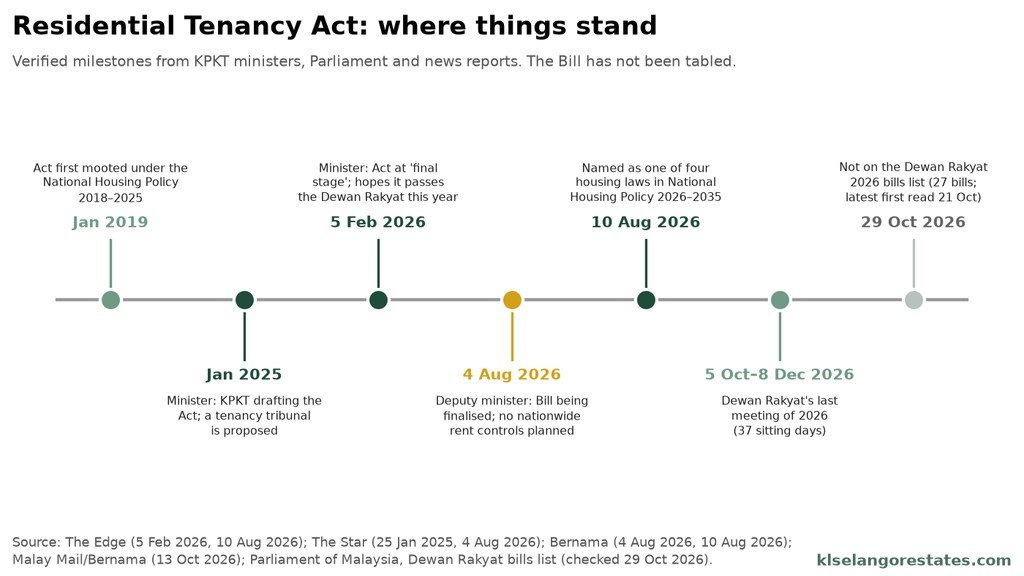
The Act was first mooted in January 2019 under the National Housing Policy 2018–2025, according to The Edge. In January 2025, the minister told The Star that KPKT was drafting it and that it would set up a Residential Tenancies Tribunal for landlords’ and tenants’ claims.
On 5 February 2026, he said the Act was “under review and has now reached its final stage”, and that he would go through each phase before taking it to the Cabinet. “Once the Cabinet reaches a consensus, we hope the RTA can be passed in the Dewan Rakyat within this year,” he said.
On 4 August 2026, the deputy minister, Datuk Aiman Athirah Sabu, told the Dewan Negara that KPKT was finalising the Bill. RTM reported that it was expected to be tabled this year. Six days later, at the launch of the National Housing Policy 2026–2035, the minister named it as one of four housing laws KPKT would draft or amend, alongside a Property Development Act, a Building Managers Act and amendments to the Strata Management Act 2013. No tabling date was given.
The Dewan Rakyat’s third and final meeting of 2026 began on 5 October and sits for 37 days until 8 December, Bernama reported. When I checked Parliament’s Dewan Rakyat bills list on 29 October 2026, it held 27 bills for 2026. The most recent, D.R.27/2026, had its first reading on 21 October. None of them is a tenancy bill. So the “this year” target can only be met if the Bill is tabled and passed in the remaining weeks of this meeting.
| Item | Status at 29 Oct 2026 | What has been said |
|---|---|---|
| A Residential Tenancy Act | Government plan | Named in the National Housing Policy 2026–2035 (10 Aug 2026) |
| Bill tabled in Parliament | Not yet | Not on the Dewan Rakyat 2026 bills list; “being finalised” (4 Aug 2026) |
| Passed, gazetted, in force | No | No commencement date announced |
| Balance of landlords’ and tenants’ rights | Stated aim | “Clearly defining the rights and responsibilities of both sides” (4 Aug 2026) |
| Tenancy tribunal or faster dispute route | Proposed | Tribunal named by the minister (Jan 2025); “quicker, easier and more affordable” disputes (4 Aug 2026) |
| Tenant’s duty to pay utilities as agreed | Proposed | Minister’s description of the draft (Jan 2025) |
| Nationwide rent control | Not planned | Government “does not intend to impose nationwide rent controls” (4 Aug 2026) |
| Deposit rules | Not confirmed | Only a stakeholder’s account of a draft clause (Jan 2025); see below |
| Transition rules for existing tenancies | Not announced | — |
What the government has said the Act would do
Very little of the Bill’s content has been made public. These are the points ministers have stated on the record:
- A fairer balance between both sides. Both the minister and his deputy have described the Act’s purpose as balancing the rights of property owners and tenants. “The proposed legislation seeks to establish a fairer relationship between tenants and homeowners by clearly defining the rights and responsibilities of both sides,” the deputy minister said on 4 August 2026.
- Cover the whole tenancy. In January 2025, the minister said the Act “aims to ensure that both parties fulfil their rights and obligations, from the pre-agreement, the subsistence of the agreement and at the termination of the agreement”.
- A tribunal or similar dispute route. The minister said in January 2025 that a Residential Tenancies Tribunal “will hear and handle claims, providing remedies for landlords and tenants”. In August 2026, the deputy minister described a “quicker, easier and more affordable way to resolve disputes”. Neither statement gave a claim limit, fees or a start date.
- Utilities. In the same January 2025 interview, the minister said that under the proposed Act a tenant must pay utility charges such as electricity, water and sewerage as agreed, and that a landlord could seek an order from the tribunal if the tenant does not. His comments followed complaints by landlords in Gopeng, Manjung and Sitiawan about large unpaid electricity bills left by tenants.
- No nationwide rent control. The deputy minister said the government does not intend to impose nationwide rent controls, because rents depend on economic factors and local market conditions. Instead it would increase affordable rental housing, improve tenant protection and widen access to home ownership.
What is still missing
The Bill itself. Its full text, section numbers, penalties and tabling date are not public. Until the Bill is tabled for first reading, nobody outside government can say exactly what it contains.
Deposit rules. You may have read that the Act will cap deposits at two months’ rent plus one month for utilities, held by the government. I could not find any KPKT statement confirming this. The only dated source I found is a January 2025 report in The Star, in which the National House Buyers Association’s secretary-general, Datuk Chang Kim Loong, described “a proposed RTA clause” under which deposits of two months’ rental and one month of utility would be “parked with a government agency” and returned at the end of the tenancy if nothing was deducted. He criticised the idea. That describes a draft as one stakeholder understood it in early 2025. It is not law, and it may have changed. Until the Bill is published, the deposit is whatever your tenancy agreement says.
The tribunal’s details. There is no published claim limit, filing fee, time limit or list of the types of dispute it would hear.
What stakeholders are still asking for. In August 2026, the NGO Architects of Diversity urged the government not to delay the Bill to 2027. It asked for enforceable anti-discrimination protections, an accessible tribunal and clear responsibilities for rental listing platforms, citing its own study of 35,367 Klang Valley room listings. The government has not said whether the Bill will cover any of these.
Transition rules. KPKT has not said whether the Act would apply to tenancies signed before it comes into force.
Why this matters more in KL and Selangor
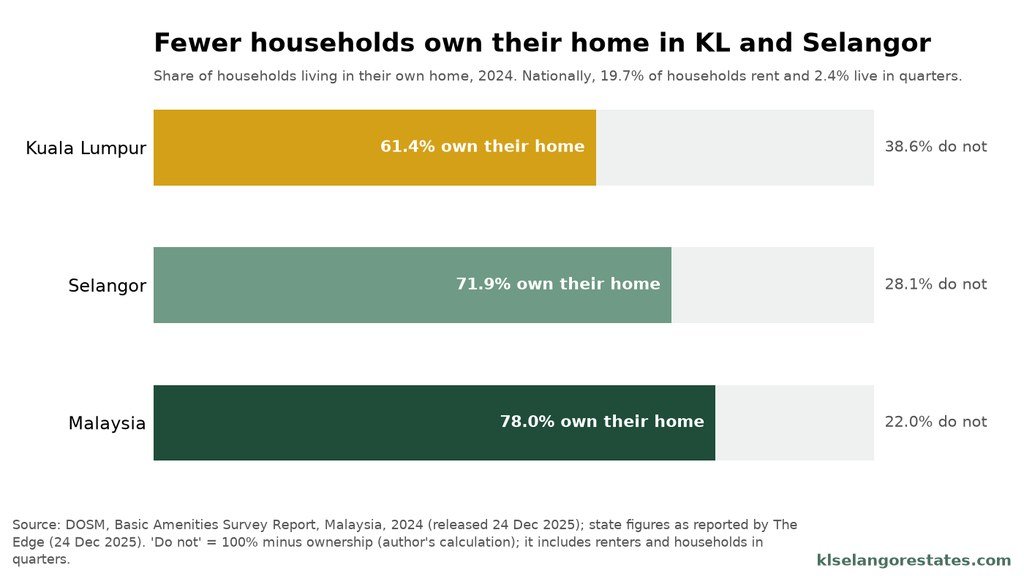
Renting is more common in the Klang Valley than in most of Malaysia. DOSM’s 2024 Basic Amenities Survey found that 78.0% of Malaysian households live in their own home, while 19.7% rent and 2.4% live in quarters. Home ownership is lower in Kuala Lumpur (61.4%) and Selangor (71.9%), as reported by The Edge. That means about 38.6% of KL households and 28.1% of Selangor households do not live in a home they own. That share includes households in employer or government quarters as well as renters, so it is not a count of tenants.
For landlords, that is a large tenant pool. It also means a lot of tenancy disputes are being handled with no dedicated tenancy law, which is why the details of the Bill matter.
What protects landlords and tenants today
Malaysia has no dedicated residential tenancy statute today. Your protection comes from the agreement you sign and from several general laws.
1. The tenancy agreement is the main rulebook. Rent, deposit, the tenancy period, notice, repairs, utilities, renewal and early termination are all set by the contract, and enforced under ordinary contract law. A tenancy is usually for a term of no more than three years, according to Kevin Wu & Associates. If a clause is missing or vague, you may end up arguing about it in court, so the drafting matters.
2. Deposits must be justified. There is no statutory cap or deposit scheme. The deposit is held and returned according to the agreement. A landlord who wants to deduct from it has to be able to prove the loss. In a recent Court of Appeal case described by WL Law Chambers, the court held that a security deposit is not automatically forfeited because a dispute arises at the end of a tenancy, and that deductions must be supported by evidence and follow the agreed procedure.
3. No eviction without a court order. Under section 7(2) of the Specific Relief Act 1950, once a tenancy has ended, a person entitled to possession “shall not enforce his right to recover it against the occupier otherwise than by proceedings in the court”. Kevin Wu & Associates notes that this rules out self-help such as changing the locks, cutting off water or electricity, or removing the tenant’s belongings, and that a landlord who does so may be sued by the tenant under section 8 of the same Act.
4. A valid notice to quit. To end a tenancy, the landlord should give notice as the agreement requires. Where the agreement is silent, the law firm cites Saadian Bte Karim v Ong Ting Chai (1996): for a monthly tenancy, the notice is one full month, ending at the end of a rental period. Without valid notice, the termination may not take effect.
5. Double rent if a tenant overstays. Under section 28(4)(a) of the Civil Law Act 1956, a tenant holding over after the tenancy has ended can be charged, at the landlord’s option, double the rent (or double the value) until possession is given up.
6. Recovering unpaid rent through the court. Under section 5 of the Distress Act 1951, a landlord, or an agent authorised in writing, may apply to a judge or registrar for a warrant of distress for rent due for up to 12 completed months before the application. This is a court process, not permission for the landlord to seize goods personally. A landlord can also sue for arrears as a debt.
7. Small claims up to RM5,000. A claim of up to RM5,000, such as an unreturned deposit or a small amount of unpaid rent, can go through the small claims procedure in the Magistrates’ Court under the Rules of Court 2012, according to the Selangor State Courts. The procedure is designed for cases where hiring a lawyer may not be practical. Larger claims go through the ordinary court process.
8. A stamped agreement. A tenancy agreement is chargeable with stamp duty, and the tenant is the party liable for it under the Third Schedule of the Stamp Act 1949. Under section 52, a document that is not duly stamped cannot be admitted in evidence until the duty and any penalty are paid. If you ever need to rely on the agreement in court, it should be stamped.
How much stamp duty on a tenancy
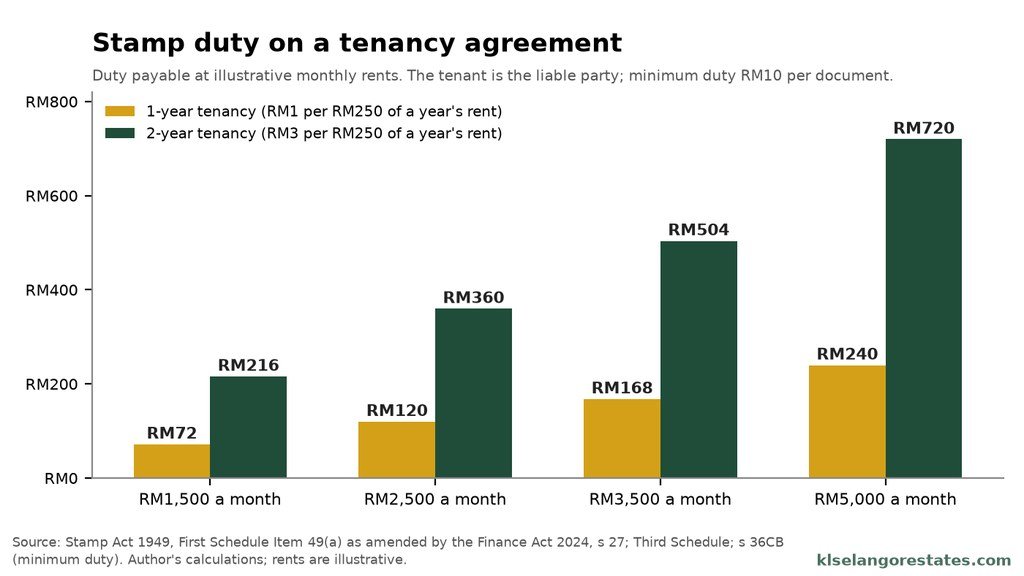
The Finance Act 2024 replaced the rates in Item 49(a) of the Stamp Act. The new rates apply from 1 January 2025, according to How, Ong & Associates. For every RM250 of a year’s rent, or part of RM250, the duty is:
| Tenancy term | Duty per RM250 of a year’s rent |
|---|---|
| Up to 1 year | RM1 |
| Over 1 year, up to 3 years | RM3 |
| Over 3 years, up to 5 years | RM5 |
| Over 5 years | RM7 |
Every document pays at least RM10. On an illustrative RM2,500 a month condo let for two years, a year’s rent is RM30,000. That is 120 units of RM250, so the duty is 120 × RM3 = RM360.
Since 1 January 2026, tenancy agreements have been stamped under LHDN’s self-assessment system on MyTax. The return must be filed within 30 days of signing. Stamping late attracts a penalty of RM50 or 10% of the unpaid duty, whichever is higher, within three months, and RM100 or 20% after that. The Ministry of Finance’s waiver of the incorrect-return penalty for these documents covers returns filed in 2026 only. If you renew in 2027, work out the duty again on the new rent and term.
Checklist for landlords
- Use a complete written agreement. Cover rent, deposit, the term, notice, repairs, utilities, renewal and early termination, and get it signed by everyone named.
- Stamp it within 30 days of signing. Agree in writing who pays, and keep the e-stamp certificate.
- Record the unit’s condition. Do a dated inventory with photos at handover, and repeat it at the end.
- Put utilities in writing. State who pays which bills. Where you can, check the accounts are up to date during the tenancy.
- Never use self-help. Do not change the locks, cut the water or electricity, or remove belongings. Use a notice to quit and the courts.
- Keep records of arrears. Keep a rent ledger and written reminders. They support a claim, a distress application or a small claim.
Checklist for tenants
- Read the deposit and deduction clauses before you sign, and ask for anything unclear to be rewritten.
- Pay by traceable transfer and keep every receipt, including for the deposit.
- Photograph the unit at move-in and send the photos to the landlord or agent so there is a dated record.
- Make sure the agreement is stamped. You are the party liable for the duty, and an unstamped agreement cannot be admitted in court until it is stamped and any penalty paid.
- Give notice in writing as the agreement requires, and do not overstay: double rent can apply.
- Ask in writing for your deposit after you hand back the keys. If it is not returned and the claim is RM5,000 or less, the small claims procedure is available.
What to ask your agent and your lawyer
Ask your agent:
- Is the person signing the registered owner, or authorised in writing by the owner?
- Which version of the tenancy agreement are we using, and who is arranging and paying for stamping?
- How will the move-in inventory and the handover at the end be recorded?
Ask your lawyer:
- Are the deposit, deduction and early-termination clauses fair and clear, and how would a court read them?
- What notice is needed to end this tenancy, and what happens if one side breaches?
- If the Residential Tenancy Act comes into force during my tenancy, how might it affect this agreement?
What is still not confirmed
- The Bill itself. Its text, final name and tabling date are not public. News reports have used both “Residential Tenancy Act” and “Rent Tenancy Act”.
- Deposit rules. No official confirmation of any deposit cap or government-held deposit scheme.
- The tribunal. Its claim limit, fees, time limits and start date have not been announced.
- Coverage. Whether rooms, serviced apartments and short-term stays would be included has not been said.
- Transition rules for tenancies signed before the Act comes into force.
- Timing. Whether the Bill will be tabled before the Dewan Rakyat rises on 8 December 2026.
Related reading
- Stamp duty self-assessment in Malaysia from 2027
- KPKT’s Real Property Development Act: what new launch buyers should check
- Urban renewal bill withdrawn: what it means for older strata in KL and Selangor
- Serviced apartments in KL and Selangor: unsold units in 2026
- Budget 2027: first-home stamp duty and SPA timing
Sources
- Parliament of Malaysia, Dewan Rakyat bills 2026 (checked 29 Oct 2026): https://www.parlimen.gov.my/bills-dewan-rakyat.html?uweb=dr&lang=en
- The Edge, “Long-awaited Residential Tenancy Act to be tabled this year — minister”, 5 Feb 2026: https://theedgemalaysia.com/node/791858
- Utusan Malaysia, “RUU Sewaan Kediaman akan dibentang di Parlimen tahun ini”, 5 Feb 2026: https://www.utusan.com.my/ekonomi/2026/02/ruu-sewaan-kediaman-akan-dibentang-di-parlimen-tahun-ini/
- The Star, “New tribunal can help with rogue tenants and issues like unpaid bills”, 25 Jan 2025: https://www.thestar.com.my/news/nation/2025/01/25/new-tribunal-can-help-with-rogue-tenants
- Bernama, “Residential Tenancy Bill being finalised to balance rights of tenants and landlords”, 4 Aug 2026: https://bernama.com/en/general/news.php/?id=2590159
- The Star, “Residential Tenancy Bill being finalised to balance rights of tenants, landlords”, 4 Aug 2026: https://www.thestar.com.my/news/nation/2026/08/04/residential-tenancy-bill-being-finalised-to-balance-rights-of-tenants-landlords
- RTM, “Kerajaan muktamadkan RUU Sewaan Kediaman, wujudkan hubungan seimbang penyewa-pemilik rumah”, 4 Aug 2026: https://berita.rtm.gov.my/nasional/senarai-berita-nasional/senarai-artikel/kerajaan-muktamadkan-ruu-sewaan-kediaman-wujudkan-hubungan-seimbang-penyewa-pemilik-rumah/
- Bernama, four housing laws under the National Housing Policy 2026–2035, 10 Aug 2026: https://www.bernama.com/en/news.php?id=2592582
- The Edge, “Housing Ministry to draft, amend four housing laws under National Housing Policy 2026-2035”, 10 Aug 2026: https://theedgemalaysia.com/node/813928
- FMT, “Don’t delay tabling Residential Tenancy Bill to 2027, NGO tells govt”, 12 Aug 2026: https://www.freemalaysiatoday.com/category/nation/2026/08/12/don-t-delay-tabling-residential-tenancy-bill-to-2027-ngo-tells-govt
- Malay Mail (Bernama), “In Dewan Rakyat today”, 13 Oct 2026: https://www.malaymail.com/news/malaysia/2026/10/13/in-dewan-rakyat-today-myanmar-refugees-gaza-crisis-and-minimum-wage/238893
- DOSM, Basic Amenities Survey Report, Malaysia, 2024 (released 24 Dec 2025): https://www.dosm.gov.my/portal-main/release-content/basic-amenities-survey-report-malaysia-2024
- The Edge, “Malaysia logs 78% home ownership in 2024 … — DOSM”, 24 Dec 2025: https://theedgemalaysia.com/node/787122
- Specific Relief Act 1950, section 7 (official text via mylaw.my): https://mylaw.my/legislation/specific-relief-act-1950/section-7
- Civil Law Act 1956, section 28 (official text via mylaw.my): https://mylaw.my/legislation/civil-law-act-1956/section-28
- Distress Act 1951, section 5 (official text via mylaw.my): https://mylaw.my/legislation/distress-act-1951/section-5
- Finance Act 2024, section 27 (amendment of Stamp Act First Schedule, Item 49): https://mylaw.my/legislation/akta-kewangan-2024/section-27
- Stamp Act 1949 (Act 378), sections 36CB, 47, 47A and 52, First and Third Schedules: https://mylaw.my/legislation/stamp-act-1949/section-36
- LHDN, Garis Panduan Operasi: Permohonan Penyeteman Melalui Sistem Taksir Sendiri Duti Setem (STSDS), 26 Dec 2025: https://www.hasil.gov.my/wp-content/uploads/20251226-garis-panduan-operasi-permohonan-penyeteman-melalui-sistem-taksir-sendiri-duti-setem.pdf
- How, Ong & Associates, legal fee and stamp duty calculator (tenancy rates effective 1 Jan 2025): https://www.hoalegal.com.my/legal-fee-stamp-duty-calculator/
- Kevin Wu & Associates, “Tenancy Law in Malaysia: Evicting Tenants”: https://www.kevinwuassociates.com/post/tenancy-law-in-malaysia-evicting-tenants
- WL Law Chambers, “Security Deposits Are Not Yours to Keep: Lessons from a Successful Appeal”: https://wllawchambers.com/insights/security-deposits-are-not-yours-to-keep-lessons-from-a-successful-appeal
- Selangor State Courts, Prosedur Tuntutan Kecil (small claims procedure): https://selangor.kehakiman.gov.my/ms/prosedur-tuntutan-kecil
About the author
Jessica Leong | Registered Estate Agent E3208
PropNex Realty Sdn Bhd (E (1) 1800/1), KLCC branch. Jessica covers new launch condos in Kuala Lumpur and Petaling Jaya, industrial property in Selangor, bank auction (lelong) properties, and PJ/Selangor offices, shophouses and en-bloc deals. See her new launch pages for Kuala Lumpur, KLCC, Petaling Jaya and Selangor.
PropNex Realty Sdn Bhd, A-G-03, Marc Residence, No. 3, Jalan Pinang, 50400 Kuala Lumpur
Office: 03-2161 8608 · Call/WhatsApp: 010-464 6088
Website: klselangorestates.com
This article is general information based on public sources as at 29 October 2026. It is not legal, tax or financial advice. The Residential Tenancy Act has not been tabled, and its final contents may differ from what is described here. Please consult your own lawyer before signing or ending a tenancy agreement.