KPKT's Real Property Development Act: What Is Confirmed, What Is Still Proposed and What New Launch Buyers in KL and Selangor Should Check
The new law meant to replace the Housing Development Act 1966 has not been tabled in Parliament. Here is what KPKT has actually announced, what Act 118 already gives you, and an 8-point checklist for buying a new launch today.
Originally published on Medium: read it on Medium

If you are buying a new launch condo in Kuala Lumpur or Selangor, you may have read that the Ministry of Housing and Local Government (KPKT) is writing a new law to replace the Housing Development (Control and Licensing) Act 1966, known as Act 118. It is called the Real Property Development Act, and KPKT says it will cover some commercial developments as well as housing.
The headlines can make it sound as if the rules have already changed. They have not. As at 27 October 2026, the Bill has not been tabled in the Dewan Rakyat, so it has not been passed or gazetted and is not in force. Every SPA you sign today is still governed by Act 118 and its regulations.
This article sets out what KPKT has confirmed, what is only proposed, and what you should check before you sign. For the market numbers behind new launches, see my Selangor new launch article, and for units on commercial land, my serviced apartments article.
Not advice. This is general information from KPKT, the Malaysian Bar, Parliament, court decisions and news reports as at 27 October 2026. The new Act’s contents are not public and may change before it is tabled. Please speak to your own lawyer before you sign an SPA.
Where the new Act stands
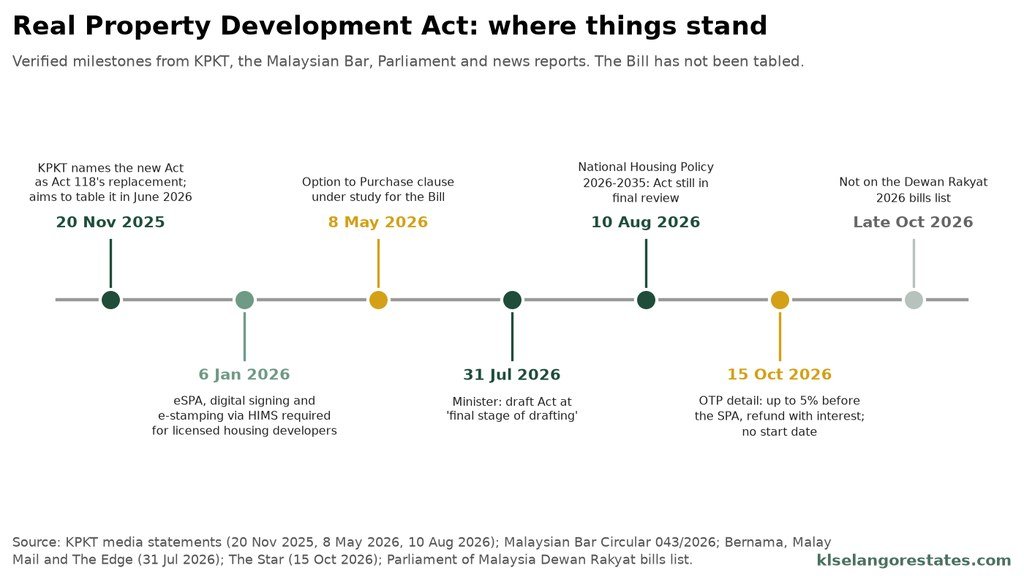
KPKT first set out the plan at its MADANI Housing Reform event on 20 November 2025. It described the Act as a “comprehensive replacement” for Act 118, and Bernama reported that the ministry expected to table the Bill in June 2026. That did not happen. On 31 July 2026 the minister, Nga Kor Ming, said the draft was “at the final stage of drafting”, and on 10 August 2026, at the launch of the National Housing Policy 2026–2035, he said it was in the final stage of review. The Dewan Rakyat’s 2026 bills list, current to bills read on 21 October 2026, does not include it.
| Item | Status at 27 Oct 2026 | What KPKT has said |
|---|---|---|
| Replace Act 118 with a new Act | Confirmed as government plan | A “comprehensive replacement” for Act 118 (20 Nov 2025) |
| Bill tabled in Parliament | Not yet | Target of June 2026 missed; draft in “final stage” (31 Jul and 10 Aug 2026) |
| Passed, gazetted, in force | No | No commencement date announced |
| Cover commercial projects | Proposed | “Certain commercial property developments”, including shop space and commercial projects |
| New models: retirement villages, rent-to-own, resi-office | Proposed | Listed by KPKT as models the Act should recognise (20 Nov 2025) |
| Option to Purchase before the SPA | Under study | Up to 5% of the price, full refund with interest if the developer does not proceed; no start date (15 Oct 2026) |
| Tougher penalties, payment and quality rules, technical audits | Under consideration | Reported by Bernama as “key proposals being considered” (20 Nov 2025) |
| Sunset clause and phased Build-Then-Sell | Policy direction only | Named in the National Housing Policy 2026–2035 (10 Aug 2026), no details |
| eSPA, digital signing and e-stamping | Already in force under Act 118 | Required for licensed housing developers from 6 Jan 2026 |
| Rules for SPAs signed before the new Act | Not announced | — |
A note on the name. KPKT’s November 2025 statement used “Akta Pemajuan Harta Tanah (Real Property Development Act)”. The August 2026 policy documents say “Akta Pemaju Harta Tanah”, and Bernama’s English report called it the “Property Development Act”. The final title will only be certain when the Bill is published.
What KPKT has said the Act is for. Its two stated aims are to widen regulation beyond housing to commercial projects, and to modernise the law to suit today’s market and land types. KPKT also said it would recognise newer models such as leasehold retirement villages, rent-to-own schemes and “resi-office” mixed-use projects. The full text, including section numbers, penalties and transition rules, has not been released.
What Act 118 already gives you today
These protections apply now, to housing projects by licensed housing developers in Peninsular Malaysia. They are worth knowing well, because they are what you can rely on if a project goes wrong.
1. A licence and an advertising permit you can check. Licensed developers must hold both. KPKT’s TEDUH portal (teduh.kpkt.gov.my) lets you check them for free, along with the project’s progress and KPKT’s lists of late, sick and abandoned projects.
2. A statutory SPA. Housing developments must use the prescribed SPA: Schedule G for landed homes and Schedule H for strata homes such as condos. The developer cannot rewrite these terms against you. In Ang Ming Lee (2019), the Federal Court held that the Housing Controller had no power to waive or modify Schedule H terms, including by granting a developer an extension of time to deliver.
3. Progress billing into a Housing Development Account. Under Schedule H you pay 10% when you sign, then instalments as each construction stage is completed and certified. The money goes into the project’s Housing Development Account (HDA), which is regulated under the Act. Part of the price is held by the developer’s lawyers as stakeholder until 8 months and 24 months after you get vacant possession, as security for defects. Since the 2015 amendments to the regulations, no one, including stakeholders, may collect any payment before the SPA except as the contract allows.
4. A fixed delivery date and LAD. Schedule H requires vacant possession within 36 calendar months of the SPA date. If the developer is late, it must pay liquidated damages (LAD) at 10% a year of the purchase price, calculated day by day. In PJD Regency (2021), the Federal Court held that LAD runs from the date you first paid money towards the purchase, not from the SPA date.
5. A 24-month defects period. Defects that appear within 24 months of vacant possession must be repaired by the developer at its own cost within 30 days of your written notice. If it does not, the SPA sets out how you can recover the cost, with the stakeholder sum as security.
6. The Tribunal for Homebuyer Claims. KPKT’s Tribunal for Homebuyer Claims (TTPR) is now part of the Housing and Strata Management Tribunal (TPPS). According to KPKT:
| Tribunal point | What KPKT says |
|---|---|
| Maximum claim | RM50,000 per claim, unless you and the developer agree in writing to a higher amount |
| Filing fee | RM10 |
| LAD and other SPA claims | File within 12 months of the CCC |
| Defect claims | File within 12 months after the defects liability period ends |
| SPA ended before the CCC | File within 12 months of termination |
| Not covered | Abandoned projects, negligence, fraud by an estate agent, design faults, CCC validity disputes, commercial buildings |
KPKT’s LAD formula is days late × purchase price × 10% ÷ 365. On an illustrative RM600,000 condo delivered 90 days late, that is 90 × RM600,000 × 10% ÷ 365 = RM14,794.52, which is within the Tribunal’s limit.
7. eSPA. Since 6 January 2026, licensed housing developers have had to use the electronic SPA, signed digitally and e-stamped through KPKT’s Housing Integrated Management System (HIMS), according to a Malaysian Bar circular. This is already in force under Act 118 and does not depend on the new Act.
Why KPKT says a new law is needed
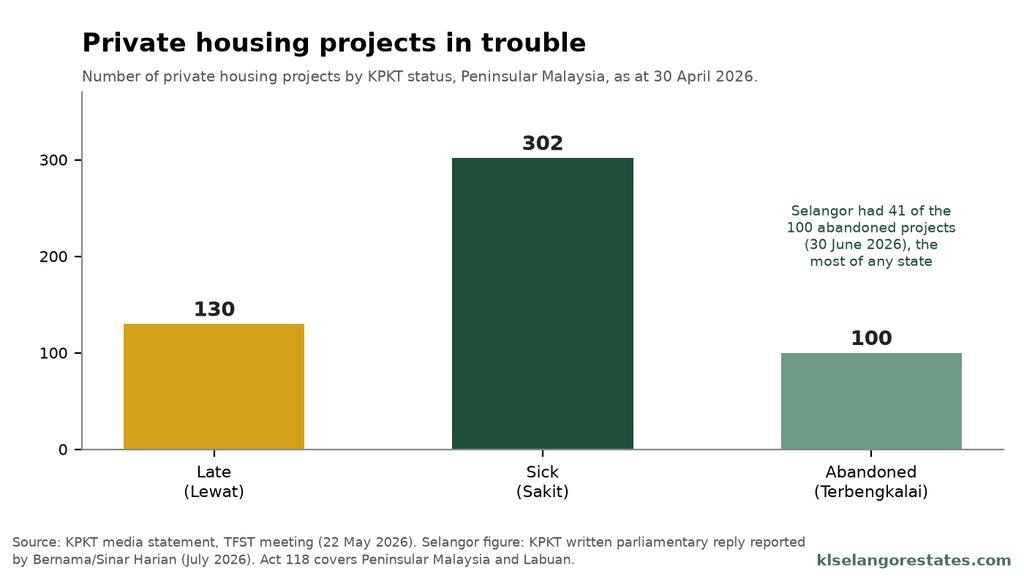
- Problem projects. At 30 April 2026, KPKT counted 130 late, 302 sick and 100 abandoned private housing projects in Peninsular Malaysia. By 30 June 2026, the 100 abandoned projects involved 27,998 homes and 14,961 buyers.
- Selangor tops the abandoned list, with 41 of the 100 abandoned projects at 30 June 2026, according to KPKT’s written reply to Parliament.
- Rescues are rising. KPKT’s task force had revived 1,726 sick and abandoned projects worth more than RM158 billion by the end of August 2026, the minister said in October. Its target is zero abandoned projects by 2030.
- The commercial gap. Act 118 does not cover commercial projects such as shop lots and offices, the minister said in August 2025, as reported by The Edge. KPKT says the new Act would close part of that gap.

The tribunals are busy. KPKT reported 12,883 cases registered at the TPPS in 2024, and 6,484 in the first half of 2025. These figures combine homebuyer and strata claims. In 2024, the homebuyer tribunal alone issued awards worth RM26.4 million.
What could change, and who it affects
Until the Bill is published, the points below are possibilities based on what KPKT has said, not rules.
Buyers of new launch condos in KL and Selangor. Most new launch condos sold by licensed housing developers are already under Act 118, so the biggest changes for you are likely to come at the start of the process:
- Option to Purchase (OTP). KPKT is studying a stage before the SPA in which you could pay up to 5% of the proposed price and submit your financial details for a loan assessment. If the developer does not go ahead, you would get a full refund with accrued interest, and developers would have to honour the indicative prices first offered. Earlier statements said buyers could also withdraw within a set period, paying administrative charges or interest. The minister noted that collecting payment before the SPA is currently prohibited, so this would need new legal backing. No period, charges or start date have been announced.
- Stronger oversight of payments and projects. Proposals reported so far include higher and standardised penalties for serious and repeat offences, tighter rules on payment collection, quality standards and maintenance obligations, and clearer technical audit and investigation powers to catch troubled projects earlier.
- Sunset clause and Build-Then-Sell. The National Housing Policy names both, along with a phased move to Build-Then-Sell, but gives no details of how they would work.
Buyers of serviced apartments, SoFo, SoVo, shops and offices. Units built on commercial land are generally sold on non-statutory SPAs today, so the delivery period, LAD and defects terms are whatever the contract says. KPKT says the new Act would cover “certain” commercial developments. It has not said which ones, so do not assume a serviced apartment launched today will gain Schedule H-style protection.
SoHo buyers. KPKT’s Tribunal FAQ lists SOHO among the home types the homebuyer tribunal can hear, but whether your project is under Act 118 depends on how it was licensed and sold. Ask your lawyer which SPA applies.
Existing owners and buyers. KPKT has not said whether, or how, the new Act would apply to SPAs already signed. Assume your current SPA terms continue to govern your purchase.
Checklist for new launch buyers now
- Check TEDUH. Match the developer’s company name, licence and advertising permit numbers and validity dates on TEDUH with the brochure and the SPA.
- Confirm which SPA applies. Ask whether it is a statutory Schedule G or H SPA under Act 118, or a non-statutory SPA for a unit on commercial land.
- Read the delivery and LAD clauses. For Schedule H, look for 36 months and 10% a year. Be wary of anything suggesting an extension of time.
- Pay only into the HDA named in the SPA. Keep every receipt and the date of your first payment, which can matter for LAD.
- Check the project’s progress. Compare each progress bill with what you see on site and the status on TEDUH, and check it is not on KPKT’s late or sick lists.
- Expect an eSPA. For licensed housing projects, the SPA should be signed digitally through HIMS with e-stamping. Ask your lawyer if it is not.
- Diary the deadlines. Note the 24-month defects period, give defect notices in writing, and remember the Tribunal’s 12-month filing windows.
- Buy under today’s rules. The Option to Purchase and the new Act are not law yet. Do not pay or sign on the expectation that they will protect you.
What to ask your agent and your lawyer
Ask your agent:
- Is the developer’s licence and advertising permit on TEDUH, and do the details match the brochure?
- Is this unit on residential or commercial land, and which SPA will I sign?
- How have this developer’s recent projects in KL or Selangor done on delivery, and are any on KPKT’s late or sick lists?
Ask your lawyer:
- Is this a statutory Schedule H (or G) SPA, and are any terms different from the prescribed form?
- What is the delivery date, how would LAD be calculated, and from which date?
- If the developer is late or the project stalls, what are my options through the Tribunal or the courts?
What is still not confirmed
- The Bill itself. Its final name, text, section numbers and tabling date are not public.
- Which commercial projects are covered. KPKT has said “certain” commercial developments only.
- The Option to Purchase. The size of any administrative charge, the length of the option period and the start date have not been announced.
- Sunset clause and Build-Then-Sell. Named as policy, with no details.
- Transition rules for projects already launched and SPAs already signed.
- Tribunal changes. KPKT has not announced any change to the RM50,000 limit or filing windows.
Related reading
- Selangor new launches, H1 2026: NAPIC numbers and what to check
- Serviced apartments in KL and Selangor: unsold units in 2026
- Budget 2027: first-home stamp duty and SPA timing
- Stamp duty self-assessment in Malaysia from 2027
- Urban renewal bill withdrawn: what it means for older strata in KL and Selangor
Sources
- KPKT, media statement on the five MADANI Housing Reforms, 20 Nov 2025: https://www.kpkt.gov.my/kpkt/resources/user_1/media_akhbar/2025/SM_REFORMASI_PERUMAHAN_MADANI.pdf
- Bernama, “KPKT to table Real Property Development Bill in June 2026”, 20 Nov 2025: https://www.bernama.com/en/news.php?id=2493079
- Malaysian Bar, Circular No 043/2026 on eSPA and e-stamping via HIMS: https://www.malaysianbar.org.my/cms/upload_files/document/Circular%20No%20043-2026.pdf
- KPKT, press release on the Option to Purchase mechanism, 8 May 2026: https://www.kpkt.gov.my/kpkt/resources/user%5F1/media%5Fakhbar/2026/SM%5FKPKT%5FTO%5FINTRODUCE%5FOPTION%5FTO%5FPURCHASE%5FMECHANISM%2C%5FALLOWING%5FPRE-SPA%5FWITHDRAWAL%5FFLEXIBILITY.pdf
- KPKT, media statement on the task force for sick and abandoned projects, 22 May 2026: https://www.kpkt.gov.my/kpkt/resources/user_1/media_akhbar/2026/SM_MOMENTUM_PEMULIHAN_TFST_TERUS_KUKUH_KPKT_TEKAD_REALISASI_SASARAN_SIFAR_PROJEK_TERBENGKALAI_MENJELANG_2030.pdf
- Sinar Harian, “303 projek perumahan sakit bernilai RM40.25 bilion setakat Jun – KPKT”, July 2026: https://www.sinarharian.com.my/article/789911/berita/nasional/303-projek-perumahan-sakit-bernilai-rm4025-bilion-setakat-jun—kpkt
- Malay Mail, “Nga Kor Ming: Draft Real Property Development Act in final stage”, 31 Jul 2026: https://www.malaymail.com/news/malaysia/2026/07/31/nga-kor-ming-draft-real-property-development-act-in-final-stage-as-part-of-housing-reforms/229705
- The Edge, report on the draft Act in final stage, 31 Jul 2026: https://theedgemalaysia.com/node/812822
- KPKT, media statement on the launch of the National Housing Policy 2026–2035, 10 Aug 2026: https://www.kpkt.gov.my/kpkt/resources/user_1/media_akhbar/2026/SM_10082026_KPKT_LUNCUR_DASAR_PERUMAHAN_NEGARA_2026-2035.pdf
- Bernama, National Housing Policy launch reports, 10 Aug 2026: https://www.bernama.com/en/news.php?id=2592582 and https://www.bernama.com/bm/am/news.php?id=2592613
- The Star, “Nga: Proposed OTP to protect homebuyers”, 15 Oct 2026: https://www.thestar.com.my/news/nation/2026/10/15/nga-proposed-otp-to-protect-homebuyers
- Parliament of Malaysia, Dewan Rakyat bills 2026: https://www.parlimen.gov.my/bills-dewan-rakyat.html?uweb=dr&lang=en
- The Edge, “Housing Development Act to be amended to cover sick commercial projects”, 18 Aug 2025: https://theedgemalaysia.com/node/766928
- KPKT, FAQ on the Tribunal for Homebuyer Claims: https://www.kpkt.gov.my/index.php/pages/view/292
- KPKT, media statement on TPPS caseload, 9 Jul 2025: https://www.kpkt.gov.my/kpkt/resources/user_1/media_akhbar/2025/SM_KPKT_TERUS_MEMPERKUKUH_PERKHIDMATAN__TPPS_NEGARA,_PERTINGKATKAN_KECEKAPAN_PENGENDALIAN_KES.pdf
- Housing Development (Control and Licensing) Regulations, Schedule H (2002 text, via National House Buyers Association): https://hba.org.my/laws/housing_reg/2002/Schedule_H.pdf
- Johore Bar, Housing Development (Control and Licensing) (Amendment) Regulations 2015: https://johorebar.org.my/wp-content/uploads/2016/05/Housing-Development-Control-and-Licensing-Amendment-Regulations-20151.pdf
- Kuek, Ong & Associates, note on the Schedule H defects liability clause: https://www.kuekong.com/?p=3074
- Federal Court, media summary, PJD Regency Sdn Bhd v Tribunal Tuntutan Pembeli Rumah & Anor (2021): https://www.kehakiman.gov.my/sites/default/files/documents/Ringkasan_Media/2021/Re%20PJD%20Regency%20Sdn%20Bhd%20and%20Tribunal%20Tuntutan%20Pembeli%20Rumah%20%26%20Anor%20and%20other%20appeals.pdf
- Zul Rafique & Partners, judgment in Ang Ming Lee & Ors v Menteri Kesejahteraan Bandar, Perumahan dan Kerajaan Tempatan & Anor (2019): https://zulrafique.com.my/ckfinder/userfiles/files/case%20update%20judgment/Ang%20Ming%20Lee%20%20%2034%20Ors%20v%20Menteri%20Kesejahteraan%20Bandar%2C%20Perumahan%20%20%20Kerajaan%20Tempatan%20%20%20Anor.pdf
- KPKT, TEDUH licence and permit check: https://teduh.kpkt.gov.my/semakan-lesen-permit
About the author
Jessica Leong | Registered Estate Agent E3208
PropNex Realty Sdn Bhd (E (1) 1800/1), KLCC branch. Jessica covers new launch condos in Kuala Lumpur and Petaling Jaya, industrial property in Selangor, bank auction (lelong) properties, and PJ/Selangor offices, shophouses and en-bloc deals. See her new launch pages for Kuala Lumpur, KLCC, Petaling Jaya and Selangor.
PropNex Realty Sdn Bhd, A-G-03, Marc Residence, No. 3, Jalan Pinang, 50400 Kuala Lumpur
Office: 03-2161 8608 · Call/WhatsApp: 010-464 6088
Website: klselangorestates.com
This article is general information based on public sources as at 27 October 2026. It is not legal, tax or financial advice. The Real Property Development Act has not been tabled, and its final contents may differ from what is described here. Please consult your own lawyer before signing any sale and purchase agreement.