Malaysia's Urban Renewal Bill on Hold: What It Means for Older Flats, Strata and En-Bloc Deals in KL and Selangor
The Cabinet pulled the Bill on 23 January 2026 for a rewrite. Here is what it proposed, why it stalled, what the law says today without it, and what owners and investors should watch next.
Originally published on Medium: read it on Medium
If you own a unit in an older flat or strata block in Kuala Lumpur, Petaling Jaya or elsewhere in Selangor, you have probably heard about the Urban Renewal Bill. Some owners hoped it would finally unlock redevelopment of tired buildings. Others feared it would let a developer take their home with only 75% or 80% of their neighbours' agreement.
On 23 January 2026, the Cabinet decided to withdraw the Bill so it could be improved and redrafted. Nine months on, no new version has been tabled.
This article explains what the Bill actually said, why it stalled, what the law is today without it, and what it means for owners and for anyone looking at en-bloc or redevelopment deals.
Not legal advice: this is general information from public sources as at October 2026. It is not legal, tax or financial advice. Please speak to your own lawyer before you sign anything relating to a redevelopment or en-bloc proposal.
What the Bill proposed
The Urban Renewal Bill 2025 (D.R. 25/2025) was tabled for its first reading in the Dewan Rakyat on 21 August 2025 by the Housing and Local Government Minister, Nga Kor Ming. It was drafted to apply to Peninsular Malaysia and the Federal Territory of Labuan, and it excluded heritage sites under the National Heritage Act 2005.
In outline, the Bill would have:
- Created a Federal Executive Committee and a State Executive Committee for urban renewal. The federal committee was to be chaired by the Minister, and each state committee by the Menteri Besar or Chief Minister.
- Covered three kinds of project: urban redevelopment (demolishing and rebuilding), urban regeneration (repairing and upgrading) and urban revitalisation (upgrading, beautifying or changing the function of an area).
- Allowed an area to be declared an "urban renewal area" by gazette: by the Minister of Federal Territories for KL, Putrajaya and Labuan, and by the State Authority in the states.
- Let an "approved developer" carry out the project, chosen from a register of qualifying developers.
- Required the developer to start within 24 months of the declaration, unless the committee extended the period.
The consent thresholds
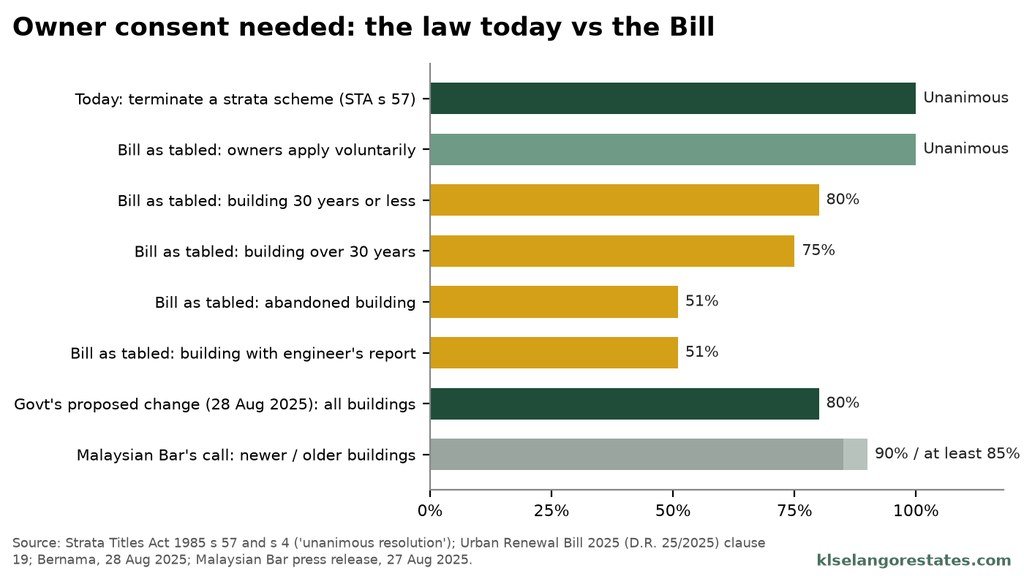
The most debated part was clause 19. It set how many owners had to agree before a project could go ahead:
- Owners applying voluntarily for a project: unanimous consent
- Committee-led project, building 30 years old or less: 80%
- Committee-led project, building more than 30 years old: 75%
- Committee-led project, abandoned building: 51%
- Committee-led project, building with a visual inspection report by a Professional Engineer: 51%
("Committee-led" means a project carried out by the federal or state executive committee.)
A building's age was to be counted from the date of its certificate of fitness for occupation or certificate of completion and compliance.
The clause owners worried about most
Clause 21(4) said that once an area was declared, the approved developer "shall transfer or acquire any alienated land" in the area "by purchase or compulsory acquisition under the Land Acquisition Act 1960", subject to the consent threshold.
In plain terms, once the threshold was reached, owners who still said no could face compulsory acquisition.
Protections in the Bill
For owners who agreed to participate, clause 24 required the committees to ensure that they:
- received an offer of benefit "not less favourable" than what they had before,
- were offered the chance to remain in the urban renewal area, and
- were kept informed of progress on request.
Disputes were to go to federal and state mediation committees. The Bill did not set up a tribunal.
What changed before it stalled
On 28 August 2025, the Minister moved the second reading and announced two changes, following a special session with the Parliamentary Special Select Committee on Infrastructure, Transport and Communications:
- Clause 19 would be amended so the consent threshold is 80% for all buildings, regardless of age. Setting the threshold at 80% regardless of building age "is still a reasonable level that balances redevelopment needs with the rights of the remaining 20% of owners", he said (The Edge).
- Clause 18 would be amended so that demographic information about affected areas is considered, to prevent sudden changes in community composition (The Edge).
The Bill was not debated that day and was deferred to the next meeting.
Two further points came out in the following months:
- No en-bloc sales. On 28 November 2025, PLANMalaysia's deputy director-general (Development), Saidin Lateh, said the government "will not implement en-bloc sales". He explained that in other countries a tender opens once 80% or 90% of residents agree and owners move out with compensation. Malaysia would instead use 80% consent "to begin consultations" and guarantee that owners can return to the same area. He said owners would receive replacement units at no cost, with relocation, temporary rental and early maintenance costs covered by the developer. Those who chose to move elsewhere would receive cash compensation based on market value. He also said government-linked companies, UDA Holdings and MARA would be prioritised as developers (Bernama).
- Still not debated. The Bill was listed on the Order Paper, but the Dewan Rakyat adjourned on 4 December 2025 without debating it (The Star).
Why it was withdrawn
On 23 January 2026, the government spokesman and Communications Minister, Fahmi Fadzil, said the Cabinet had agreed "to withdraw the Urban Renewal Bill to allow for amendments and enhancements". The redrafted Bill would be "retabled in Parliament in the form of a new bill" (Bernama).
He said the decision took into account views from MPs in the Dewan Rakyat and feedback from Umno and other Cabinet members. He added that the Attorney-General's Chambers would draft the new law, which would take some time. The same day, KPKT said it would continue engagement with residents, academics, elected representatives and industry experts so that "the rights of original owners" are guaranteed more comprehensively.
The concerns that led there came from across the spectrum:
- The Malaysian Bar (27 August 2025) said the thresholds were "set too low". It urged at least 85% for older buildings and 90% for newer ones, with independent verification of consent. It called it "illogical to allow compulsory acquisition to proceed merely on the basis that the developer has secured the consent threshold". It also wanted protection for non-participating owners and tenants, and a tribunal rather than mediation alone.
- Residents' and buyers' groups, including the National House Buyers Association (HBA) and KL residents' associations, called for the Bill to be withdrawn. They proposed safeguards including a consent threshold of at least 95–100%, strictly limited land acquisition powers and compensation above market value (Malay Mail, 25 August 2025).
- Government MPs. Petaling Jaya MP Lee Chean Chung (PKR) listed three concerns: the different consent thresholds, the extent of ministerial authority in declaring projects, and the need for more room for resident-initiated renewal. Umno's task force head, Titiwangsa MP Johari Ghani, said "legislation must never come at the expense of the people" (The Star, 28 September 2025).
- Opposition MPs raised forced acquisition, the protection of Malay Reserve and waqf land, the fate of lower-income tenants, and the risk that gentrification would push original residents to the outskirts (The Star).
- Professional and civil society groups. Nine organisations, including the Royal Institution of Surveyors Malaysia and the Malaysian Institute of Property and Facility Managers, called for withdrawal and fresh consultations (The Star).
For its part, the government has defended the Bill's aims. The Minister said Malay Reserve land, customary land and heritage buildings are not involved (Bernama, 1 September 2025). PLANMalaysia's FAQ says the Bill does not seize people's property and that owners would receive terms "no less favourable" than before.
Where things stand now (October 2026)
- No new Bill has been tabled. In a written parliamentary reply on 20 October 2026, the Minister said the Bill is meant to complement existing laws on dilapidated and abandoned buildings. Replacement properties would be valued taking into account the developer's projected profits, as regulated and agreed by the government (The Edge; The Star).
- The Bill is still on the order paper. The Edge reported on 21 October 2026 that the Bill "has yet to be formally withdrawn from Parliament and remains on the order paper". In practice, the Cabinet has decided to replace it, but the procedural withdrawal has not happened yet.

The law today, without the Bill
With no Urban Renewal Act in force, redevelopment of an occupied building still runs through the existing laws.
1. Ending a strata scheme needs a unanimous resolution
Under section 57 of the Strata Titles Act 1985, a management corporation may be directed to terminate the subdivision of a building when:
- the building is totally destroyed,
- the parcel owners seek to demolish it, or
- there is only one proprietor for all the parcels.
The direction must come by unanimous resolution. The Act defines this as a resolution passed at a properly convened general meeting, with at least 21 days' notice of the proposed resolution, "against which no vote is cast".
There is one safety valve. Under section 57(7), a court may order the management corporation to act "notwithstanding the absence of a unanimous resolution", if it is satisfied that "the justice of the case so requires". The court can also stop a termination.
PLANMalaysia's own FAQ confirms the position: for terminating a strata scheme in Malaysia, the 100% consent in the Strata Titles Act remains.
2. Compulsory acquisition is a State power, with compensation
Under section 3(1) of the Land Acquisition Act 1960, the State Authority may acquire land that is needed:
- for any public purpose,
- by any person or corporation for a purpose which, in the State Authority's opinion, benefits Malaysia's economic development or the public, or
- for mining, residential, agricultural, commercial, industrial or recreational purposes.
Article 13 of the Federal Constitution requires adequate compensation for compulsory acquisition. PLANMalaysia notes that compensation under the Act is based on current value, assessed by the Valuation and Property Services Department (JPPH). Owners who disagree can go to court.
The Minister's October 2026 reply noted that amendments to the Land Acquisition Act in force since 2017 provide procedures for acquiring subdivided land or buildings. He added that the Strata Titles Act, amended in 2016, also provides a mechanism for dilapidated or abandoned strata schemes, but that it is limited to strata schemes (The Star).
3. Local guidelines exist, but they are not the Bill
PLANMalaysia's FAQ notes that DBKL's 2023 guideline on redevelopment incentives in Kuala Lumpur used a minimum participation threshold of 51%. It also says a redevelopment in Kampung Sungai Baru began when consent reached 66%.
These guidelines govern incentives and planning in KL. They do not change the unanimity rule for terminating a strata scheme.
What it means for owners of older flats and strata in KL, PJ and Selangor
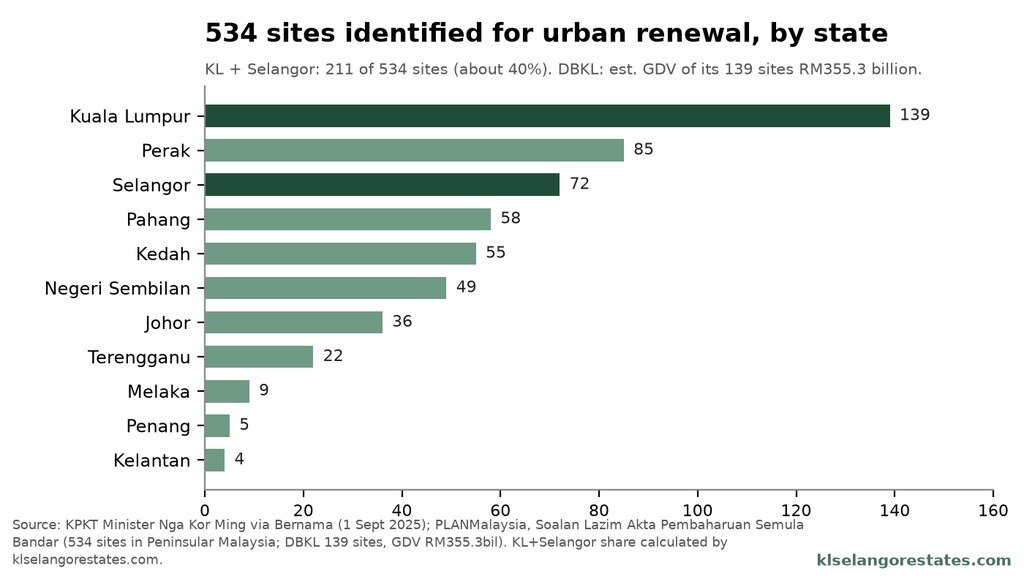
The numbers show why this matters here. According to the Minister, 534 sites in Peninsular Malaysia have been identified for urban renewal by state governments: 139 in Kuala Lumpur and 72 in Selangor, or about 40% of the total between them. PLANMalaysia says DBKL's 139 sites have an estimated gross development value of RM355.3 billion.
For an individual owner today, the practical points are:
- Nobody can force a strata termination on you by majority vote today. The Strata Titles Act still needs a unanimous resolution, unless a court orders otherwise.
- Developer offers are private deals. Any approach you receive now is a commercial offer to buy your unit or to join a redevelopment. It is not an exercise of powers under the Bill, because the Bill is not law. Take your time, get the terms in writing and have your own lawyer read them.
- Compulsory acquisition remains possible under the Land Acquisition Act, through the State Authority and with compensation. That has always been the case, Bill or no Bill.
- Maintenance still matters. Under section 85A of the Street, Drainage and Building Act 1974, PLANMalaysia notes, a periodic inspection is required 10 years after the CCC or CFO and every 10 years after that. A well-run management corporation protects your building's value whatever happens to the Bill.
- Paperwork can be the real obstacle. PLANMalaysia estimates that 20% to 25% of owners in older buildings face title issues: charged titles or non-performing loans, strata titles not yet issued, multiple owners or unresolved estates, owners who cannot be traced, and caveats. If you want your building to have options later, sort out your own title now.
What it means for en-bloc and redevelopment deals
For investors and developers, especially in older commercial blocks, shophouse rows and older strata in KL and PJ, the withdrawal changes the timeline more than the method.
- Unanimity is the planning assumption. A collective sale of a strata building still means either buying every unit, or getting a unanimous resolution to terminate the scheme, or obtaining a court order under section 57(7). Price a deal on the basis that the last owners have strong bargaining power.
- Don't price in the Bill. There is no gazetted law, no final threshold and no confirmed compulsory acquisition clause. Any deal model that assumes 75% or 80% consent is speculative.
- The redraft may not favour classic en-bloc. The government's stated approach, as described by PLANMalaysia in November 2025, is "return-to-same-area" redevelopment, not Singapore-style collective sales. It also prioritises government-linked developers. Private en-bloc buyers should not assume a new Act will help them.
- Valuation will be contested. The Minister's latest reply says replacement units would be valued taking into account the developer's projected profits. Owners will use that benchmark in negotiations even before any law is passed.
- Due diligence takes longer in old buildings. Title searches, caveats, charges, estates, unissued strata titles and management corporation records all take time. Build that into your programme.
- Watch the zoning. Sites identified for urban renewal sit within development plans. The local plan and any special area plan decide density and plot ratio, which drive the economics of any redevelopment.
What to watch next
- The new Bill's text. Will the threshold stay at 80%, rise, or vary by building condition?
- Compulsory acquisition. Will the redraft keep a clause like 21(4), and on what terms?
- Protection for non-participating owners and tenants. Will the "no less favourable" guarantee extend to everyone, as the Malaysian Bar urged?
- Who verifies consent. Will it be the State, an independent body or the developer?
- Valuation rules. How will replacement units and cash compensation be valued?
- Dispute resolution. Will there be a tribunal, or mediation only?
- State action. Watch how KL and Selangor move on the sites they have identified, through local plans and guidelines.
- Formal withdrawal and retabling. Watch the Dewan Rakyat Order Paper.
Practical checklist for owners and investors
If you own a unit in an older building
- Check that your strata title has been issued and is in your name. Resolve any estate, caveat or charge issues.
- Keep copies of your SPA, title and recent bills, and track your management corporation's accounts and inspection reports.
- Attend general meetings. A termination resolution needs 21 days' notice, so read every notice carefully.
- If a developer approaches you, do not sign under pressure. Ask for written terms on the replacement unit's size and location, temporary accommodation, who pays which costs, and what happens if the project stalls.
- Get independent legal advice and, where needed, your own valuation.
If you are looking at an en-bloc or redevelopment deal
- Model the deal on 100% acquisition or a unanimous resolution, not on a proposed threshold.
- Run title searches on every unit early, and budget for untraceable owners and estates.
- Check the development plan, zoning and plot ratio with the local authority.
- Keep any agreement with owners conditional on approvals and on reaching full ownership.
- Monitor the redrafted Bill, and stress-test your plan if it changes consent, compensation or developer selection.
Sources
- Urban Renewal Bill 2025 (D.R. 25/2025), full text: https://www.cljlaw.com/files/bills/pdf/2025/MY_FS_BIL_2025_25.pdf
- Parliament of Malaysia, Dewan Rakyat bills list: https://www.parlimen.gov.my/bills-dewan-rakyat.html?uweb=dr&lang=en
- KPKT media statement, "KPKT sedia menambah baik RUU PSB..." (23 January 2026): https://www.kpkt.gov.my/kpkt/resources/user_1/media_akhbar/2026/SM_KPKT__SEDIA_MENAMBAH_BAIK_RUU_PSB_BAGI_MEMASTIKAN_HAK_PEMILIK_ASAL_TERJAMIN_SECARA_LEBIH_MENYELURU.pdf
- PLANMalaysia, Soalan Lazim Akta Pembaharuan Semula Bandar: https://www.planmalaysia.gov.my/main/faq/soalan-lazim-akta-pembaharuan-semula-bandar
- Strata Titles Act 1985, section 57 (official text via mylaw.my): https://mylaw.my/legislation/strata-titles-act-1985/section-57
- Land Acquisition Act 1960, section 3 (official text via mylaw.my): https://mylaw.my/legislation/land-acquisition-act-1960/section-3
- Malaysian Bar, "Malaysian Bar's Position on the Urban Renewal Bill 2025" (27 August 2025): https://www.malaysianbar.org.my/article/news/press-statements/press-statements/press-release-malaysian-bar-s-position-on-the-urban-renewal-bill-2025
- Malay Mail, "Urban Renewal Bill 2025 tabled for first reading" (21 August 2025): https://www.malaymail.com/news/malaysia/2025/08/21/urban-renewal-bill-2025-tabled-for-first-reading/188473
- Malay Mail, "Residents, rights groups: URA Bill may displace Malaysians..." (25 August 2025): https://www.malaymail.com/news/malaysia/2025/08/25/residents-rights-groups-ura-bill-may-displace-malaysians-divide-communities-and-enrich-developers/188840
- Bernama, "Urban Renewal Bill: KPKT to amend provisions, including consent threshold" (28 August 2025): https://www.bernama.com/en/news.php?id=2461730
- The Edge Malaysia, "Urban Renewal Bill: Govt to raise consent threshold to 80% for all projects..." (August 2025): https://theedgemalaysia.com/node/768606
- Bernama, "Kerajaan Negeri Warta 534 Tapak Pembaharuan Semula Bandar - Nga" (1 September 2025): https://www.bernama.com/bm/news.php?id=2462762
- The Star, "Don't rush Urban Renewal Bill through Parliament in Oct, urge MPs" (28 September 2025): https://www.thestar.com.my/news/nation/2025/09/28/don039t-rush-urban-renewal-bill-through-parliament-in-oct-urge-mps
- Bernama, "Govt rejects en-bloc model, urban renewal to rely on owners' consent – PLANMalaysia" (28 November 2025): https://www.bernama.com/en/news.php?id=2496633
- The Star, "Urban Renewal Bill not debated" (5 December 2025): https://www.thestar.com.my/news/nation/2025/12/05/urban-renewal-bill-not-debated
- Bernama, "KPKT to continue engagement to improve Urban Renewal Bill - Nga" (23 January 2026): https://www.bernama.com/en/news.php?id=2516110
- NST, "Cabinet withdrawal allows improvements to Urban Renewal Bill, says Nga" (23 January 2026): https://www.nst.com.my/news/nation/2026/01/1363149/cabinet-withdrawal-allows-improvements-urban-renewal-bill-says-nga
- Malay Mail, "Fahmi: Putrajaya pulls Urban Renewal Bill..." (23 January 2026): https://www.malaymail.com/news/malaysia/2026/01/23/fahmi-putrajaya-pulls-urban-renewal-bill-to-make-room-for-fresh-input-after-mp-feedback/206517
- The Edge Malaysia, "Urban Renewal Bill to factor in developers' projected profits in valuing replacement properties" (21 October 2026): https://theedgemalaysia.com/node/822601
- The Star, "Nga: Urban Renewal Bill to complement existing laws" (22 October 2026): https://www.thestar.com.my/news/nation/2026/10/22/nga-urban-renewal-bill-to-complement-existing-laws
About the author
Jessica Leong is a Registered Estate Agent (E3208) with PropNex Realty Sdn Bhd (E (1) 1800/1), KLCC branch. She covers new launch condos in Kuala Lumpur and Petaling Jaya, industrial property in Selangor, bank auction (lelong) properties, and PJ/Selangor offices, shophouses and en-bloc deals.
PropNex Realty Sdn Bhd, A-G-03, Marc Residence, No. 3, Jalan Pinang, 50400 Kuala Lumpur
Office: 03-2161 8608 · Call/WhatsApp: 010-464 6088
Website: klselangorestates.com
This article is general information based on public sources as at 23 October 2026. It is not legal, tax or financial advice. The Urban Renewal Bill has not been passed and its contents may change. Please consult your own lawyer before acting on any redevelopment or en-bloc proposal.