Kuala Lumpur Assessment Tax: A DBKL Owner’s Checklist Heading into 2027
How to read annual value and property categories, check an electronic bill, and choose the right route for a valuation dispute, account correction or vacancy-related application.
Also on Medium: read it on Medium
A property’s asking price attracts attention. Its assessment-tax account usually does not—until a bill changes, a payment goes missing or a sale brings an old balance into view.
For Kuala Lumpur owners, a useful starting point is DBKL’s own assessment record, not a general Klang Valley tax percentage. A residential building, a serviced apartment and a commercial unit can be treated differently. A paid maintenance statement does not settle the council account. An empty unit does not automatically become exempt.
This guide is specifically about Kuala Lumpur and Dewan Bandaraya Kuala Lumpur (DBKL). It does not import Selangor’s revaluation limitations or council-specific phasing into the capital.
In the official material reviewed for this article, I have not verified a separate general DBKL assessment-tax increase for 2027. That is a limited research finding, not proof that no further announcement exists or will be made. The practical task now is to understand the published framework, reconcile the current account and read any new notice on its own terms.
The short version
- Cukai taksiran, or cukai pintu, is assessment tax administered by DBKL. It is separate from land or parcel rent and from strata-management charges.
- DBKL’s published formula is annual value × applicable percentage rate. Annual value for buildings is an estimated gross annual rental measure, not the sale price or mortgage balance.
- DBKL’s FAQ distinguishes property categories and, for some categories, locations inside and outside its stated 36-square-mile area. Do not choose a category or zone from an advertisement.
- DBKL’s July 2026 reminder says physical assessment bills are no longer sent. Owners should check electronically rather than wait for the post.
- A valuation objection, a payment/account correction and a relief application are different tasks. Start with the right documents and department.
- No general 2027 deadline calendar or guaranteed future bill is asserted here. Your operative notice and current bill matter.
1. Establish that this is a DBKL account
Start with the property address, assessment account number and issuing authority. Keep a separate record for each property or account. “Kuala Lumpur” in a mailing address is not a sufficient check of the local authority that administers a particular property.
The DBKL Valuation and Property Management Department page, checked 8 November 2026, explains that assessment supports municipal services, maintenance and development in Kuala Lumpur. Its FAQ is the principal operational source for the calculation and category examples in this article. The FAQ itself has no clear publication or revision date, so the figures below are identified as DBKL’s published guidance at the time checked, not a newly gazetted 2027 schedule.
Kuala Lumpur also has a distinct legal setting. DBKL’s legislation directory, checked 8 November 2026, lists the Federal Capital Act 1960 (Act 190), City of Kuala Lumpur Act 1971 (Act 59) and Local Government Act 1976 (Act 171), among other legislation. DBKL’s assessment FAQ expressly refers to Act 171 for valuation-list amendments and objections.
The Federal Territory should not be described as operating under Selangor’s state-government decisions. In the officially hosted Act 171 reprint, text as at 1 December 2012, the definition of “State Authority” has a separate Federal Territory limb referring to the minister responsible for local government. This explains why state terminology in a statute cannot simply be read as “Selangor” for a Kuala Lumpur property. The reprint is not presented here as a verified consolidated 2026 edition.
For an owner, the immediate lesson is straightforward: use DBKL’s documents for the assessment account and seek legal advice on a contested statutory procedure rather than borrow another council’s rules.
2. Keep assessment, land revenue and maintenance separate
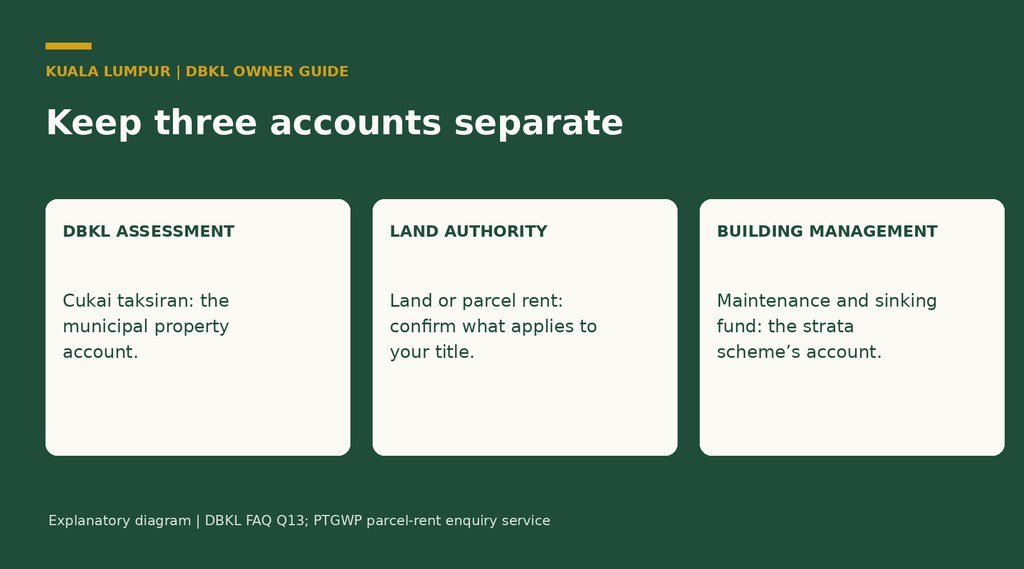
Three records can exist alongside each other without representing the same charge.
Assessment tax concerns the DBKL rateable-property account. Quit rent, or cukai tanah, and parcel rent, or cukai petak, concern land administration. Maintenance charges and sinking-fund contributions concern the management of a strata scheme and its common property.
DBKL’s assessment FAQ, question 13, explicitly distinguishes assessment from building-maintenance charges: the latter maintain common property, whereas assessment supports municipal services and infrastructure.
For land or parcel-rent enquiries, use the Federal Territories land authority, not the DBKL assessment account. Its public Kuala Lumpur parcel-rent enquiry page, checked 8 November 2026, is a separate official service. The appropriate land-revenue arrangement depends on title status; ask the land office or your conveyancing solicitor which account applies rather than assume every strata building has identical arrangements.
For a condominium or strata office, retain distinct receipts for the council account, the applicable land-revenue account and management charges. If a management office collects money on an owner’s behalf, ask what it covers and obtain evidence of payment to the relevant account. A maintenance statement marked “paid” is not, by itself, proof that the assessment bill has been settled.
3. Read annual value before looking at the percentage
DBKL defines a building’s Nilai Tahunan, or annual value, as the reasonable estimated gross annual rent it could obtain. The same rental-based approach applies to owner-occupied property. Living in your own home does not, on its own, remove its rental value for assessment purposes.
This is not the amount you paid for the property, its advertised sale price or the bank’s security valuation. It is also not necessarily the rent in one particular tenancy agreement. A discounted tenancy, a short vacancy or an unusually favourable letting does not by itself establish that the assessment figure is wrong.
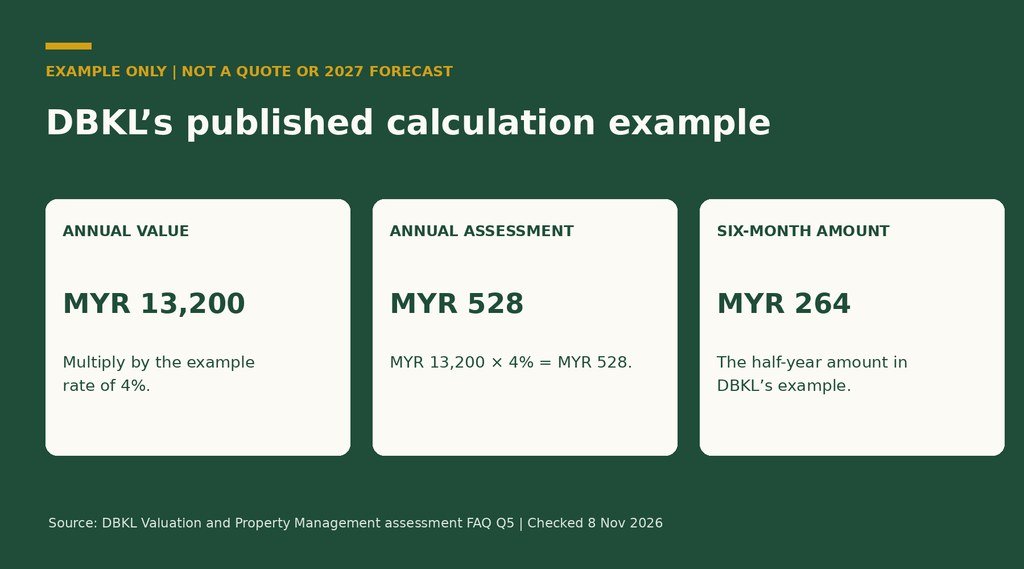
DBKL’s own published worked example, FAQ question 5, is:
- Annual value: MYR 13,200.
- Example rate: 4%.
- Annual assessment: MYR 13,200 × 4% = MYR 528.
- Six-month amount in the example: MYR 264.
These are DBKL’s example figures, not a valuation or tax quotation for a particular unit. An actual account can also contain credits, arrears, approved adjustments or other entries. Check the statement, not just the base calculation.
For vacant land, DBKL’s FAQ describes annual value as 10% of the land’s market value. This is a step in the valuation basis, not a statement that annual assessment is 10% of the land’s sale price. Obtain the applicable land classification and rate separately.
4. Why two KL properties may have different bills
DBKL’s published FAQ separates residential buildings, serviced apartments and commercial buildings. It also labels columns for inside and outside 36 square miles.
As published when checked:
- Residential buildings are listed at 4% in both columns.
- Serviced apartments are listed at 7% inside and 5% outside.
- Commercial buildings are listed at 10% inside and 8% outside.
- Low-cost flats are listed at 2% in both columns.
These are selected categories from the official DBKL FAQ, question 2, not a complete rate schedule or an assurance of future treatment. The FAQ also lists vacant-land and village categories. Do not apply a building rate to an empty lot without checking its own classification.
The serviced-apartment distinction deserves particular attention. A unit marketed as a “home” should not automatically be budgeted at the FAQ’s ordinary residential-building rate. Equally, an owner should not decide that a higher percentage must apply merely because a development is mixed-use. Ask DBKL to confirm the category actually recorded for the holding.
The geographic distinction is also an administrative fact to establish, not a distance to estimate from the city centre. This article does not map the 36-square-mile boundary or identify any specific building as inside or outside it.
DBKL separately identifies floor area, position—such as an end unit—and use as reasons bills can differ between neighbours. Compare like with like: the same period, category, relevant location and account adjustments. A neighbour’s smaller bill is a reason to investigate, not proof of an error.
For industrial or specialised property, do not invent a rate from the selected categories above. Obtain DBKL’s actual classification and assessment details, and use a registered valuer where the valuation issues require specialist help.
5. A changed bill is not always a new citywide policy
DBKL’s FAQ says annual value remains until revaluation, subject to amendments to the valuation list under section 144 of Act 171. It lists reasons including new buildings, alterations or additions, demolition, new titles, planning-related changes affecting value and corrections to an existing assessment.
That means a particular property can receive an amendment without a general announcement changing every owner’s rate. Keep the valuation-list notice, effective date and bill together. Ask what changed: annual value, percentage, classification, the period assessed or the account balance.
A general revaluation and an amendment affecting a specific holding are different processes. The Act 171 reprint, sections 142–144, distinguishes objections to a valuation list from amendments. DBKL’s FAQ also addresses amendments expressly.
Do not turn an online discussion about another council into evidence of a Kuala Lumpur change. This review has not established a new general DBKL 2027 increase, a universal cap or a guaranteed freeze. If a new announcement is issued, read its commencement date, affected categories and operative documents before changing the budget for your property.
6. Electronic bills: do not wait for an envelope
In its payment reminder published 29 July 2026, DBKL says it no longer sends physical assessment bills and advises owners to check online.
The reminder concerned the second term of 2026, with payment on or before 31 August 2026. That date has passed. It is included here to identify the notice accurately—not as a current payment window or a verified 2027 deadline.
DBKL’s official DBKLBayar service description, checked 8 November 2026, says the service covers account enquiries, bills, statements and online payment for assessment and other DBKL services. Start from the official DBKL website, identify the correct account and retain the resulting statement and receipt.
Before paying, check the account number, address, period, current charge, any arrears and previous payments. Afterwards, confirm the receipt and account posting. A bank debit and a correctly reconciled council account are related checks, not the same document.
If something does not match, keep the transaction reference and ask for reconciliation. Do not respond to an unexplained balance by paying a different account or assuming the system will identify the property from the owner’s name alone.
7. Choose the correct route when something is wrong
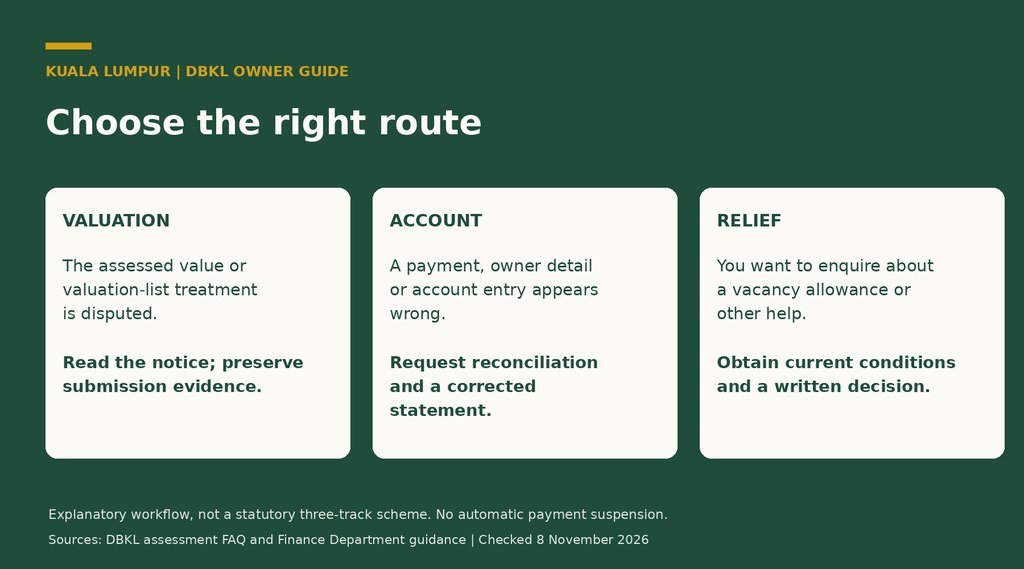
A valuation objection concerns the assessed value or valuation-list treatment. DBKL’s FAQ identifies grounds under section 142 including overvaluation or undervaluation, a holding that is not rateable, an omission, or holdings that should be valued together or separately differently.
Read the actual notice promptly and confirm the submission deadline and channel. The deadline for one statutory process should not be copied into another. This article deliberately does not supply a universal number of days from receipt or a future objection date.
Prepare the notice, assessment account number, concise reasons and relevant evidence: measurements, approved plans where applicable, photographs, comparable rental information and documents identifying the holding. Match the evidence to the issue. Sale-price comparisons alone may not answer a dispute about rental-based annual value.
Keep proof of submission and the written outcome. If considering a further legal appeal, obtain advice promptly rather than assume an informal query preserves appeal rights.
An account correction concerns matters such as an uncredited payment, wrong correspondence details or an entry posted to the wrong account. Supply the bill, dated receipt and transaction reference. Ask for an updated statement explaining the correction. If a wrong area or use is embedded in the valuation record, ask whether a formal valuation process is also needed.
A relief enquiry asks whether an allowance, refund or other approved assistance applies. It does not necessarily dispute the underlying annual value. Obtain the relevant conditions and written decision. For any unresolved matter, ask DBKL to confirm the amount currently payable; do not assume that lodging a query suspends all payment.
8. Empty premises: allowance is not automatic exemption
DBKL’s assessment FAQ, question 14, says a vacant or unoccupied property is not automatically exempt, but the owner can apply to its Finance Department for elaun kekosongan, or vacancy allowance.
The Finance Department page, checked 8 November 2026, lists “Syarat Pulangan Balik Cukai Taksiran (Elaun Kekosongan)” with an update date of 31 March 2026. Obtain that current conditions document when enquiring.
A DBKL refund application form labelled DBKL/PBCT-01-2023, read in full for this article, refers to section 162 of Act 171 and requests the empty unit or floor, area and claim period. Its declarations refer to payment for the claimed half-year and a claim covering one term. However, the form’s 2023 identifier does not prove it incorporates every condition in the later-listed guidance.
For that reason, this article does not turn its application dates or commercial-area note into a current entitlement checklist. Ask DBKL which form and complete conditions apply, whether any initial notification is needed, what evidence establishes vacancy, and the submission requirements for the period concerned.
Do not treat vacancy relief as a hardship scheme or assume a percentage refund. An application, approval and actual account adjustment are separate stages.
9. Update records when buying, selling or inheriting
DBKL’s valuation department instructions say owner-name and correspondence-address changes have been handled online through the public ePenilaian & Hartanah portal since 1 April 2023.
The published checklist includes identification or company-registration documents, specified sale-and-purchase agreement pages, assessment-bill information and death-certificate or will documentation where relevant. Check the current checklist for your transaction; an inheritance or company-owned holding may need different supporting material.
Do not assume that updating land-title records, a bank or the management office automatically updates DBKL’s account. Ask your conveyancing solicitor to confirm assessment arrears, contractual apportionment and the ownership-update steps. Retain acknowledgement and check the next statement.
A practical closing checklist
Homeowners: Check annual value, category, floor area and the same billing period across years, particularly after extensions.
Strata and serviced-apartment owners: Confirm DBKL’s category and account identity; keep assessment separate from land revenue and management payments.
Shop and office owners: Check which floors or parcels the holding covers and whether ownership changes require a joint or separate assessment review.
Industrial owners: Obtain the recorded use, area and valuation basis rather than assume the general residential or commercial examples fit.
Landlords with vacant premises: Enquire about current vacancy conditions promptly, keep evidence and obtain written confirmation of payment obligations.
Heading into 2027, the most useful preparation is not predicting a headline. It is knowing which account applies, how the charge is calculated and which route can resolve a genuine problem.
General information only, not legal, tax or valuation advice. Sources checked 8 November 2026 (MYT). Official notices, individual circumstances and subsequent changes may affect the position. Confirm time-sensitive requirements with DBKL or the relevant authority.
Jessica Leong | Registered Estate Agent E3208
PropNex Realty Sdn Bhd (E (1) 1800/1)
KLCC branch, Marc Residence, Jalan Pinang
Office: 03-2161 8608 | Call/WhatsApp: 010-464 6088