Abandoned Housing and Budget 2027: What Buyers Should Check Before Counting on Stamp-Duty Relief
The Budget proposes bringing back a 100% exemption for qualifying revival-related instruments. Project certification, the parties involved, execution dates and the implementing rules still matter.
Also on Medium: read it on Medium
For a buyer waiting for an unfinished home, a stamp-duty exemption is welcome news. But it answers only one part of a much larger problem: whether the project can be completed, who will complete it, what documents the buyer must sign and how the existing financing will be handled.
There is a real Budget 2027 proposal behind the headline. The Ministry of Finance’s tax-measures document proposes reintroducing a 100% stamp-duty exemption on certain loan agreements and instruments of transfer connected with the revival of abandoned housing projects certified by the Ministry of Housing and Local Government, or KPKT.
That is not the same as saying every buyer in every delayed development already has a claim. Nor does it establish a rescue timetable, a refund of earlier duty or permission to stop servicing a loan.
This guide is written for affected buyers in Kuala Lumpur and Selangor, using federal Budget and housing-administration sources. It is not a state-specific incentive and should not be mixed with either DBKL’s assessment-tax rules or Selangor councils’ arrangements.
The position in one minute
- The proposal exists: Appendix 17 of the official Budget 2027 tax measures proposes restoring the exemption for rescue contractors or developers and original buyers in qualifying revival situations.
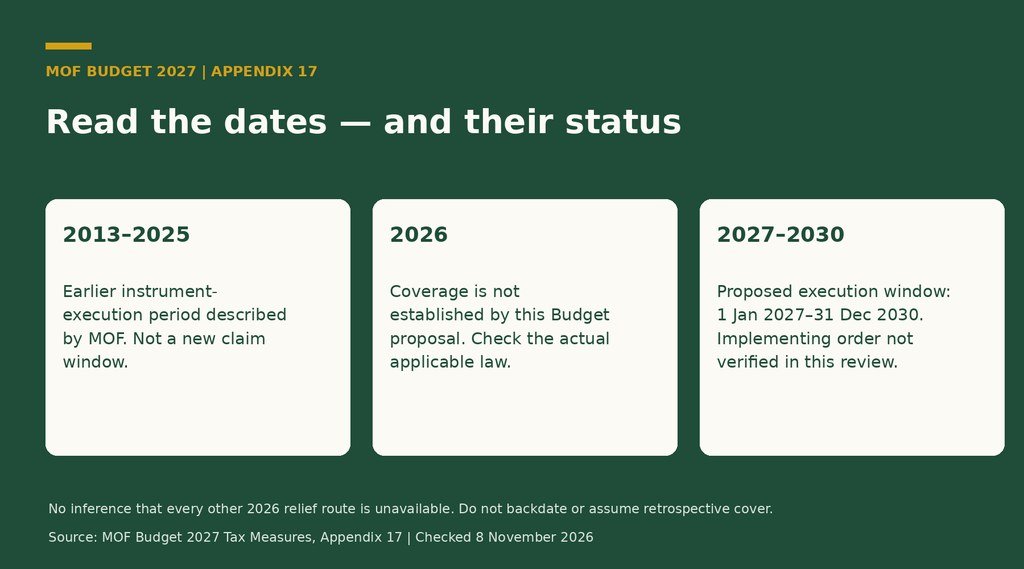
- The proposed window is 1 January 2027 to 31 December 2030, referring to execution of the loan agreements and transfer instruments—not simply the date of an old sale-and-purchase agreement.
- The project must be certified by KPKT under the wording of the proposal. A stopped site, a buyer-group description or a marketing promise is not a substitute for official evidence.
- Legal implementation remains a verification point: this review has not verified a gazetted order implementing the proposed 2027–2030 measure. The article therefore treats it as a Budget proposal, not an established entitlement available today.
- Do not assume continuous coverage through 2026. The Budget appendix describes the earlier exemption period as ending on 31 December 2025, then proposes reintroduction from 2027.
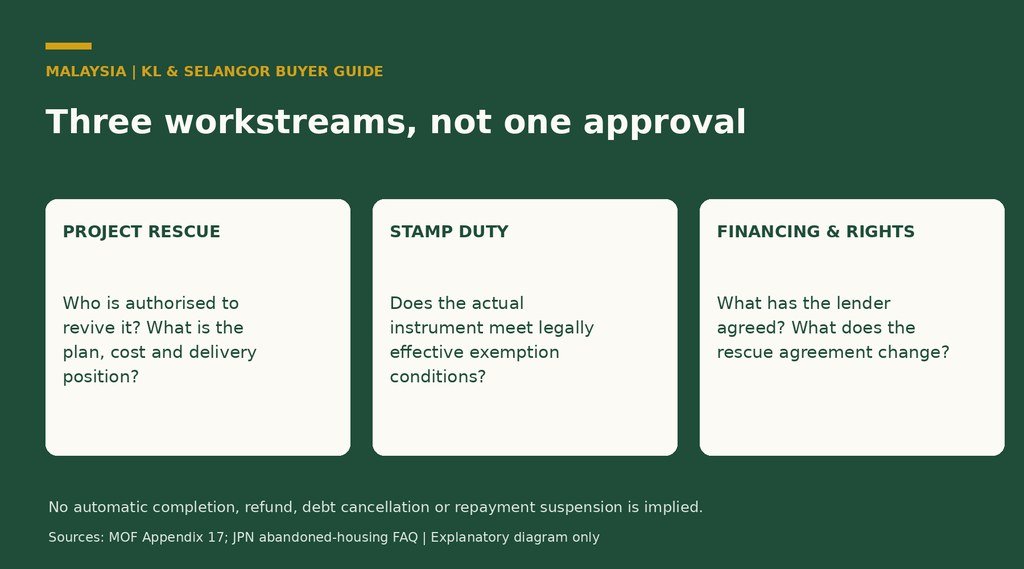
- Stamp-duty relief is not project completion, debt cancellation or automatic bank assistance. Those are separate matters requiring their own documents and decisions.
1. What the official Budget document actually says
The controlling source for this article’s description of the announcement is MOF’s Budget 2027 Tax Measures, Appendix 17: Stamp Duty Exemption for Revival of Abandoned Housing Projects. It accompanies the Budget presented on 9 October 2026. The official Budget speech, paragraph 57, also announces relief for revival-related loan agreements and transfer instruments involving rescuing contractors or developers and original purchasers.
Appendix 17 separates the previous position from the proposal.
Its account of the earlier arrangement identifies two groups. For rescue contractors or developers, it lists loan agreements for financing and instruments transferring land or abandoned housing projects. For original buyers, it lists loan agreements for additional financing and instruments transferring residential homes. It describes the earlier execution period as 1 January 2013 to 31 December 2025.
The proposal then says a 100% exemption should be reintroduced for loan agreements and transfer instruments executed by rescue contractors or developers and original buyers in relation to reviving abandoned housing projects certified by KPKT. Its stated proposed execution window is 1 January 2027 to 31 December 2030.
The distinction matters. The earlier arrangement helps explain the policy’s purpose, but it is not a substitute for the operative wording of any new order. Do not assume every historic definition, exception, beneficiary category or documentary condition will be carried forward unchanged.
This measure is also separate from the first-home purchase proposal in Appendix 16. Do not import that proposal’s price thresholds or sale-and-purchase agreement timing into Appendix 17, or assume both exemptions can simply be added together.
2. Proposal, legislation and approval are different stages
A Budget announcement explains the Government’s intended policy. An implementing legal instrument establishes the applicable exemption and conditions. A particular document must then fit those rules and be dealt with through the appropriate stamping process.
As at 8 November 2026, this review has obtained and read the official Budget appendix but has not verified a gazetted implementing order for this proposed 2027–2030 measure. Searches of official sources did not produce one that could be verified, and the Federal Gazette website returned an access error during checking. That is not proof that no order exists.
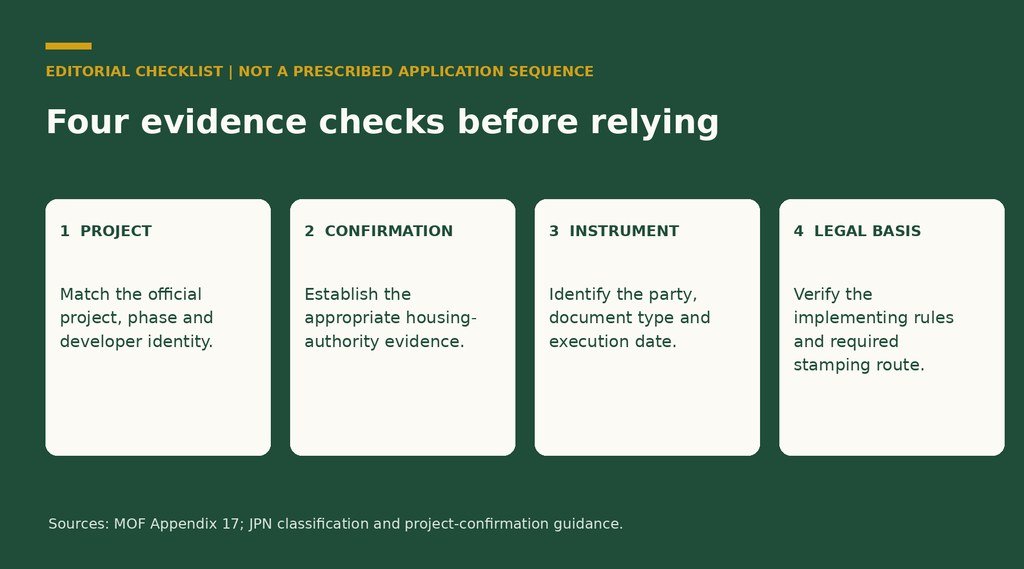
The careful description is therefore “proposed reintroduction”, with the Budget’s stated dates, rather than “every original buyer is now exempt”. Before relying on relief, ask the solicitor handling the instrument to identify the applicable order or other legally effective authority, its commencement and the conditions relevant to that document.
For an instrument already signed in 2026, the Budget’s future window should not be treated as retrospective cover. Ask for advice on the law applying to its actual execution date and any separate available relief. Do not backdate, alter dates or postpone a statutory submission merely because an exemption may be implemented later.
Equally, a signing date within the proposed future window would not alone establish eligibility. The project, party, instrument and certification requirements must also be satisfied under the final applicable rules.
3. Delayed, sick and abandoned are not interchangeable
People understandably use “abandoned” to describe a development that appears silent or badly behind schedule. Official classifications are more specific.
The National Housing Department’s published classification guidance, updated 6 October 2023, describes a projek sakit, or sick project, as one delayed by more than 30% against the progress that should have been achieved, or where the sale-and-purchase agreement period has expired. This is the department’s published administrative explanation; buyers should obtain the current recorded status for their own phase rather than classify it themselves.
A delayed project describes lateness, but lateness by itself does not establish that the project is formally abandoned or certified for tax purposes. This article does not invent a separate numerical definition for every delayed-status category.
The department’s Abandoned Project Rehabilitation Division page, updated 23 October 2023, describes unfinished projects and a continuous period of six months without significant site activity, together with ministerial confirmation of abandoned-project status. The department’s pages contain differing legacy statutory references, so this guide does not reproduce them as a verified current legal test.
The practical point is stronger than any shortcut: a buyer’s observation is evidence to raise with the authority, not the declaration itself. A project classified as sick should not automatically be treated as a certified abandoned project under the Budget proposal.
“Revival” adds another distinction. A project may have a proposed rescue plan, works restarting or a rehabilitation process under discussion. None of those descriptions alone proves completion, delivery of vacant possession or tax eligibility for every transaction. Establish what is officially recorded, what has been approved and what remains a plan.
4. Check the exact project, phase and document trail
Begin with the official TEDUH housing information portal, which the department’s classification guidance directs users to for project-status checks. Match the project with the developer’s legal name, relevant phase and identifying details from the original agreement. Similar names or different phases can otherwise lead to the wrong conclusion.
Save the result with the date checked. If the entry is missing, unclear or inconsistent with a letter you hold, seek clarification from the National Housing Department rather than assume the project is safe—or automatically eligible for relief.
The department’s abandoned-housing FAQ, updated 10 October 2023, explains how buyers may seek a Surat Pengesahan Projek Terbengkalai, or project-confirmation letter. It directs buyers to check whether the project is listed and to approach the relevant department for clarification if it is not.
That confirmation letter and the certification required for a tax exemption should not be assumed to be interchangeable in every situation. Ask the solicitor and the relevant authorities exactly what evidence the eventual exemption requires. A letter obtained for a financing enquiry is not, by itself, an exemption approval from HASiL.
5. Who might be covered—and what still needs checking
The Budget proposal names rescue contractors or developers and original buyers. It does not say that every later purchaser, investor, assignee, beneficiary or person buying a unit in a revived scheme automatically qualifies.
An original buyer should begin with the original sale-and-purchase agreement and the identity recorded there. If ownership or rights have since changed through assignment, inheritance, divorce or another arrangement, put the full history before the solicitor. The eventual legal instrument—not an assumption based on an earlier scheme—must resolve how that situation is treated.
Rescue-side relief concerns the financing and transfer arrangements involved in rehabilitation. It is not necessarily a personal tax saving that passes directly to each buyer. Ask how any claimed relief affects the proposed rescue budget, who bears each cost and what the buyer is being asked to sign.
For the buyer’s own documents, identify the precise instrument. Is it a new or additional financing agreement, an instrument of transfer, a supplemental agreement, an assignment or something else? Different documents should not be treated as one generic “property transaction”.
The proposal does not establish an exemption for every fee connected with the project. Legal fees, valuation fees, interest, arrears, contractual payments and other charges are separate questions. Even a qualifying 100% stamp-duty exemption is not a statement that the entire rescue process is free.
6. Build a practical buyer file
The official JPN application form for an abandoned-project confirmation letter, read in full for this article, asks for buyer, developer, project and financing details. Its checklist includes a full copy of the sale-and-purchase agreement, identification, current buyer and financing-institution or EPF addresses, a contact number and the earlier confirmation letter for repeat applications. The form does not display a clear issue date, so confirm the latest version before submitting it.
Alongside that administrative pack, prepare a solicitor-review file containing:
- The original agreement and any supplemental, assignment or succession documents.
- Existing financing agreements, current statements and written bank correspondence.
- Official project-status and confirmation letters, with the relevant phase identified.
- Any rescue proposal and evidence of the proposed party’s authority or appointment.
- Draft instruments, intended execution dates and a breakdown of proposed costs.
- Earlier stamping records, assessments and receipts, if any.
This expanded list is a practical preparation checklist, not a claim that KPKT or HASiL has prescribed every item for the new exemption. Keep originals safely and share identity and financial documents only through the authority’s confirmed channel or with the appointed professional who needs them.
7. Where stamping fits in
KPKT’s role in project status and certification is different from HASiL’s administration of stamp duty. Obtain the project evidence through the relevant housing-authority route, then have the instrument handled through the applicable stamping process.
HASiL’s e-Duti Setem information page, updated 22 June 2026, identifies registered-user categories including legal firms, banks, agents and individuals. Its Stamp Duty Self-Assessment System guidance, updated 28 August 2026, describes phased implementation through MyTax, beginning in 2026 and extending to specified real-property transfers in 2027.
Those system changes do not, by themselves, create this exemption. Nor should every document be assumed to follow an identical self-assessment route. Ask the handling solicitor or HASiL which assessment or exemption procedure applies to the particular instrument and what legal reference and supporting evidence are required.
No dedicated, verified application checklist for the proposed 2027 abandoned-project exemption was obtained in this review. Accordingly, this guide does not invent an exemption code, online menu, processing time or automatic approval route. Keep the assessment, any written decision and proof of stamping together.
8. Financing and buyer rights remain separate
The housing department’s confirmation-letter FAQ describes the letter as potentially helping buyers seek consideration from financing and other institutions. That wording matters: it is an application for consideration, not an automatic change to a loan contract.
Ask the financier directly what assistance may be considered, what documents are needed and how any approved arrangement changes instalments, interest or profit, the remaining term and the total amount payable. Obtain the decision in writing. Do not stop repayments on the strength of a Budget announcement, an online status label or a buyer-group message.
Likewise, revival does not automatically settle claims involving delayed delivery, variations, termination, insolvency or additional contributions. A proposed rescue agreement can affect important rights. Have a solicitor review the terms before accepting waivers, new payment obligations or revised delivery commitments.
This article does not set a universal deadline for legal claims. The relevant cause of action, contract, proceedings and applicable law matter. Seek advice promptly; do not assume a pending rescue discussion preserves every right indefinitely.
9. Questions to take to your solicitor
Before counting a tax saving in the household budget, ask:
1. What is the exact official project and phase status, and what certification is available?
2. Which legally effective exemption authority applies to this particular instrument?
3. Does the party signing qualify under that authority, including any ownership changes?
4. Which instrument is involved, and which execution date controls eligibility?
5. What evidence must be submitted, through which route and within what applicable time limits?
6. Which costs remain payable even if stamp duty is exempt?
7. What happens if relief is refused, implementation differs from the Budget proposal or an earlier payment is involved?
8. Does the rescue agreement change financing obligations or existing legal rights?
A hypothetical buyer with an old agreement and a proposed additional loan illustrates the distinction. The original purchase date, the new instrument’s execution date, the project evidence and the buyer’s legal position each need checking. None can be replaced by the single statement “the project is abandoned”. This is an illustration only, not an eligibility determination.
The practical conclusion
Budget 2027 contains a genuine proposed measure for the revival of certified abandoned housing projects. Its value to an individual buyer depends on legal implementation and the facts of the instrument—not simply on the headline percentage.
For KL and Selangor buyers, the useful next step is to organise the evidence, establish the project’s official position and ask the handling professionals to separate project rescue, stamp-duty treatment and financing obligations. Relief may reduce a qualifying transaction cost. It is not a substitute for a workable rescue plan or a written decision on the buyer’s own documents.
General information only, not legal, tax or financing advice. Sources checked 8 November 2026 (MYT). The 2027–2030 exemption is described as a Budget proposal; a gazetted implementing order has not been verified in this review. Confirm current law, project evidence and time-sensitive requirements before acting.
Jessica Leong | Registered Estate Agent E3208
PropNex Realty Sdn Bhd (E (1) 1800/1)
KLCC branch, Marc Residence, Jalan Pinang
Office: 03-2161 8608 | Call/WhatsApp: 010-464 6088