Bank Lelong in KL and Selangor: How the Deposit, the Balance Deadline and Your Loan Really Work
The 10% deposit is the easy part. Whether an auction purchase completes depends on the balance deadline, your financing and the conditions of sale. Here is how court, land office and bank auctions handle each, and what happens if a buyer cannot pay.
Also on Medium: read it on Medium
Most first-time auction buyers focus on the fall of the hammer. The harder part starts after it: paying the balance on time, with a loan that may not be approved yet, under conditions that someone else wrote.
My earlier practical guide to bank lelong for first-time buyers covers the basics: the two types of auction, inspection, strata arrears and when a subsale is the better choice. This article follows the money from auction day to completion: what the deposit is a percentage of, how long you have to pay the rest, how to line up financing, and what you stand to lose if you cannot complete.
Legal references are to the National Land Code (Revised 2020), Act 828. Every auction has its own Proclamation and Conditions of Sale, and those govern your purchase. Treat this as a map, not as the terms of any particular sale.
The short version
- Find out who wrote the rules. Court and land office auctions follow the National Land Code. Non-judicial (assignment) auctions follow the bank's own conditions of sale.
- The deposit is not always 10% of the same number. In court and land office sales it is 10% of the reserve price. Many non-judicial sales ask for 10% of the reserve to register, then a top-up to 10% of your winning bid.
- The deadline is fixed in judicial sales. The balance is due within 120 days of the sale, with no extension. Non-judicial sales set 90 or 120 days, and any extension is at the bank's discretion.
- Default costs more than you think. You lose the deposit. Under some non-judicial conditions, the bank can also resell and claim any shortfall from you.
- Line up financing before you bid, and test it against the deadline.
Three auction routes, three rulebooks
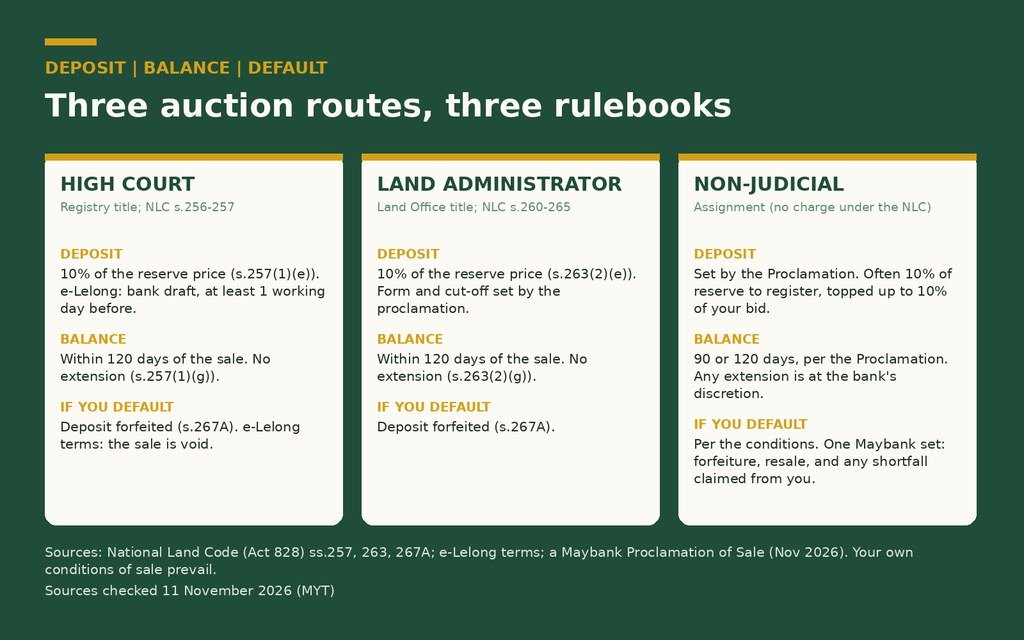
1. High Court sales. For a charged Registry title, the bank applies to the High Court for an order for sale under section 256 of the National Land Code. The court procedure for these "charge actions" is in Order 83 of the Rules of Court 2012. Section 257 fixes the key terms of every order: a public auction, a reserve price equal to the estimated market value, a deposit of 10% of that reserve, and a balance payable within 120 days with no extension. High Court auctions in Peninsular Malaysia use the judiciary's online e-Lelong system.
2. Land office sales. For a charged Land Office title, the bank applies to the Land Administrator instead (sections 260 to 265). Strata (subsidiary) titles appear in both lists, so your lawyer's title search will show which route applies. The land office order under section 263 carries the same core terms: 10% of the reserve to bid, and 120 days with no extension. Selangor's e-Tanah system lists bidder registration as one of its auction functions. A Kuala Selangor land office Proclamation I read required the 10% deposit by bank draft before 9.30 a.m. on auction day.
3. Non-judicial sales. Where the bank's security is an assignment of the buyer's rights, typically because no title had been issued when the loan was made, the bank sells under its contract through a licensed auctioneer, without a court order. A Malaysian Bar Law & Realty column described this type as "not regulated by any legislation", so everything turns on the Proclamation. A title issued later does not by itself change the route: one Maybank Proclamation for an office lot noted that the strata title had been issued, yet the sale was still by assignment.
The deposit: 10% of what, paid how, and by when
Court and land office sales. No one may bid unless they hold "ten per centum of the reserve price" at the time of the sale (sections 257(1)(e) and 263(2)(e)). If you win, that sum becomes your deposit, credited to the borrower's account pending the balance. It stays tied to the reserve, even if you bid well above it.
On e-Lelong, you register once with identity documents, then deliver the 10% as a bank draft, by Pos Laju or by hand, no later than one working day before the auction. If you lose, a posted draft is processed for return within three working days.
Non-judicial sales. Here the Proclamation decides, and the two bank documents I read follow a two-step pattern:
- To register: 10% of the reserve price. Hong Leong Bank's auction FAQ asks bidders to bring this by bank draft or banker's cheque. A Maybank Proclamation for an online auction on 16 November 2026 accepts a bank draft, RENTAS transfer or FPX, by 5 p.m. at least one working day before the auction.
- After the hammer: a top-up to 10% of the winning bid. Hong Leong's FAQ says this is paid immediately after the auction. The Maybank conditions give online bidders three working days.
So the non-judicial deposit is effectively 10% of the winning bid, while the court deposit is 10% of the reserve.
Auctions can also be called off. Under section 266, a borrower can stop a court or land office sale by paying what is due before the sale concludes, and the Maybank conditions let the bank postpone or call off a sale before the hammer falls.
The balance: 120 days, 90 days and the word "extension"
Court and land office sales. Sections 257(1)(g) and 263(2)(g) require the balance to be settled "not later than one hundred and twenty days from the date of the sale" and state that "there shall be no extension". Day 120 is the deadline.
Non-judicial sales. The Bar column noted that some Proclamations give 90 days and others 120. Some allow no extension, while others leave it to the bank's absolute discretion and, if granted, subject to interest. Hong Leong Bank's FAQ also refers to "90/ 120 days". The Maybank conditions I read set 120 days and allow an extension only if the buyer asks in writing before the period expires. The bank may then agree, refuse (in which case the 10% is forfeited) or agree subject to conditions such as late payment charges or interest. Plan to complete within the stated period, and treat any extension as a bonus.
What happens if you cannot complete
This is where the two systems differ most.
Court and land office sales. Section 267A of the National Land Code says that if the purchaser fails to settle the balance within the period in the order, "the deposit shall be forfeited". It goes first to quit rent, outgoings and sale expenses, and the rest reduces the borrower's debt. e-Lelong's terms add that "the sale shall be void". I did not find a provision in these sections making a defaulting judicial purchaser liable for a later shortfall, but that is not proof none exists, so ask your lawyer.
Non-judicial sales. Here the contract can reach further. In the Maybank conditions, if the balance is not paid on time, the deposit is forfeited and the bank may resell. The cost of the resale and any "deficiency in price" are then "recoverable from the defaulting Purchaser", supported by a bank officer's certificate that the conditions treat as conclusive. A failed completion could cost more than the 10%. Other banks' conditions may differ, which is why you read your own.
Those conditions also let the bank forfeit the deposit and re-auction in situations that have nothing to do with money, including:
- a foreign citizen or company winning without the required prior written consent from the Economic Planning Unit and/or the relevant state authorities;
- a non-Bumiputera buyer winning a Bumiputera-reserved unit and being unable to obtain the consents before completion;
- a buyer who does not qualify for a low-cost unit;
- a bankrupt or wound-up bidder.
Eligibility is a pre-bid question, not a post-auction one.
Financing: get the loan ready before you bid
Hong Leong Bank's auction FAQ tells bidders to "check your financing eligibility before bidding". The Bar column warned that 90 or 120 days "may not be sufficient" when a loan is needed, and that for a low-cost flat needing authority consent, 120 days is "definitely insufficient".
What to do before the auction:
- Give your banker the Proclamation. Ask whether it finances auction purchases of this type and title, and whether it lends against the winning bid, its own valuation or the lower of the two.
- Ask for a realistic date for the letter of offer and for disbursement, counted back from the deadline. The deadline is for payment, not approval.
- Check what undertakings are needed. For housing accommodation, the Maybank conditions require a letter of undertaking from the buyer or the buyer's financier to the developer. If progress payments are still owed to the developer, they require the financier's undertaking (or, for a cash buyer, a bank guarantee) in the developer's favour.
- Have a fallback. If the loan is reduced or declined, you need the difference in cash or you risk the deposit.
The Bank Negara limits that shape the numbers:
- 70% loan-to-value for the third housing loan. Bank Negara Malaysia introduced a maximum loan-to-value ratio of 70% in November 2010 for "the third house financing facility taken out by a borrower", later described as the "third and above outstanding" housing loan per individual. First and second home financing is left to each bank's credit policy.
- 60% for non-individual borrowers, such as companies. A Bank Negara Deputy Governor's speech records a 60% loan-to-value limit on housing loans to non-individual borrowers, introduced in December 2011.
- 35-year maximum tenure for financing to buy residential and non-residential property, under measures announced on 5 July 2013. Banks must also apply prudent debt service ratios.
I found no Bank Negara rule specific to auction properties, so confirm the margin with the bank that will actually lend.
A worked example, with illustrative figures
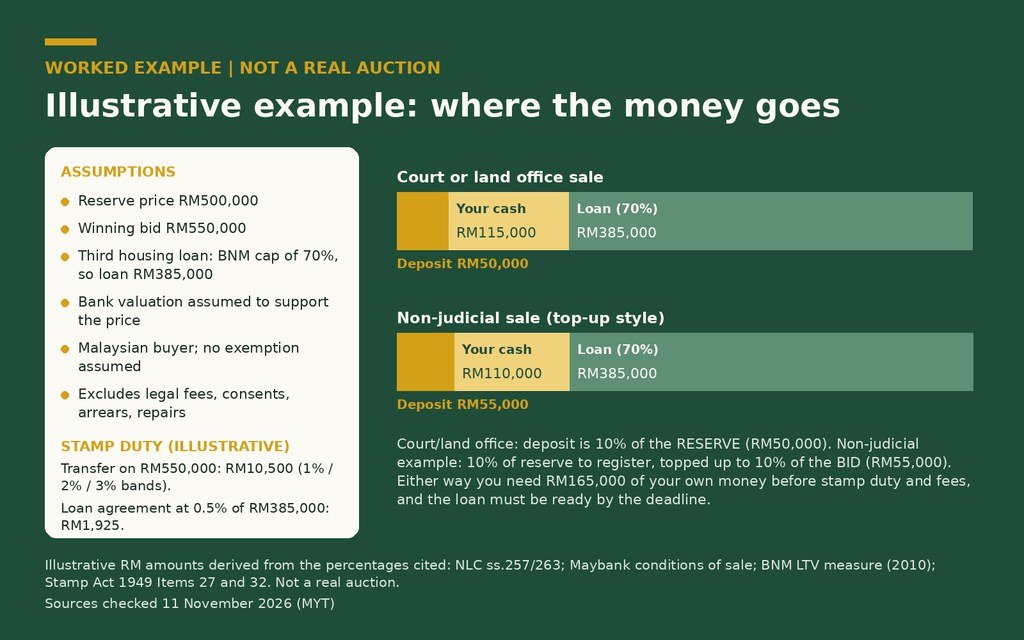
Assume a reserve price of RM500,000, a winning bid of RM550,000, a Malaysian buyer taking a third housing loan, and a bank valuation that supports the price.
- Court or land office sale: deposit RM50,000 (10% of the reserve), paid before bidding. Balance RM500,000 within 120 days.
- Non-judicial sale with a top-up: RM50,000 to register, plus RM5,000 to reach RM55,000 (10% of the bid). Balance RM495,000 within the Proclamation's period.
- Loan: at the 70% cap, RM385,000. So in either case the buyer needs RM165,000 of their own money towards the price, of which RM50,000 to RM55,000 is committed before any loan is disbursed.
- Stamp duty on the transfer: RM10,500 on RM550,000 (1% on the first RM100,000, 2% on the next RM400,000, 3% on the remaining RM50,000), assuming the market value is not higher than the price.
- Stamp duty on the loan instrument: RM1,925 (0.5% of RM385,000).
Legal fees, valuation, consent fees, arrears, repairs and the cost of recovering possession are all extra.
Stamp duty and the transfer document
What you stamp and register depends on the route:
- Court and land office sales: after full payment, you receive a certificate of sale (Form 16F from the court, Form 16I from the Land Administrator), registrable "as if it were an instrument of dealing" (section 267). Where the chargee is a financial institution, you pay the bank, which certifies receipt in writing within 14 days (sections 259(3A) and 265(4A)). e-Lelong's terms then give the Registrar 14 days to deliver Form 16F.
- Non-judicial sales: the bank executes a deed of assignment prepared by your solicitors, and a memorandum of transfer may also be needed if the title has been issued. The Maybank conditions name the deed of assignment as the principal instrument for stamp duty and put stamp duty, registration fees and legal costs on the purchaser.
LHDN's stamp duty guideline sets the transfer rates: 1% on the first RM100,000, 2% up to RM500,000, 3% up to RM1,000,000 and 4% above, on the consideration or market value, whichever is higher. The Stamp Act 1949 charges RM5 per RM1,000 (0.5%) on a loan instrument that is the principal security.
LHDN's Stamp Duty Self-Assessment System (STSDS) covers "Transfer of Real Property (not involving JPPH valuation)" from 1 January 2027. My article on stamp duty self-assessment from 2027 explains how LHDN has said this applies to auction purchases. My earlier guide covers the first-home exemption question.
Arrears: quit rent, assessment and maintenance
Court and land office sales. Section 268 puts quit rent and outgoings payable to the State Authority or local authority first in line from the purchase money. e-Lelong's terms require the bank, within 14 days of receiving your balance, to pay fees and charges due to the State Authority and local authorities up to the auction date, and to give you copies of the receipts.
Non-judicial sales. In the Maybank Proclamation, the bank bears quit rent and assessment arrears up to the auction date. However, the buyer must submit the receipts together with the balance payment, or later claims "will not be entertained". Arrears of maintenance charges and utilities are borne by the buyer. The Bar column gave an example of a property bought for RM128,000 with about RM40,000 of service charges outstanding. Get a statement from the management office before you bid.
Consents and eligibility
- Court sales on e-Lelong: for registering the Form 16F certificate, State Authority consent for a restriction in interest "is not applicable", per the terms. Bidders remain subject to state law restrictions, and foreign bidders need approval for restricted property.
- Non-judicial sales: the Maybank conditions make obtaining developer, proprietor or state authority consent the buyer's "sole and absolute responsibility", at the buyer's cost, within the completion period. If consent comes with conditions the bank does not accept, the bank may terminate and refund without interest, less costs.
Consent time eats into your payment period, so ask the developer or management about their process and timing before the auction.
Vacant possession
Neither route promises an empty unit. e-Lelong's terms say the bank "shall not be responsible to deliver vacant possession", and the Maybank conditions leave the buyer to take possession at their own cost. For judicial sales, section 267 limits which tenancies bind the purchaser, depending on registration or endorsement. If the unit looks occupied, have a lawyer explain your position, time and cost before you bid.
A practical timeline from auction day to completion
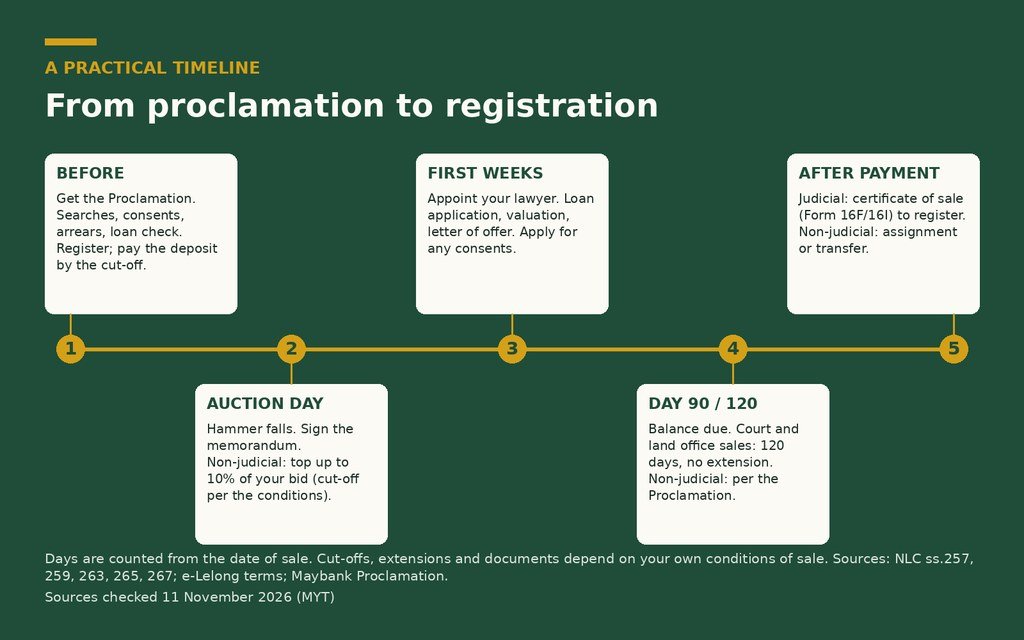
- Step 1, before the auction: Proclamation, searches, consents, arrears and financing; then register and pay the deposit by the cut-off.
- Step 2, auction day: sign the memorandum of sale. In non-judicial sales, pay the top-up to 10% of your bid by the set time.
- Step 3, the first weeks: appoint your lawyer, apply for the loan, arrange valuation and apply for consents. On e-Lelong, the bank files Form 16Q within seven days.
- Step 4, by day 90 or 120: pay the balance. Court and land office deadlines cannot be extended.
- Step 5, after payment: judicial sales lead to the certificate of sale; non-judicial sales to the assignment and any transfer. Stamp, register, then deal with possession.
Pre-bid checklist
- Get the full Proclamation and Conditions of Sale, and read every clause on deposit, balance, extension, default and arrears.
- Identify the route: High Court, Land Administrator or non-judicial assignment.
- Note exactly what the deposit is 10% of, the payment method and the cut-off time.
- Write down the balance deadline in days and as a date. Note whether an extension is possible and on what terms.
- Do a title search, and check tenure, restrictions in interest and any Bumiputera, low-cost or foreign-ownership limits.
- Ask the developer, proprietor or management about consent requirements, fees and timing.
- Get statements for maintenance, sinking fund and utilities, and confirm who bears quit rent and assessment.
- Give the Proclamation to your banker. Confirm the margin (70% if this would be your third housing loan), the valuation basis and a realistic disbursement date.
- Keep cash for the deposit, any top-up, the shortfall between loan and price, stamp duty, fees and a buffer.
- Read the default clause. Know whether the bank can claim a resale shortfall from you.
- Assess occupancy and the likely cost and time of recovering possession.
- Set a maximum bid that still works after all costs, and have your own lawyer review everything before you bid.
The practical conclusion
An auction can be a sound way to buy, but the deposit is only the entry ticket. The purchase succeeds or fails on paying the balance before a deadline that may not move. Read the conditions, line up the money, and involve your lawyer and banker before auction day. No agent's view, including mine, replaces the Proclamation and your lawyer's advice.
General information only. This is not legal, financial or tax advice. Laws, official guidance and bank documents were checked on 11 November 2026 (MYT) and may change. Each auction is governed by its own Proclamation and Conditions of Sale. Please have a Malaysian lawyer review the specific Proclamation, and confirm financing with your bank, before you bid.
Jessica Leong | Registered Estate Agent E3208
PropNex Realty Sdn Bhd (E (1) 1800/1), KLCC branch
Marc Residence, Jalan Pinang, Kuala Lumpur | Office 03-2161 8608
Call/WhatsApp 010-464 6088
Sources (checked 11 November 2026, MYT)
- National Land Code (Revised 2020), Act 828, s. 256, s. 257, s. 259, s. 263, s. 265, s. 266, s. 267, s. 267A and s. 268 (text synced from Laws of Malaysia, AGC)
- Rules of Court 2012, P.U. (A) 205/2012, as gazetted (Order 83, Charge Actions)
- e-Lelong, High Court of Malaya: Terms and Conditions and FAQ
- Kuala Selangor Land Office: Proclamation of Sale under ss. 257 and 263 of the National Land Code (auction of 3 October 2024)
- e-Tanah Selangor user guide: auction functions
- Maybank: Proclamation and Conditions of Sale, non-judicial online auction of 16 November 2026
- Hong Leong Bank: Property Auction Listing FAQ
- Malaysian Bar, "LAW & REALTY: Making a bid at a public auction" (Andrew Wong, 2006), text as reproduced by the National House Buyers Association
- Bank Negara Malaysia: maximum LTV of 70% for the third house financing facility (3 November 2010)
- Bank Negara Malaysia: Deputy Governor's remarks on macroprudential policies (70% LTV on third and above; 60% for non-individuals)
- Bank Negara Malaysia: measures of 5 July 2013 (35-year maximum tenure)
- LHDN: Garis Panduan Pengenaan Duti Setem (Jadual Pertama Akta Setem 1949)
- Stamp Act 1949 (Act 378), reprint text as at 1 January 2024 (LHDN copy), First Schedule Items 27 and 32
- LHDN: Stamp Duty Self-Assessment System (STSDS)