Buying a Tenanted Shop, Office or Factory in KL and Selangor: What to Check Before Signing
A tenant already in the unit is where your checks start, not proof of income. Here is how to verify the rent, the tenancy's legal standing, the deposits and the building before you commit.
Also on Medium: read it on Medium
A sitting tenant can make a commercial purchase look safer: rent from day one, no letting period, no fit-out risk. But a tenant in place only tells you that someone occupies the unit today. It does not tell you how much rent actually arrives, on what terms, for how long, or what the building and the business inside it may cost you later.
This guide is for buyers and investors in Kuala Lumpur and Selangor who are buying from a private seller. Bank auctions and enforcement sales follow different rules and are not covered here.
The short version
- Verify the rent, not just the tenancy. Compare the signed tenancy and every variation with the rent ledger and redacted proof of payment.
- Know which kind of letting it is. The National Land Code treats short tenancies, endorsed tenancies and registered leases differently.
- Put the tenancy decision in the sale contract. Either you buy subject to the tenancy or you buy with vacant possession. Neither should be left to assumption.
- Account for every ringgit at completion. That means deposits, prepaid rent, arrears and outgoings, each with evidence and in writing.
- Judge the income net of the owner's costs, not by the headline rent.
- Check the building and its use separately from the tenant's licence, especially for factories.
1. A tenant in place is not proof of reliable rent
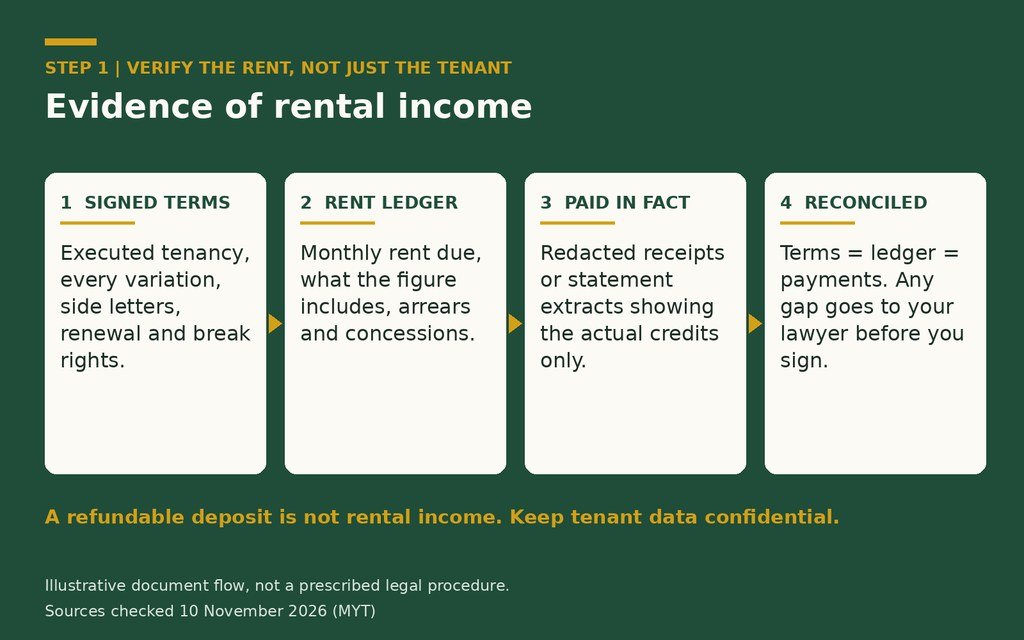
Separate three things: what the documents say the tenant should pay, what the seller says the tenant pays, and what has actually been paid.
Ask for the executed tenancy agreement and every variation: rent reviews, extensions, rent-free periods, and letters agreeing to a discount, deferment or change of use. A later side letter can cut the rent or add a break right. Ask your lawyer to have the seller confirm in the contract that no other agreement with the tenant exists.
Then reconcile:
- Rent ledger against tenancy terms. Does the monthly figure match the current agreed rent, or does the quoted "rent" include service charges, car-park bays or signage fees?
- Ledger against payment evidence. Ask for redacted proof of receipt for a recent period, such as statement extracts showing only the relevant credits. You do not need the seller's full bank statements.
- Arrears and concessions. Are there arrears, payment plans or rent waived during a dispute? Has any deposit been used to cover unpaid rent?
- Term, renewal and break rights. How long is left to run? Is there an option to renew, and on what rent? Can either side end the tenancy early?
- Guarantees, disputes and notices. Is there a guarantee, and would it still protect you after the sale? Has either side served notice about defects, rent or termination?
Treat tenant information as confidential and use redacted copies.
2. Tenancy or lease: what the National Land Code actually says
Peninsular Malaysia's National Land Code (Revised 2020), Act 828 draws a clear line based on the length of the term. The section references below come from the official 2020 revised reprint; your lawyer should confirm the current text for your transaction.
- Up to three years. Section 223 allows tenancies "for terms not exceeding three years". Section 213(1) calls these "tenancies exempt from registration": they can be oral or written "in any form whatsoever", and cannot be registered.
- More than three years. Under section 221, a lease is for a term exceeding three years, granted by an instrument in Form 15A, the registrable route.
- Renewal options do not lengthen the term. Section 224(b) measures a fixed term without counting an option to renew, so a "3+3" is generally a three-year term with an option. Your lawyer should confirm how your document is structured.
The key provision for buyers is section 213(3). Such a tenancy is not binding on a later transferee unless, before the transfer takes effect, it is protected by an endorsement on the register document of title (sections 316–317, recorded as "Exempt tenancy claimed"). Section 317(5) says the endorsement does not confirm the tenancy is valid.
Do not take this statutory rule as permission to ignore an occupier or take possession yourself. Your lawyer needs to review the title, the tenancy and any promises made in the sale contract, and work out your position on the facts. Equally, do not assume every tenancy automatically binds a new owner.
Also raise:
- Oral options. Section 228(2) means an option in an oral tenancy is not made enforceable against a transferee by the transfer provisions. Get promised renewals in writing.
- Bank consent. If the property was already charged to a bank when the tenancy was granted, section 226 required the chargee's consent, given in writing. Ask whether it was obtained, and what any gap means.
- Who is actually there. Check signage, the licence holder and who operates on site. A subtenant or related company in occupation may or may not be permitted by the tenancy.
- No self-help eviction. Under Specific Relief Act 1950, section 7(2), if an occupier stays after a tenancy ends, possession must be recovered through the courts.
Your lawyer's title search (the Code provides for private and official searches in sections 384–385) shows the proprietor and registered charges, leases, caveats and endorsements. A blank endorsements section does not mean the building is empty.
3. Decide in writing: subject to tenancy or vacant possession
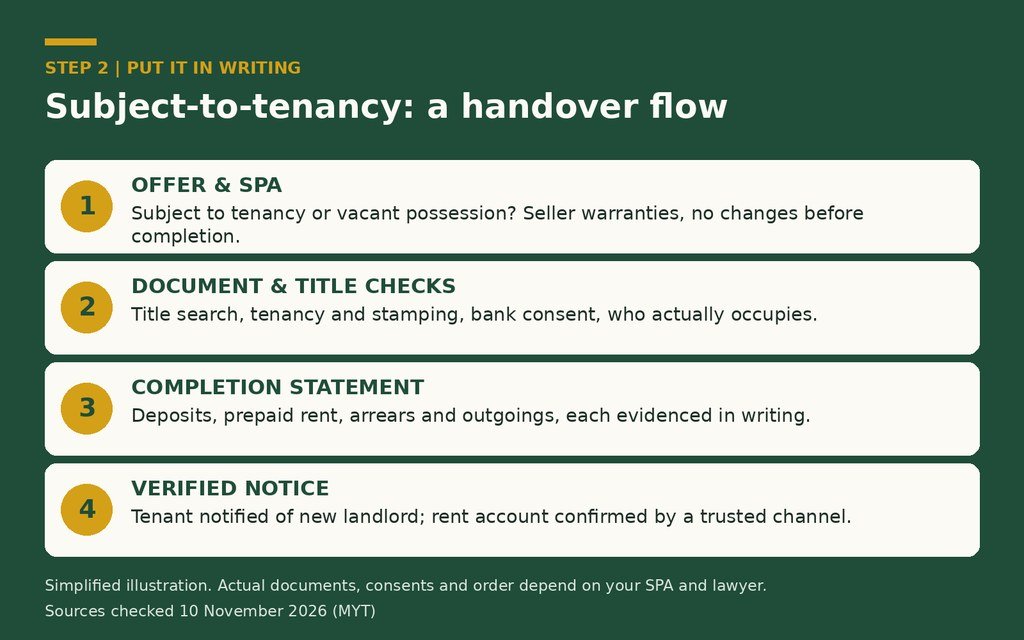
There is no universal prescribed form for buying tenanted commercial property, and no automatic right to vacant possession. The offer letter and the sale and purchase agreement (SPA), read with the law, decide it. Conveyancing guidance from C K Lim & Partners starts at the same point: establish whether the purchase is with vacant possession or subject to the existing tenancy.
Keep three layers apart:
- Legal rules. The Code provisions above, stamping law, the court process for possession.
- Negotiated contract protections. Seller warranties on rent, deposits, arrears and side agreements; no variation, renewal or termination before completion without your consent; listed completion deliverables; remedies if they are missing.
- Recommended due diligence. What you check yourself: inspections, reconciliation, third-party confirmations.
If you buy subject to tenancy, identify the tenancy documents in the SPA and let your lawyer decide how the landlord's position moves to you: an assignment, a novation involving the tenant, a notice, or a combination. VCC Law describes solicitors usually preparing an assignment of the tenancy. Whether the tenant must consent depends on the tenancy terms and the structure; there is no single fixed rule.
If you need vacant possession, check whether the tenancy can actually end by completion, what notice is required and whether it has been served, and what happens if the tenant stays. A promise of vacant possession only helps if there is a mechanism and a remedy behind it.
Ask about stamping. Under Stamp Act 1949, section 52, an instrument chargeable with duty generally cannot be admitted in evidence unless duly stamped, though the proviso allows admission once duty and any penalty are paid. LHDN's Stamp Duty Self-Assessment System has covered lease and tenancy instruments since Phase 1 began on 1 January 2026. Ask for evidence of stamping for the tenancy and its variations.
Guard against payment fraud. Confirm any new rent account details through a verified channel, such as an independent call to a known number, never by replying to the message announcing the change.
4. Deposits, prepaid rent and the completion accounts
Commercial tenancies often involve a security deposit, a utility deposit paid to the landlord, and sometimes rent paid in advance. Do not assume these sums have been handed over or correctly accounted for just because the property is being sold. The SPA and completion statement should spell out how each amount is dealt with. Ask for:
- the amount of each deposit, the clause it was paid under and evidence it was received;
- confirmation of whether any part has been applied to arrears or repairs;
- the agreed treatment at completion, whether paid to you, credited against the balance price or otherwise accounted for, recorded in writing;
- the same treatment for any rent paid beyond the completion date.
Keep a landlord-held "utility deposit" separate from the electricity account. TNB describes a change of tenancy as opening a new account, with a deposit payable by the applicant. Its security deposit page says deposits are refunded on closing an account, less anything outstanding. So the meter deposit does not simply travel with the property. Check whose name the account is in.
Do not count a refundable deposit as rental income; you may have to repay it. Prepaid rent raises a timing question: LHDN's Public Ruling 12/2018 treats rent received in advance as gross income of the period it is received (paragraph 9). Ask your tax adviser how that affects seller and buyer.
Agree in writing how rent and outgoings around completion are apportioned, rather than assuming a standard formula.
5. Look at net income, not headline rent
Annual rent divided by the purchase price gives the gross rental yield. That is a figure before any of the owner's costs, so treat it as a starting point at best. List what the owner pays:
- assessment tax to the local council, and quit rent or parcel rent where applicable;
- for strata units, maintenance charges and sinking fund contributions. The Strata Management Act 2013 requires these to be paid to the management body (for example, sections 25 and 52);
- insurance the owner must hold;
- repairs and replacements the tenancy leaves with the landlord, such as roofs, structure, lifts or major mechanical items;
- letting and legal costs at renewal or re-letting, and downtime between tenants;
- reinstatement: what the tenant must remove or restore at the end, and what happens if they do not.
LHDN's ruling gives examples of deductible direct expenses for non-business letting, such as assessment, quit rent, loan interest, fire insurance and ordinary repairs (paragraph 8.2). How they apply to you is for your tax adviser.
If you are borrowing, compare the net figure with your actual financing cost, not a generic rate. Commercial rent may also fall within service tax depending on the parties. Customs lists a Rental or Leasing Services guide, with the latest Malay version dated 14 May 2026, so ask your tax adviser. For background, see my earlier guide to e-invoicing and service tax on commercial rent.
6. Shops, offices and factories carry different risks
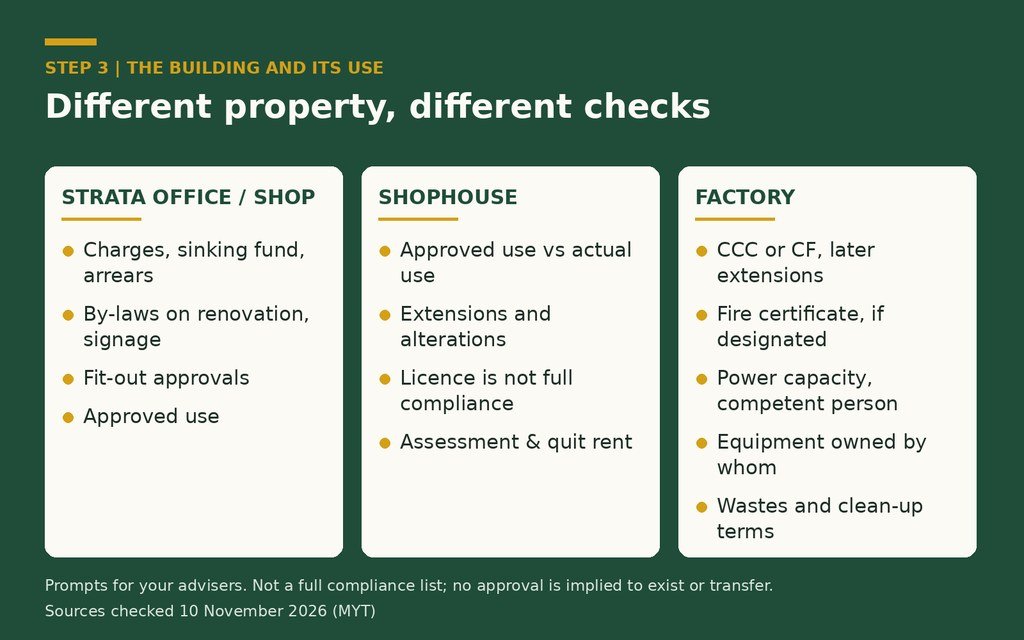
A tenant's valid business licence is useful, but it does not prove the building and its use comply with everything else. DBKL's licensing guidance says a premises licence is issued for an address and cannot be moved. It lists unapproved additions or alterations and fire-safety non-compliance among reasons an application can be refused. Check approvals directly rather than inferring them from a licence.
Strata offices and shops. Ask the management body for a statement of charges, sinking fund and arrears. Read the by-laws on renovation and signage, and ask whether the tenant's fit-out was approved.
Use and planning. In Selangor, the Town and Country Planning Act 1976 (2006 reprint) defines "development" to include a material change in the use of land or buildings, and section 19 generally requires planning permission, subject to exemptions. Kuala Lumpur has its own planning law, the Federal Territory (Planning) Act 1982. In both, check that the tenant's actual use and your intended use fit the approved use, and do not assume an approval carries over to a different occupier or activity.
Factories need the most homework:
- Completion certification. The Board of Architects' CCC circular explains that the Certificate of Completion and Compliance replaced the Certificate of Fitness for Occupation from April 2007, issued by the principal submitting person after required certifications and clearances, including TNB and generally the fire department. Ask for the CCC or CF, and approvals for later extensions or mezzanines.
- Fire certificate. Under Fire Services Act 1988, section 28, designated premises require a fire certificate, and the certificate "shall be renewable annually". Ask whether the premises is designated and who holds and renews the certificate.
- Power. Compare installed supply and capacity with what you or a future tenant need. The Electricity Regulations 1994, published by the Energy Commission, require installations to be inspected by a competent person (regulations 66–67), subject to exemptions. Ask who engages that person, and for recent records.
- Equipment. Agree in writing which items (cranes, transformers, compressors, racking) are sold with the building and which belong to the tenant.
- Environment. Some industrial activities generate scheduled wastes. Under the Environmental Quality (Scheduled Wastes) Regulations 2005, regulation 3, a waste generator must notify the Department of Environment within 30 days of generating new categories. Ask what the occupier handles on site, what the tenancy says about clean-up, and whether environmental advice is warranted.
7. What a clean completion file looks like
By completion, you should be able to put your hand on:
- the signed tenancy agreement, every variation and side letter, and evidence of stamping;
- the reconciled rent ledger and redacted payment evidence;
- a written statement of deposits and prepaid rent, showing amounts, evidence of receipt and how each was dealt with at completion;
- the owner's outgoings statements: assessment, quit or parcel rent, and strata charges and sinking fund where relevant;
- a dated condition record with photographs and an inventory of what belongs to the landlord and what belongs to the tenant;
- the notice to the tenant and rent payment instructions, checked against fraud;
- keys, access cards, alarm codes and management-office records where applicable;
- building approvals, CCC or CF, and certificates relevant to the property type.
8. Eight questions before you commit
- What is the current rent, and does the payment evidence match it?
- Are there arrears, concessions, side letters or disputes?
- How long is left on the term, and who holds renewal or break rights?
- Is the letting a tenancy of up to three years or a registered lease, and is anything endorsed on the title?
- Is the purchase subject to tenancy or with vacant possession, and is that written into the offer and the SPA?
- Which deposits and prepaid rent exist, who holds them, and how will each be accounted for at completion?
- What does the owner pay each year before any rent reaches you?
- Do the building's approvals and certificates support the current use and your intended use?
9. Red flags to take to your lawyer
- The tenancy is oral, unsigned, unstamped or "being renewed".
- The occupier is not the named tenant.
- Payment evidence is refused or offered only as a summary.
- Rent was raised, discounted or prepaid shortly before the sale.
- Deposits cannot be evidenced.
- The property is charged and no written bank consent to the tenancy can be produced.
- There are unapproved extensions, a change of use or missing CCC or CF records.
- Factory power, fire or waste arrangements are unclear.
- Anyone asks you to change the rent payment account by message.
The practical conclusion
A sitting tenant can be a real advantage if the income is documented, the tenancy's standing is understood and the handover is settled in writing. Inspect the unit yourself. Have your lawyer search the title and review the tenancy documents before you sign anything binding, and bring in the surveyor, engineer or tax adviser your property needs. An agent can help gather documents and ask the right questions. No agent's assurance, including mine, replaces that verification.
General information only. This is not legal, tax or financial advice. Laws and official guidance were checked on 10 November 2026 (MYT) and can change. Every purchase depends on its own documents and facts. Have a Malaysian conveyancing lawyer and other qualified advisers review your case before you commit.
Jessica Leong | Registered Estate Agent E3208
PropNex Realty Sdn Bhd (E (1) 1800/1), KLCC branch
Sources (checked 10 November 2026, MYT)
- National Land Code (Revised 2020), Act 828, official reprint: ss. 213, 221, 223–228, 316–317, 384–385
- JKPTG land legislation list
- Specific Relief Act 1950, s. 7 (secondary reproduction, mylaw.my)
- Stamp Act 1949, LHDN online version as at 1 January 2026: s. 52
- LHDN: Stamp Duty Self-Assessment System
- LHDN Public Ruling No. 12/2018, Income from Letting of Real Property: paras 8–9
- Royal Malaysian Customs Department, MySST industry guides
- TNB: Business change of tenancy and security deposit
- Energy Commission: Electricity Regulations 1994: regs 66–67
- Strata Management Act 2013, Act 757, as enacted (PPj copy): ss. 25, 52
- Town and Country Planning Act 1976, 2006 reprint (FAOLEX copy): ss. 2, 19
- DBKL Licensing and Business Development Department
- Board of Architects Malaysia, General Circular No. 1/2008 on CCC
- Fire Services Act 1988, s. 28 (secondary reproduction, mylaw.my)
- Environmental Quality (Scheduled Wastes) Regulations 2005, DOE copy: reg. 3
- C K Lim & Partners: Buying Property in Malaysia (2026)
- VCC Law: Guide to Buying Secondary Market Property in Malaysia (Part II)