Leasehold vs Freehold in KL and Selangor: How Lease Renewal Works, What It Costs, and How It Affects Your Loan and Resale
Leasehold is not a reason to walk away from a property, and freehold is not a guarantee of value. What matters is how many years are left, what renewal would cost and how that affects the next buyer and their bank. Here is how the process works under the National Land Code, the premium formulas in KL and Selangor, and what the RM5,000 Selangor scheme actually involves.
Also on Medium: read it on Medium
"Is it freehold or leasehold?" is one of the first questions buyers ask in KL and Selangor. Often the next thought is that leasehold is bad and freehold is safe. The reality is more nuanced.
Much of Selangor's township land, and some land in KL, was alienated by the state on leasehold titles, often for 99 years and sometimes for 60 or fewer. Many owners in older parts of Petaling Jaya are now facing the question of renewal. Buyers looking at leasehold condos in KL, or older terraces in PJ, need to understand what happens when a lease runs down.
This article explains what the law says, how renewal works, how the premium is calculated in KL and in Selangor, the Selangor scheme that lets owners renew for a nominal fee, and the effect on financing and resale.
Not legal advice: this is general information from public sources as at 13 November 2026 (MYT). Land matters depend on your own title. Please check with your lawyer and the relevant land office before you act.
The short version
- Leasehold land returns to the State when the lease expires, unless it has been extended. That is section 46 of the National Land Code (NLC).
- You can apply to extend the lease before it expires. Section 90A of the NLC lets the owner apply. The State Authority decides and can charge a premium. Anyone with a registered interest, such as your bank, must consent.
- For a strata building, the management corporation applies, on the authority of a unanimous resolution of owners.
- In KL, the premium for residential land is set by formula: 1/16 × land value × 1/99 × (new term − remaining term), payable within three months of the Form 5A notice.
- In Selangor, the full premium as reported is ¼ × 1/100 × land value × 99 years, with a 30% discount. Owners who don't plan to sell can instead pay a nominal fee, now reported as RM5,000 (it was RM1,000 when the scheme started in 2011), but transfers are then limited to family unless the balance is paid.
- Remaining lease affects financing and resale, so check the years left on the title, not just the word "leasehold".
Freehold and leasehold: what they mean
Freehold land is alienated in perpetuity. There is no expiry date on the title. Freehold owners still pay quit rent and assessment, are subject to the conditions and restrictions on the title, and their land can still be compulsorily acquired by the State under the Land Acquisition Act 1960, with compensation.
Leasehold land is alienated for a term of years, which is shown on the title. Section 46(1)(a) of the NLC says alienated land "shall revert to and vest in the State Authority … upon the expiry of the term, if any, specified in the document of title". In other words, when a lease runs out and has not been extended, the land goes back to the State.
That is why the remaining term matters far more than the label. A 99-year lease with 90 years left is a very different asset from one with 25 years left.
Restrictions in interest
Many leasehold titles also carry a restriction in interest, which means you need the State Authority's consent to transfer, charge or lease the property. Malay Mail described it as a clause that "prevents leasehold property owners from selling, pledging or leasing the property without the state authority's permission". Consent adds time to a sale or refinancing. Your lawyer's title search will show whether your title has one.
How lease renewal works under the National Land Code
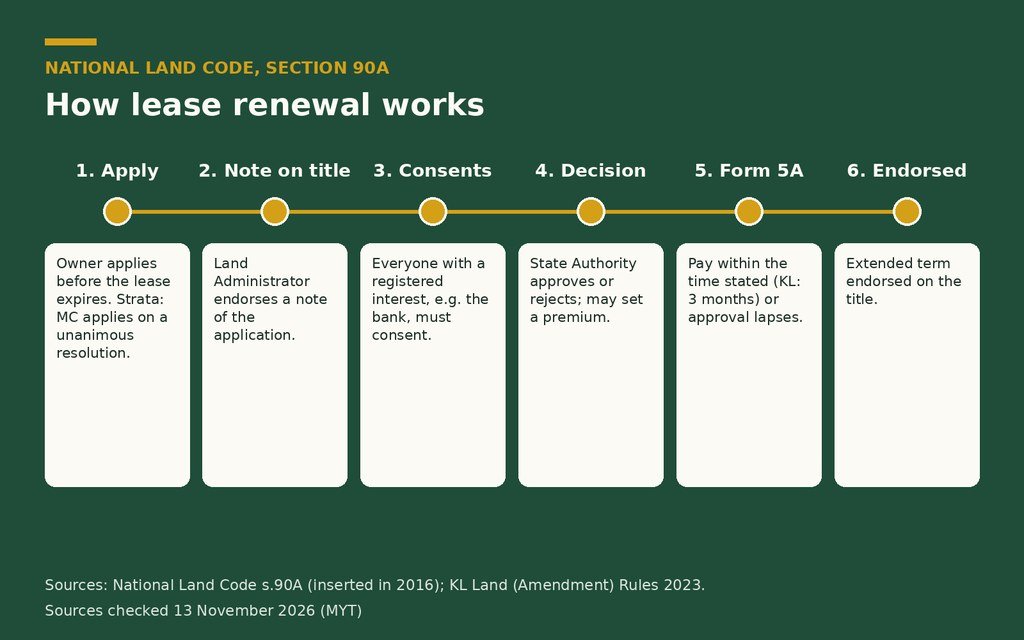
Since the National Land Code (Amendment) Act 2016, section 90A has set out a specific process to extend land alienated for a term of years. In summary:
- Apply before the lease expires. The owner applies to the State Authority. The application must be made before the expiry of the term on the title (s.90A(1)–(2)).
- A note goes on the title. The Land Administrator endorses a note of the application on the register document of title (s.90A(3)).
- Registered interests must consent. The State Authority won't consider the application unless everyone with a registered interest, such as a bank holding a charge, has consented or their consent should be dispensed with (s.90A(4)).
- The State decides. Approval or rejection is at the State Authority's discretion. Approval may be subject to a premium and other conditions (s.90A(5)).
- Form 5A. If approved, the Land Administrator serves a notice in Form 5A requiring payment within the time stated. If the sum is not paid in time, the approval lapses (s.90A(6)).
- The extension is endorsed. Once paid, a memorial of the extended term is endorsed on the title (s.90A(7)).
For strata properties, section 90A(8) allows the management corporation to apply, on the authority of a unanimous resolution, and the extension then applies to the subsidiary strata titles as well. In practice, that means every parcel owner has to agree, which can be the hardest step in an older condo or apartment block.
How the premium is calculated in Kuala Lumpur
KL is a Federal Territory, so the Federal Territory of Kuala Lumpur Land Rules apply. The Kuala Lumpur Land (Amendment) Rules 2023, P.U.(A) 213/2023, set the premium for extending alienated land under section 90A. For buildings used for housing, the premium is:
1/16 × land value × 1/99 × (new term − remaining term)
Other categories use different fractions: 1/8 for commercial and industrial land, 3/32 for mixed development, 1/32 for agriculture and 1/16 for other purposes.
The rules also say:
- the application is made to the Land Administrator on the prescribed form (Schedule 1A), with the fee, written consent from each party with a registered interest, and the issue document of title;
- if the application is approved, the Land Administrator issues a Form 5A requiring payment of the premium and other charges within three months of the notice being properly served.
Worked example (calc). Suppose a residential lot in KL has a land value of RM1,000,000 and 40 years left, and the owner applies for a new term of 99 years:
1/16 × RM1,000,000 × 1/99 × (99 − 40) = about RM37,247.
The land value used is determined by the authorities, not by the owner, and the actual new term is what the State approves. The example only shows how the formula responds: the fewer years left, the higher the premium.
How the premium is calculated in Selangor
In Selangor, the premium formula is set out in the Selangor Land Rules 2003. I was not able to access the official text or a Selangor land office document online. The figures below come from consistent reports in The Edge (2011), The Star (2025) and Malay Mail (2026), which quote the state's scheme and its booklet.
The full premium
As reported by Malay Mail in July 2026, an owner who intends to sell has to renew the lease for 99 years and pay the full premium based on:
¼ × 1/100 × value of land × 99 years × area of land
Because ¼ × 1/100 × 99 = 0.2475, this works out to roughly a quarter of the land's value (not the value of the house). The Edge described it the same way in 2011: "for the renewal of a 99-year lease, the owner has to pay around a quarter of the property's current value". The land value can be obtained from the Valuation and Property Services Department (JPPH), according to the Bukit Gasing assemblyman (The Star, 8 September 2025).
There is a 30% discount on the full premium. Malay Mail reports that the premium must be settled within six months after Form 5A is issued. The Star reported that the 30% discount applies to the first renewal.
Worked example (calc). On land valued at RM1,000,000:
- full premium: 0.2475 × RM1,000,000 = RM247,500;
- with the 30% discount: RM173,250.
The nominal-fee option (Private Residential Ownership Scheme)
Selangor also lets owners renew without paying the full premium up front, under what was launched as the Private Residential Ownership Scheme.
- What it costs. The Star (8 September 2025) and Malay Mail (22 July 2026) both report the nominal fee as RM5,000.
- The catch. After renewing this way, the owner can only transfer the property to a spouse or to biological or legally adopted children (Malay Mail). If the owner later sells to anyone else, the balance of the full premium must be paid (The Star).
- Who qualifies. The arrangement applies only to residential lots, not agricultural or commercial land, according to the assemblyman (The Star). Applicants have been asked to submit recent photos showing the house is still used as a home.
RM1,000 or RM5,000? You will see both figures online. When the scheme came into force on 1 June 2011, The Edge reported the nominal fee as RM1,000, and said it could also extend 60-year leases to 99 years. In March 2025, the National House Buyers Association referred to the 2011 policy as allowing renewal "for RM1,000". The more recent reports, in September 2025 and July 2026, both quote RM5,000. I could not find an official state document setting out when the figure changed. The safest reading is that RM1,000 was the original 2011 figure and RM5,000 is what owners are being quoted now. Confirm the current fee with your district land office before you apply.
Critics and timing
Not everyone sees the nominal option as a solution. A Petaling Jaya residents' association chairman told The Star it "pushes the real cost into the future", since the full premium is still due on a sale and land values tend to rise. The assemblyman told Malay Mail that the state has no record of rejecting complete applications and that owners can renew at any time before expiry, but that approval could take up to two years in the Petaling district because of the number of applications.
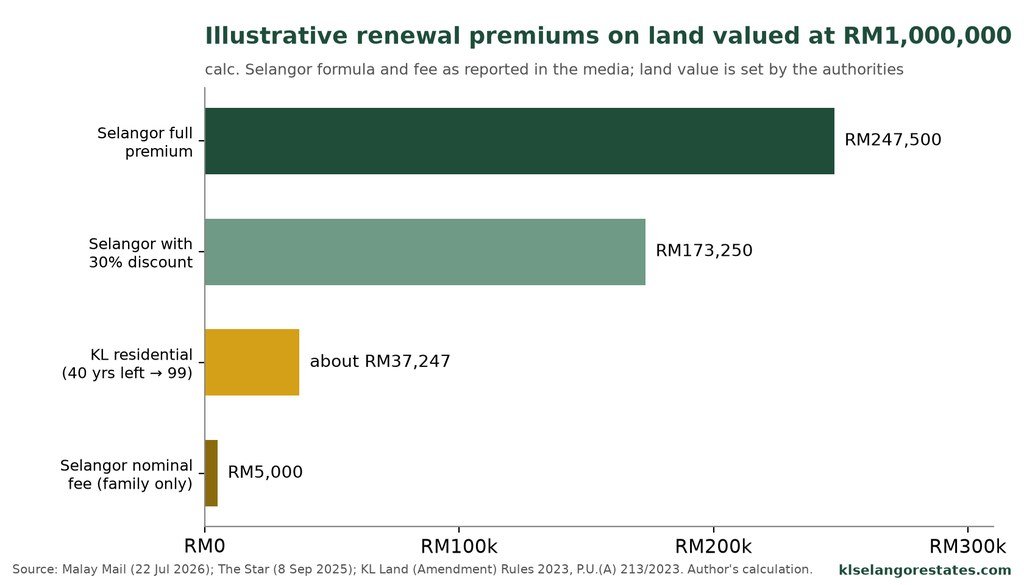
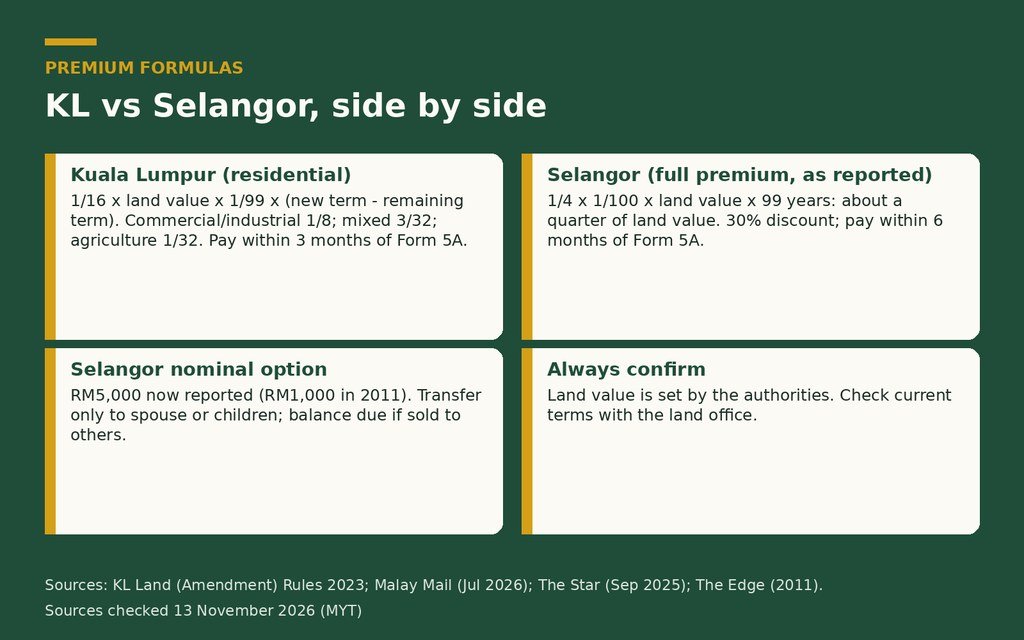
Comparing KL and Selangor. The two formulas are built differently. KL's charges for the years being added, at 1/16 of land value per 99 years. Selangor's full premium, as reported, is about a quarter of land value for a 99-year renewal, before the discount. Don't compare them without checking the land value each authority would use and the term it would approve.
How remaining lease affects financing
Banks lend against security. The shorter the remaining lease, the less security they have, and the harder it can be for a buyer to borrow.
I have not found a published, industry-wide rule on minimum remaining lease for a home loan. Policies vary by bank and change over time. One PJ resident told Malay Mail that "banks generally refuse loans for properties with leases between 20 to 25 years or less", and that buyers are affected by "the narrow margins of loans and the repayment periods extended by banks, based on the shorter lease period". Treat that as a resident's experience, not a rule. If you are buying, ask your bank directly before you sign:
- Will you finance this property, given the remaining lease?
- What is the maximum tenure, and how does it relate to the lease?
- What margin of finance will you offer?
- If the title has a restriction in interest, how long does state consent to charge usually take?
How remaining lease affects resale
The same issues follow you when you sell:
- A smaller pool of buyers. If buyers can't get a loan, or can only get a short one, the property appeals mostly to cash buyers. A Section 11 resident told Malay Mail that "only cash-rich people can afford to purchase the property", and that they usually bargain for a low price.
- Renewal costs come into the price. In Selangor, an owner who renewed under the nominal option must pay the balance of the premium to sell to an outsider. Either the seller pays it or the price reflects it.
- Consent and approvals take time. A restriction in interest, a pending renewal or a slow land office can all lengthen the completion period.
- Nearby freehold competes. Residents in PJ pointed out that leasehold areas sit next to freehold neighbourhoods, which buyers can choose instead.
I am not aware of official data that measures a "leasehold discount" in KL or Selangor, so I won't put a figure on it. The practical point is simple: the fewer years left, the more the next buyer and their bank will ask about it.
What about converting to freehold?
Some owners hope for conversion to freehold. In August 2022, Negeri Sembilan announced that leasehold residential properties could be converted to freehold, with some exceptions (Malay Mail). Residents' groups in PJ have asked Selangor to follow. The assemblyman said the question would have to be referred to the Menteri Besar's office. As of the date of this article, I have not found any announcement of a freehold conversion policy for Selangor or KL.
A practical checklist
If you are buying a leasehold property
- Read the title: the expiry date, the years remaining and any restriction in interest.
- Ask your bank about financing, tenure and margin before you sign anything.
- Check whether a renewal application is pending, and whether a previous renewal was made under the nominal-fee option.
- For a strata property, ask the management corporation whether renewal has been discussed, and remember that it needs a unanimous resolution.
- Factor a possible premium into your offer, using the formulas above as a rough guide only.
If you own a leasehold property
- Know your expiry date. Applications must be made before the lease expires.
- Get the current checklist and fee from your district land office.
- Decide between the full premium (with the discount) and the nominal option, based on whether you may sell.
- Line up your bank's consent if the property is charged.
- Allow for approval to take time: up to two years in Petaling, according to the assemblyman.
- Pay within the Form 5A deadline: three months in KL; six months for the Selangor discount, as reported. If you miss it, the approval lapses.
The practical conclusion
Leasehold doesn't make a property a bad buy, and freehold doesn't make one a good buy. What matters is the number of years left, what renewal would realistically cost, and how both affect the next buyer and their bank. In KL, the premium is set by a published formula that depends on how many years you add. In Selangor, owners can choose between a full premium with a 30% discount, or a nominal fee that is now reported as RM5,000, which keeps the property in the family but defers the full cost to a sale. Check the title, ask the bank and confirm the current terms with the land office before you commit.
General information only. This is not legal, financial or valuation advice. The Selangor premium formula and the nominal fee are as reported by The Edge, The Star and Malay Mail; I could not access an official Selangor document, so please confirm the current terms with your district land office. Worked examples are illustrations (calc) using assumed land values. Figures were checked on 13 November 2026 (MYT).
Jessica Leong | Registered Estate Agent E3208
PropNex Realty Sdn Bhd (E (1) 1800/1), KLCC branch
Marc Residence, Jalan Pinang, Kuala Lumpur | Office 03-2161 8608
Call/WhatsApp 010-464 6088
Sources (checked 13 November 2026, MYT)
- National Land Code (Revised 2020), section 46 and section 90A (text from Laws of Malaysia, AGC)
- National Land Code (Amendment) Act 2016, section 15 (inserting section 90A)
- Kaedah-Kaedah Tanah Wilayah Persekutuan Kuala Lumpur (Pindaan) 2023, P.U.(A) 213/2023, rule 3 (new rule 8A) and rule 3A
- Malay Mail, "Petaling Jaya's leasehold dilemma: High premiums, shrinking buyers and ageing leases" (22 July 2026)
- The Star, "Understand your options, PJ leasehold owners told" (8 September 2025)
- The Star, "Lower premiums for PJ Old Town shop owners" (3 March 2025)
- The Edge, "Lease renewal for just RM1,000" (2011)
- The Edge, "Scheme solves issues of renewing land leases" (2011)