The Urban Renewal Bill Is Back on the Dewan Rakyat Order Paper: What That Means, and What to Watch From 30 November to 8 December 2026
The Cabinet decided in January to withdraw and redraft the Bill, yet it is listed again for resumed debate. Here is what a listing does and doesn't mean, how we got here, the possible outcomes and what owners of older flats and strata in KL and Selangor should do now.
Also on Medium: read it on Medium
On 9 November 2026, the New Straits Times reported that the Urban Renewal Bill is among seven bills lined up for the Dewan Rakyat from 30 November. If you own a unit in an older flat or strata block, your first reaction may well be: "I thought it was withdrawn. Is it coming back?"
It is a fair question. In January 2026, the Cabinet decided to withdraw the Bill so it could be improved and re-tabled. In my earlier article I explained what the Bill proposed, why it stalled and what the law says without it. This follow-up covers what has happened since, what the new listing means and what to watch when the Dewan Rakyat turns to bills between 30 November and 8 December 2026.
Not legal advice: this is general information from public sources as at 13 November 2026 (MYT). It is not legal, tax or financial advice. Please speak to your own lawyer before you sign anything relating to a redevelopment or en-bloc proposal.
The short version
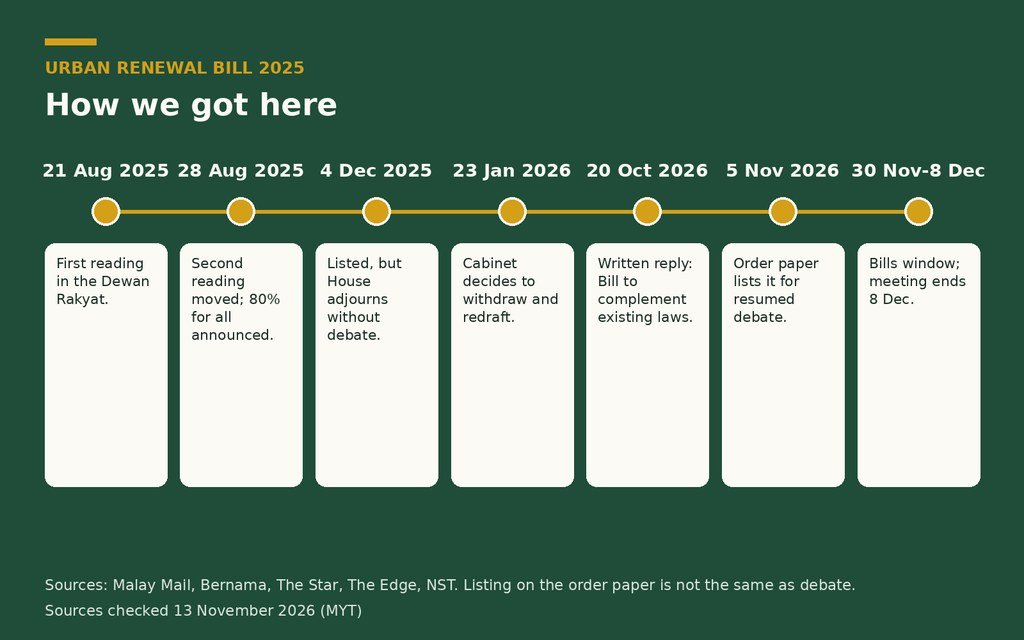
- The Bill is listed, not scheduled for a vote. According to the NST, the Dewan Rakyat Order Paper dated 5 November lists the Urban Renewal Bill 2025 for the resumption of debate. The second reading began on 28 August 2025.
- It was never formally withdrawn. The Cabinet decided to withdraw it in January 2026, but The Edge reported on 21 October 2026 that the Bill "has yet to be formally withdrawn from Parliament and remains on the order paper".
- Being listed is not the same as being debated. The Bill was also listed in December 2025, and the Dewan Rakyat adjourned without debating it.
- The window is short. Budget 2027 committee-stage debates run from 16 to 19 November. Bills and other government business are slotted from 30 November to 8 December, when the meeting ends.
- Several outcomes are possible: the Bill is not reached, it is formally withdrawn, debate resumes with amendments, or a redrafted bill is tabled.
- Nothing changes for owners today. Without a new law in force, ending a strata scheme still needs a unanimous resolution under the Strata Titles Act 1985, unless a court orders otherwise.
What exactly was reported
The NST report of 9 November 2026 is based on the Dewan Rakyat Order Paper dated 5 November. It says seven bills, including those on adoption, the criminal registry, the judiciary and urban redevelopment, are among the business scheduled after the Budget 2027 debates. Some are listed for second reading and others for the resumption of debates that were adjourned earlier.
On the Urban Renewal Bill specifically, the NST wrote that it "began its second-reading debate on Aug 28 last year" and "is also listed for the resumption of debate".
Two details in the same report matter just as much:
- the official calendar shows that sittings from 16 to 19 November are still allocated to the Budget 2027 debates at committee stage, with bills and other government business from 30 November to 8 December;
- the list "is based on the Nov 5 order paper and is subject to the latest order of business to be issued by parliament".
In other words, the listing tells us the Bill is still formally before the House. It does not tell us the government has decided to bring it to the floor in this meeting.
Why a withdrawn Bill can still appear on the order paper
There are two separate steps here, and the news has run them together.
The Cabinet decision came first. On 23 January 2026, the government spokesman said the Cabinet had agreed to withdraw the Bill to allow for amendments and enhancements. The same day, the Housing and Local Government Minister, Nga Kor Ming, said his ministry would continue engagement sessions and that once improvements were finalised, the Bill "will be re-tabled in Parliament in an enhanced format" (The Star).
The parliamentary step has not followed. Once tabled, a bill stays before the Dewan Rakyat until the House disposes of it, for example by passing it or through a formal withdrawal, or until Parliament is dissolved. On 21 October 2026, The Edge reported that the Bill "has yet to be formally withdrawn from Parliament and remains on the order paper".
So when the Bill appears again on the order paper, that is consistent with its procedural status. It is not, on its own, evidence of a change of policy.
We have seen this before
The best guide to what a listing means is what happened last time. In December 2025, the Bill was listed as item number five on the Order Paper on the final day of that meeting. The Star reported on 5 December 2025 that it "never made it to the floor" and that the Dewan Rakyat adjourned without debating it. That was despite the Minister having said shortly before that his ministry was ready to bring it forward, pending a slot from the Leader of the House.
What the government has said most recently
The clearest recent statement is the Minister's written parliamentary reply of 20 October 2026 to the MP for Bukit Bintang, who had asked about legal mechanisms for the compulsory acquisition of abandoned strata buildings. According to The Star and The Edge, the Minister said:
- the proposed Bill is intended to complement existing laws on abandoned and dilapidated strata buildings, not replace them;
- the Land Acquisition Act 1960, following amendments in force since 2017, already provides procedures to acquire subdivided land or buildings, and the Strata Titles Act 1985, as amended in 2016, also provides a mechanism for dilapidated or abandoned strata schemes, though its scope is limited to strata;
- under the proposed framework, owners would receive rights and interests "no less favourable", including a suitable new property based on the value of their existing one;
- that valuation would take into account future values, with developers bearing the cost based on projected profits "regulated and agreed upon by the government".
He added: "The government cannot remain silent and allow ageing, dilapidated buildings to continue endangering the people and hampering national development."
Two things stand out. First, the government is still committed to an urban renewal law. Second, the ministry has not published a redrafted text, so we don't know how these ideas would be written into a bill.
What changed in the original Bill before it stalled
For readers who missed the earlier debate, here is a brief recap. The Bill as tabled in August 2025 (D.R. 25/2025) set different consent thresholds for committee-led projects: 80% for buildings 30 years old or less, 75% for those over 30 years and 51% for abandoned buildings or those with a Professional Engineer's visual inspection report. Owners applying voluntarily needed unanimous consent.
On 28 August 2025, the Minister announced that clause 19 would be amended to set 80% for all buildings. The Prime Minister confirmed the next day that the government had agreed to raise the threshold to 80% (The Star, 30 August 2025). In November 2025, the Minister said in a written reply that the proposed 30-year age threshold was under review (The Star, 27 November 2025).
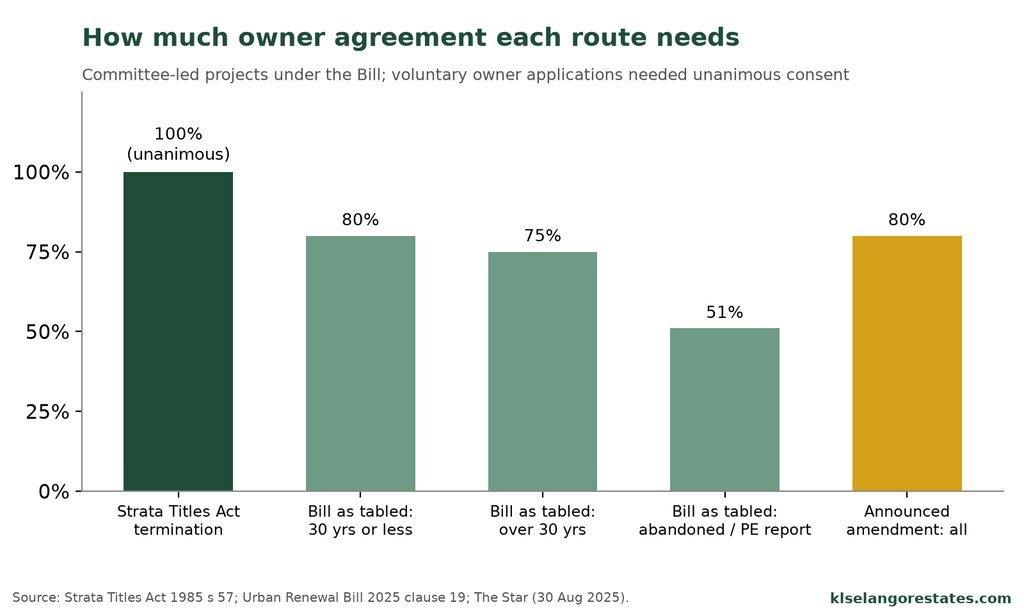
Those amendments were announced but never moved in the House. Any version that comes forward, whether through resumed debate or a new bill, could look different.
The opposition has not gone away
The political temperature is still high. Speaking on 12 November 2026, MCA president Datuk Seri Dr Wee Ka Siong said "more than 70 residents' associations had raised concerns about the proposed legislation", particularly on consent requirements, compensation and the rights of existing homeowners. He said the opposition "was not against urban redevelopment itself" but wanted existing owners "adequately protected and not placed at a disadvantage" (Sinar Daily, 13 November 2026).
That matters for timing. A Bill that drew objections from the Malaysian Bar, residents' associations, professional bodies and MPs on both sides in 2025 is unlikely to be pushed through quickly without visible changes.
Four possible outcomes between 30 November and 8 December
I can't tell you which will happen, and nobody outside government can yet. But these are the realistic possibilities, and what each would mean.
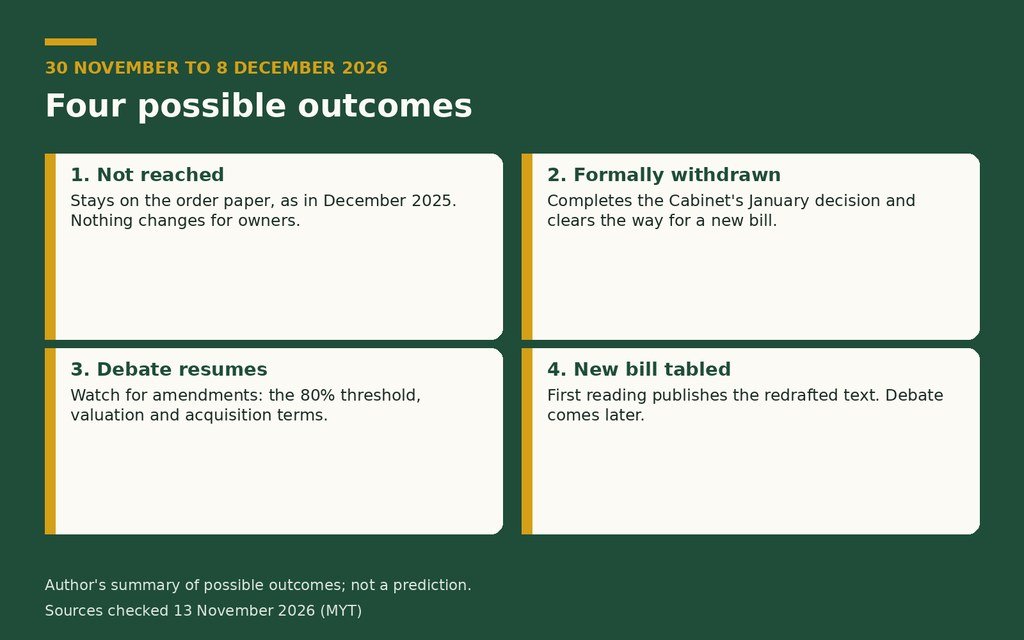
1. The Bill is not reached. This is what happened in December 2025. It would stay on the order paper, and nothing would change for owners. The question would roll into the first meeting of 2027.
2. The Bill is formally withdrawn. This would complete the step the Cabinet decided on in January. It would clear the way for a new bill, but it would not by itself tell us when the new bill will come or what it will say.
3. Debate on the original Bill resumes. If that happened, watch whether the government moves the amendments it announced in August 2025, such as the 80% threshold for all buildings and the demographic factor, and whether it adds anything on valuation and compulsory acquisition. Even if the Dewan Rakyat passed the Bill, it would still need to pass the Dewan Negara and receive royal assent. The Bill also provides that it comes into operation on a date the Minister appoints by notification in the Gazette.
4. A redrafted bill is tabled for first reading. This would be the "enhanced format" the Minister promised in January. A first reading only introduces a bill and makes its text public. Debate would come later. If this happens, the published text is the thing to read closely.
What to watch, item by item
- The daily Order of Business. The Dewan Rakyat publishes its order of business for each sitting day. See whether the Urban Renewal Bill moves up the list, and whether it is called.
- A motion or statement on withdrawal. That would be the clearest sign that a new bill is coming.
- A new bill number. A redrafted bill would carry a new D.R. number and a published text.
- The consent threshold. Will it be 80% for all buildings, higher, or tied to building condition?
- The age threshold. Is the 30-year marker kept, changed or dropped?
- Compulsory acquisition. Does the text keep a power like clause 21(4), which tied acquisition under the Land Acquisition Act 1960 to the consent threshold?
- Valuation. How will "no less favourable" and the developer's projected profits be defined, and who verifies them?
- Tenants and non-participating owners. Are they protected, and how?
- Disputes. Does the redraft add a tribunal, or keep mediation committees only?
What this means for owners of older flats and strata today
Whatever happens in the sitting, the legal position for owners today has not changed.
- A strata scheme can't be ended by majority vote today. Under section 57 of the Strata Titles Act 1985, terminating a strata subdivision needs a unanimous resolution, unless a court orders otherwise under section 57(7).
- Developer approaches are private offers. If someone approaches you to buy your unit or join a redevelopment, that is a commercial proposal. It is not an exercise of powers under the Bill, because the Bill is not law. Get the terms in writing and have your own lawyer read them.
- Compulsory acquisition by the State is still possible under the Land Acquisition Act 1960, with compensation. That was true before the Bill and remains true.
- Building inspections already apply. Under section 85A of the Street, Drainage and Building Act 1974, high-rise buildings must undergo inspections 10 years after the Certificate of Completion and Compliance or Certificate of Fitness, and every 10 years after that, as the Minister noted in November 2025.
- Your own paperwork matters. If your title is not in order, for example an unresolved estate, an unissued strata title or a caveat, sort it out now. It will matter in any future sale or redevelopment.
- Good management protects value. Attend your management corporation's AGM, read the accounts and check the sinking fund. I explained how in my guide to checking an older condo's finances.
If you are buying or investing in an older building
Don't price in the Bill. There is no new text, no final threshold and no confirmed acquisition power. A deal that only works if a law passes in a particular form is a speculation, not a plan. For collective purchases of strata buildings, plan on the basis that you need every owner, or a unanimous resolution, or a court order. I compared the main structures for en-bloc deals in my Selangor en-bloc article.
After 8 December
According to the NST, the meeting is scheduled to run for 37 days and end on 8 December 2026. If the Bill isn't dealt with by then, the next opportunity will be at the first meeting of 2027, and the questions above will still be the ones to ask.
The practical conclusion
The Urban Renewal Bill's appearance on the order paper is real news, but it is not, by itself, a sign that the old Bill is about to pass. The Cabinet decided in January to redraft it, the Bill has not been formally withdrawn and it was listed without being debated once before. The useful thing for owners is to watch for a concrete step: a debate, a formal withdrawal or a new text. Until then, the protections in today's law remain in place.
General information only. This is not legal, tax or financial advice. The Urban Renewal Bill has not been passed and its contents may change. Parliamentary business is subject to the order of business issued by Parliament. Facts were checked on 13 November 2026 (MYT) against the sources listed. Please consult your own lawyer before acting on any redevelopment or en-bloc proposal.
Jessica Leong | Registered Estate Agent E3208
PropNex Realty Sdn Bhd (E (1) 1800/1), KLCC branch
Marc Residence, Jalan Pinang, Kuala Lumpur | Office 03-2161 8608
Call/WhatsApp 010-464 6088
Sources (checked 13 November 2026, MYT)
- New Straits Times, "Seven bills lined up for Dewan Rakyat from Nov 30" (9 November 2026)
- The Edge Malaysia, "Urban Renewal Bill to factor in developers' projected profits in valuing replacement properties" (21 October 2026)
- The Star, "Urban Renewal Bill to complement laws on dilapidated strata buildings, says Nga" (21 October 2026)
- Sinar Daily, "Political differences should not hinder fight to protect homeowners - MCA" (13 November 2026)
- The Star, "Housing Ministry will continue to enhance URA before re-tabling, says Nga" (23 January 2026)
- Malay Mail, "Fahmi: Putrajaya pulls Urban Renewal Bill to make room for fresh input after MP feedback" (23 January 2026)
- The Star, "Urban Renewal Bill not debated" (5 December 2025)
- The Star, "Govt reviewing proposed 30-year age threshold for ageing buildings, says Nga" (27 November 2025)
- The Star, "It's at 80% consent now" (30 August 2025)
- Bernama, "Urban Renewal Bill: KPKT to amend provisions, including consent threshold" (28 August 2025)
- Malay Mail, "Urban Renewal Bill 2025 tabled for first reading" (21 August 2025)
- Urban Renewal Bill 2025 (D.R. 25/2025), full text: clauses 1(3), 19 and 21(4)
- Strata Titles Act 1985, section 57
- Malaysian Bar, "Malaysian Bar's Position on the Urban Renewal Bill 2025" (27 August 2025)
- Parliament of Malaysia, Dewan Rakyat bills list