Buying an Older Condo in KL or Selangor: How to Check the Building's Finances Before You Buy
Age alone does not show a building's financial health, and a fresh lobby does not show what remains for less visible work. Here is how to ask for the right documents, read them without an accounting background and take the open questions to your lawyer before you commit.
Also on Medium: read it on Medium
An older condo can be a sensible buy, and it has a history you can check in its accounts, minutes and repair records. Age alone does not make a building unhealthy, and newness does not make one healthy. Some older buildings are well run and well funded. Some younger ones are not.
Age does affect the timing of big repairs: lifts, pumps, pipes, roofs and waterproofing, the façade and fire systems. Whether those costs land comfortably or as a surprise depends on the building's money and its owners' decisions. A fresh lobby does not show what remains available for less visible work.
This guide is for buyers of an existing unit in Kuala Lumpur or Selangor from a private seller: what to ask for, who can obtain it and how to read it. The legal references are to the Strata Management Act 2013 (Act 757) as enacted and the Strata Management (Maintenance and Management) Regulations 2015, the versions I could obtain. Always have your lawyer confirm the current text. For background, see my earlier article on strata management law for owners.
The short version
- Separate four questions: how much cash the building really has, how well owners pay, what it already owes or has committed, and what major work is coming.
- Treat the two accounts separately. Charges and the sinking fund are different accounts with different legal purposes.
- Ask through the right person. A prospective purchaser can apply for a statutory certificate. Other records usually come through the seller or someone the seller authorises.
- Read audited accounts with questions in mind. An audit is an opinion on the figures, not a survey of the building.
- Keep building-wide arrears and your unit's arrears apart. Then let your lawyer handle both the legal position and the sale contract.
- Do not treat low charges as a bargain, or as a warning, until you know why they are low.
First, who runs the building?
Most strata buildings are managed by a joint management body (JMB) or a management corporation (MC). A JMB generally manages before the MC takes over, typically where strata titles have not been issued or the MC has not held its first annual general meeting. The Act gives the two bodies similar but separately numbered duties: sections 21 to 34 for a JMB, and sections 59 to 78 for an MC. Some provisions are worded differently for each, so ask the seller or management office which body is in place, and who the managing agent is. Section 4 provides for a Commissioner of Buildings (COB) to administer the Act; in Kuala Lumpur, DBKL publishes COB strata circulars on its guidelines page.
Four separate questions about the money
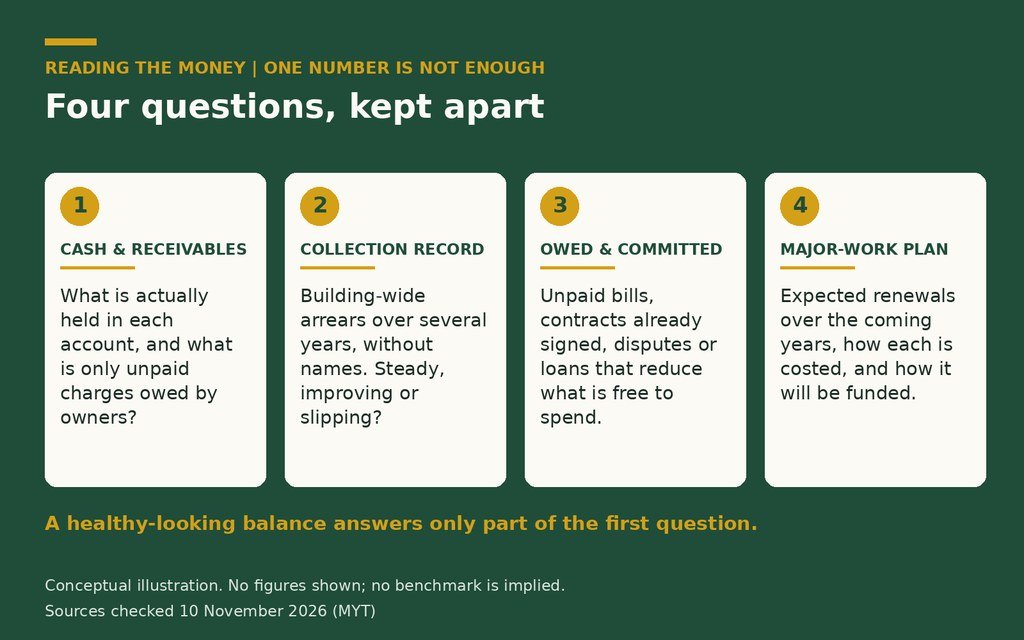
It is easy to stop at one number, such as "the sinking fund has a healthy balance". Ask four separate questions instead.
1. What is the cash position, and what is only a receivable?
The accounts show money held in each account, often in current accounts and fixed deposits, and sums owners owe but have not paid. Those arrears are receivables, not money in the bank, and some may never be collected. Ask how much of each account is cash or deposits, and how much is unpaid charges.
2. What is the owners' collection track record?
One year's arrears figure says little; a trend over several years says more. Ask for building-wide arrears for each recent year, without owners' names or unit numbers. Is collection steady, improving or slipping, and is it a few large defaulters or widespread?
3. What does the building already owe, or has it already committed?
Unpaid contractors, accrued bills, deposits held, disputes, loans and unfinished contracts all reduce what is free to spend. The statutory certificate described below shows the sum in each account "that has been committed or reserved for expenses already incurred". That is a useful start, but it may not capture work discussed and not yet contracted.
4. Is there a multi-year plan for major work?
Ask whether there is a schedule of expected major works and how they will be funded. Some buildings have a formal plan backed by a professional condition assessment, some a list in the minutes, some nothing written. No plan does not prove trouble is coming, but you are relying on less evidence.
Two accounts, two purposes
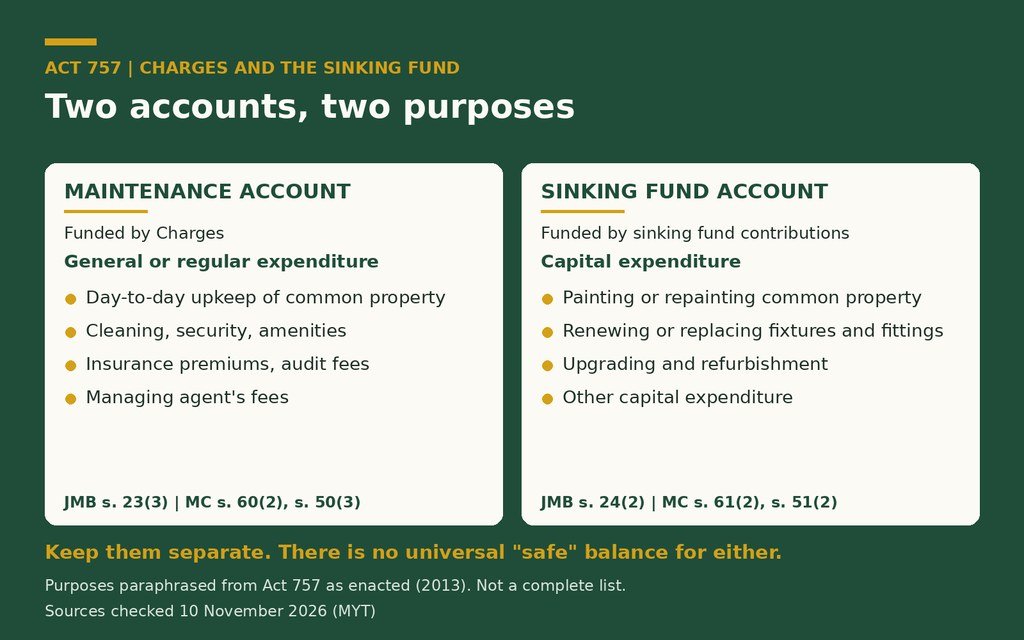
Charges go into the maintenance account. For a JMB, section 23(3) says this account is to be used "solely for the purpose of meeting the actual or expected general or regular expenditure". It lists items such as day-to-day upkeep of common property, cleaning and security, insurance premiums, minor painting, audit fees and the managing agent's fees. The MC equivalent is section 60(2), which applies the purposes in section 50(3).
Sinking fund contributions go into the sinking fund account. Section 24(2), for a JMB, limits it "solely" to "actual or expected capital expenditure". That covers painting or repainting common property, renewing or replacing fixtures and fittings, upgrading and refurbishment, and other capital expenditure. The MC equivalent is section 61(2), which applies section 51(2).
The enacted text sets the contribution rate separately for each body, in different words. For a JMB, section 25(4) sets it at 10% of the Charges "unless otherwise determined by the joint management body from time to time at a general meeting which shall not be less than ten percent of the Charges". For an MC, section 61(3), "subject to section 52", sets it at 10% of the Charges "unless otherwise determined from time to time at a general meeting of the management corporation, but such contribution to the sinking fund shall not be less than ten per cent of the Charges". Neither provision measures how big any building's fund ought to be.
There is no universal "safe" balance. It depends on the building's size, systems, condition, past works and plans. A large balance may be earmarked for a lift contract; a modest one may suit a building that has just finished major renewal. Nor is there an automatic link between a fund balance and a unit's rental yield or value.
The same caution applies to low monthly charges. They can reflect efficient management or fewer facilities. They can also reflect underfunding, with charges kept down while repairs pile up. Compare the budget with actual spending, and check how often additional contributions have been needed.
What you can ask for, and who can get it
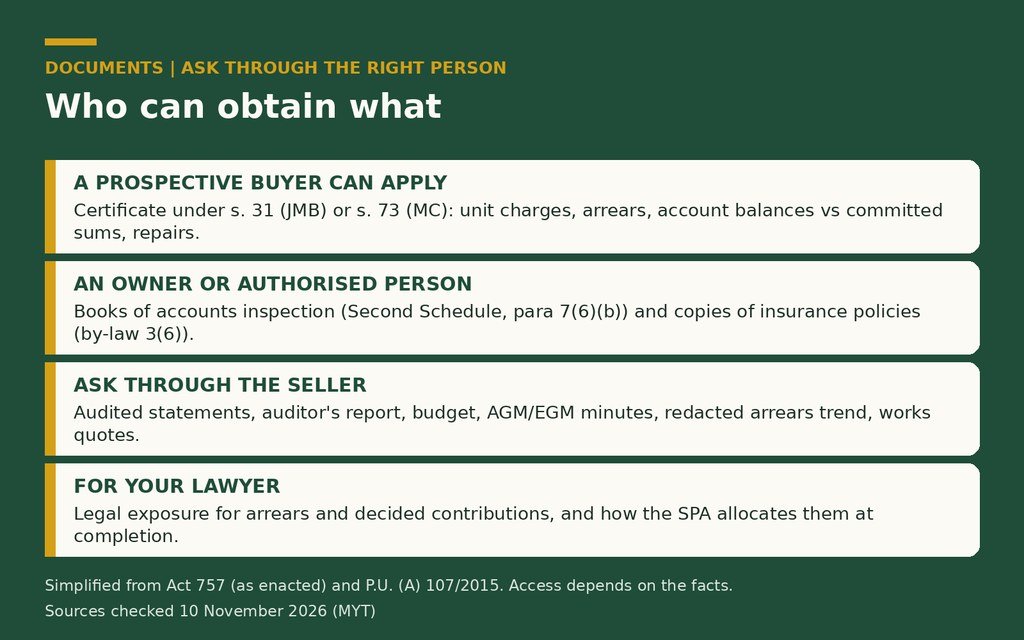
Not every record is open to the public. This is how the enacted text sorts access.
The statutory certificate a prospective buyer can apply for
Section 31 (for a developer or JMB) and section 73 (for an MC) say that, on application by or on behalf of a parcel owner or proprietor or a prospective purchaser or proprietor, and on payment of a fee not exceeding RM50, the body "shall issue" a certificate. The certificate sets out:
- the Charges and sinking fund contribution payable for the unit, and the time and manner of payment;
- any arrears of Charges and sinking fund contribution on the unit;
- the sum standing to the credit of the maintenance account, and the sum committed or reserved for expenses already incurred;
- the same two figures for the sinking fund account;
- the nature of repairs and estimated expenditure, where the body has incurred expenditure or is about to do repairs, work or an act for which the unit's owner is likely to become liable.
Regulations 19 and 30 of the 2015 Regulations require it within 21 days, in Form 10 (JMB) or Form 19 (MC). Your lawyer may apply as part of the purchase. It is a dated snapshot, so check it against the accounts.
Records the owner, or someone the owner authorises, can inspect
Under paragraph 7(6)(b) of the Second Schedule to the Act, the management committee must make the books of accounts available for inspection during office hours. This applies on the application of a proprietor or chargee, or anyone they authorise in writing, at a fee not exceeding RM50 per inspection. Section 22(2) applies this Schedule to a JMB with modifications. A prospective buyer is not named, so the practical route is to ask the seller to obtain the records or to authorise inspection.
Documents to request through the seller
- Recent audited financial statements, with the auditor's report. The Act requires JMBs and MCs to have the accounts audited annually by an approved company auditor and to provide audited financial statements to their members (sections 21(1)(g), 26, 59(1)(g) and 62).
- The current budget and management accounts, if the management office prepares them.
- Minutes of recent annual and extraordinary general meetings. The Second Schedule requires minutes to be kept. Within 28 days of a general meeting, copies must be extended to all proprietors or displayed on the notice board (paragraph 7(1) and (9)).
- A redacted arrears and collection trend for the whole building.
- Details of approved, tendered or quoted major works, and how each will be paid for.
- Insurance policies. By-law 3(6) in the Third Schedule to the 2015 Regulations requires copies of the policies to be furnished to a proprietor on written request, for a fee not exceeding RM50. Check what the building policy covers and excludes. Section 93 requires a damage policy for the building. Do not assume it covers an owner's contents or renovations.
Respect privacy: you need building-wide patterns, not other owners' names or debts.
How to read the accounts without being an accountant
You do not need to audit the auditor, but read with a few questions in mind and ask an accountant if something looks unusual.
- Start with the auditor's report. Note any qualified opinion, disclaimer, emphasis of matter or going-concern note, and ask why.
- Find each account separately. Look for the maintenance and sinking fund balances, and whether they are held as cash, deposits or both.
- Look at receivables. How much is unpaid Charges, and is part of it written down as unlikely to be collected?
- Look at payables, accruals and commitments. Some of the cash may already be spoken for.
- Compare income with spending over several years. Is the maintenance account running deficits?
- Check what the sinking fund paid for. Does it look like capital work, or regular running costs?
- Compare the budget with actual results. Large, repeated gaps are worth a question.
An audit is an opinion on whether the financial statements are fairly presented. It is not an engineer's view of the building, and it does not mean every decision was wise. If the latest audited accounts are missing or old, ask why. A gap is a reason for questions, not on its own proof that the law was broken, but you will be relying on less evidence.
Building-wide arrears vs your unit's clearance
Building-wide arrears affect the building's cash and ability to carry out work, and may lead to higher charges or additional contributions later. Your unit's arrears are whether the seller has paid what is due on your unit, which the statutory certificate shows.
How the law treats a seller's unpaid sums needs careful reading. For an MC, sections 60(4) and 61(4) say that Charges and sinking fund contributions may be recovered under section 78 from the proprietor "or his successor-in-title to, the parcel". The JMB provisions (sections 25(6) and 34) are worded around the parcel owner or purchaser. What this means for a particular purchase depends on the facts, the documents and the current law. Ask your lawyer to check your legal exposure, and separately to make sure the sale and purchase agreement (SPA) and the completion arrangements deal with arrears, apportionment and any sums decided before completion.
Take the same care with additional contributions, often called special levies. Ask your lawyer to verify the authority and resolution behind any levy, its amount, its due dates and your legal exposure as the incoming owner, and then, separately, how the SPA allocates it between you and the seller. That allocation binds buyer and seller. It does not necessarily limit what the JMB or MC can lawfully recover, or from whom.
Upcoming works and possible additional contributions
Older buildings face familiar big items: lifts, roofs and waterproofing, façade, pumps and tanks, pipes, fire systems and repainting.
For each, ask:
- whether it has been discussed, approved, tendered, contracted or completed;
- whether the cost comes from a professional quotation or an estimate;
- how it will be funded: the sinking fund, an additional contribution, a loan or a mix;
- whether a fair procurement and tender process was followed. By-law 3(7) of the Third Schedule requires "proper procurement procedures and tender process in a fair and transparent manner".
Keep your walk-round in proportion. Rusty pipes, ceiling stains, cracked render and lift breakdown notices are worth noting, but that is a visual checklist. Whether a system is safe or near the end of its life is a question for an engineer or the relevant competent person, and sometimes an authority.
Lifts are a good example. DOSH states that power-driven lifting machinery must hold a valid Certificate of Fitness to be operated, under regulations in force since 1 June 2024. A current certificate is evidence of compliance at inspection. It is not a forecast of when the lift will need major renewal. Fire systems have their own maintenance and approval requirements. Ask the management for maintenance records and for any certificates or approvals that apply to the building, rather than assuming.
Not every building commissions engineering reports, and existing ones may not be shared. Treat what you cannot see as a gap.
Signals that deserve a follow-up question
None of these is a verdict on its own; each is a reason to ask more.
- Audited accounts that are late, missing or carry a qualified opinion.
- Arrears rising year after year, or concentrated in a few large accounts.
- Sinking fund spending that looks like routine running costs.
- Repeated deficits in the maintenance account, or large unexplained transfers.
- Major works discussed for years but never funded.
- Very low charges with a long list of deferred repairs.
- A general meeting that could not reach quorum, or frequent committee turnover.
- Disputes with contractors, or pending tribunal or court claims.
- Reluctance to provide documents an owner is entitled to see.
A well-attended general meeting is encouraging but does not prove financial health, and fresh paint does not show the funds are adequate.
A buyer's checklist
- Confirm whether a JMB or MC runs the building, and who the managing agent is.
- Ask your lawyer to apply for the section 31 or section 73 certificate, and check its date.
- Obtain the last two or three years of audited financial statements, with the auditor's reports.
- Obtain the current budget and any recent management accounts.
- Ask for a redacted building-wide arrears and collection trend.
- Read recent AGM and EGM minutes for works, levies, disputes and quorum.
- List approved, tendered or quoted major works and how each will be paid for.
- Compare each account's balance with its committed sums and receivables.
- Check the building policy's scope and exclusions; arrange your own cover.
- Note visible defects and get professional advice where needed.
- Have your lawyer check legal exposure for arrears and decided contributions, and how the SPA allocates them.
Questions to put in writing
- When were the latest accounts audited, and has the auditor's report been presented to a general meeting?
- How much of each account is held in cash or deposits, and how much is committed?
- What were the building-wide arrears at the end of each of the last few years, without owners' details?
- Has any additional contribution been approved or proposed, and when is it payable?
- What major works are planned, and is there a professional assessment or quotation behind each one?
- What does the building insurance cover, and what does it exclude?
- Are there any arrears, interest or charges outstanding on this unit?
The practical conclusion
An older condo does not need to be perfect to be a good purchase. You want enough evidence to understand what the building holds, collects, owes and faces. Get it through the proper routes, read it calmly, and let your lawyer turn open questions into answers and contract terms before you sign. If redevelopment is part of your thinking for an older block, see my earlier article on older strata and proposed urban renewal. An agent can help gather documents and ask the questions. No agent's assurance, including mine, replaces that verification.
General information only. This is not legal, financial, accounting, engineering or tax advice. Laws and official guidance were checked on 10 November 2026 (MYT) against the versions named in the sources and may change. Every purchase depends on its own documents and facts. Have a Malaysian conveyancing lawyer and other qualified advisers review your case before you commit.
Jessica Leong | Registered Estate Agent E3208
PropNex Realty Sdn Bhd (E (1) 1800/1), KLCC branch
Sources (checked 10 November 2026, MYT)
- Strata Management Act 2013, Act 757, as enacted (English print hosted by PPj): ss. 4, 21–26, 31, 34, 50–52, 59–62, 73, 78, 93; Second Schedule para. 7
- National Housing Department (JPN, KPKT): Act 757 and regulations page
- Strata Management (Maintenance and Management) Regulations 2015, P.U. (A) 107/2015 (JPN copy): regs. 19, 30; Forms 10 and 19; Third Schedule by-law 3
- DBKL guidelines page, including the Commissioner of Buildings KL strata circulars
- DOSH: Application Guide for Design Verification of Lift, Escalator and Walkalator (2025): sections 1.0–2.0