Selling Your Home or Shop in KL or Selangor: RPGT, the Buyer's Retention, Stamp Duty Self-Assessment and Every Cost Before You Get Paid
Most sellers focus on the price. The money that actually reaches your account depends on how long you have owned the property, who you are for tax purposes, what you paid along the way and what has to be cleared at completion. Here is how each piece works, using LHDN's own rules and the official fee scales.
Also on Medium: read it on Medium
Almost everything I have written this year has been for buyers. This one is for the other side of the table: owner-occupiers moving on, investors taking profit, families selling an inherited house, and companies selling a shop, office or factory in Kuala Lumpur or Selangor.
Sellers ask me the same questions. How much real property gains tax (RPGT) will I pay? Why is the buyer keeping part of my money? Does the 2027 stamp duty change affect me? What will the agent and lawyer cost, and what else comes out before I am paid?
The answers depend on facts only you and your advisers know: your residency status, your dates, your receipts and your loan. What I can do is show you how the rules work, where the official numbers come from and what to prepare. Every rate below comes from the Inland Revenue Board (LHDN), the gazetted solicitors' scale or the estate agency board's published scale.
The short version
- RPGT depends on who you are and how long you have owned the property. A Malaysian citizen or permanent resident pays 30% on the gain in the first three years, 20% in the fourth, 15% in the fifth and nothing from the sixth year. Companies and non-citizens still pay after year five.
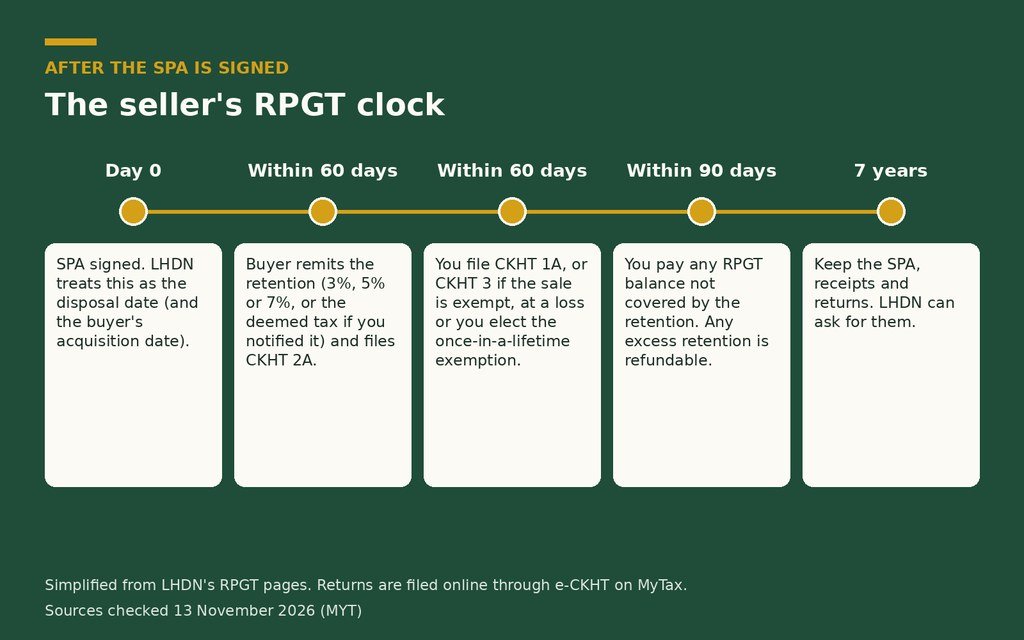
- The buyer must hold back part of the price for LHDN. It is 3% for most individuals, 5% or 3% for companies depending on how long they have owned the property, and 7% for non-citizens. The buyer has 60 days to pay it to LHDN.
- You file your own RPGT return. Since 2025, RPGT is self-assessed. The seller files within 60 days of the disposal date and pays any balance within 90 days.
- Stamp duty on the transfer is normally the buyer's cost. But self-assessment of property transfers from 1 January 2027 changes how the buyer's side files, and that can affect your timetable.
- Your costs reduce your taxable gain, if you can prove them. Agent's and lawyer's fees on the sale, and money you spent improving the property, are allowed. Keep the receipts.
- Plan for the deductions at completion: the bank's redemption sum, any early settlement charge in your loan agreement, and unpaid assessment, quit rent and strata charges.
Part 1: Real property gains tax
RPGT is charged under the Real Property Gains Tax Act 1976 on the gain when you dispose of property in Malaysia: houses, condos, shops, offices, factories and land. LHDN says it applies whether or not the seller is resident in Malaysia.
Which rate applies to you
LHDN groups sellers into three categories in Schedule 5 of the Act:
- Part I: individuals who are Malaysian citizens or permanent residents (and others not in Parts II or III, such as partnerships).
- Part II: companies incorporated in Malaysia, trustees of a trust and registered bodies of persons.
- Part III: individuals who are not citizens or permanent residents, executors of their estates, and companies not incorporated in Malaysia.
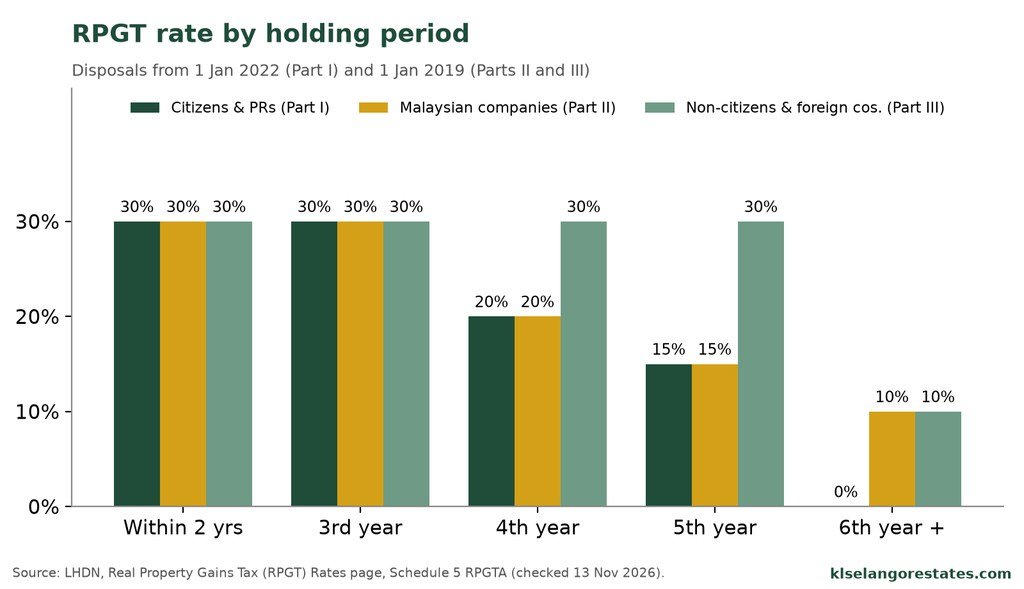
The rate then depends on the holding period, counted from the date you acquired the property to the date you dispose of it. For disposals from 1 January 2022 (Part I) and 1 January 2019 (Parts II and III), LHDN's rate table reads:
- Within two years: 30% for all three groups.
- In the third year: 30% for all three groups.
- In the fourth year: 20% for Part I and Part II, 30% for Part III.
- In the fifth year: 15% for Part I and Part II, 30% for Part III.
- From the sixth year: 0% for Part I, 10% for Part II and Part III.
The dates matter more than most sellers realise. Under LHDN's rules, the disposal date is the date of the written agreement, which is normally your sale and purchase agreement (SPA). It is not the completion date. Where there is no written agreement, it is the date ownership is transferred or the date you receive the whole price, whichever is earlier. Your acquisition date is generally the date of the agreement under which you bought.
So if you are a citizen close to the five-year mark, signing the SPA a few weeks later could move you into the 0% band. Before you sign, check both dates with your lawyer. Don't rely on memory.
How the gain is worked out
The taxable gain is not simply "sold for minus bought for". LHDN's method is:
- Disposal price = the sale price, less money spent to enhance or preserve the property's value (still reflected at the time of sale), less money spent to establish, preserve or defend your title, and less the incidental costs of the sale. LHDN lists those incidental costs as fees, commission or remuneration for the professional services of a surveyor, valuer, accountant, agent or legal adviser. Its example of enhancement spending is the cost of renovating a kitchen.
- Acquisition price = what you paid, plus the incidental costs of buying, less certain items such as insurance payouts for damage and any deposit forfeited to you.
- Chargeable gain = disposal price minus acquisition price.
Two practical points. First, LHDN does not allow expenses that are deductible against income tax, such as a landlord's repairs claimed against rental income, whether or not you actually claimed them. Second, you need evidence. Since 2025, LHDN requires sellers to keep documents for seven years and produce them on request. A renovation you cannot document is a deduction you may not get.
Exemptions worth knowing
- RM10,000 or 10%. Individuals get an exemption of RM10,000 or 10% of the chargeable gain, whichever is greater, on each disposal (paragraph 2, Schedule 4). It is reduced proportionately if you sell only part of your share.
- Once-in-a-lifetime private residence exemption. A Malaysian citizen or permanent resident can elect to exempt the gain on one private residence, once in their lifetime (section 8). The election is made on Form CKHT 3 through e-CKHT and is irrevocable. Because you only get it once, it may be worth saving if this sale's gain is small or falls in the 0% band anyway. Discuss it with your tax adviser before you elect.
- Transfers within the family. A gift between husband and wife, parents and children, or grandparents and grandchildren is treated as "no gain, no loss" for the donor, as long as the donor is a Malaysian citizen. A gift to anyone else is treated as a sale at market value. Transfers between spouses for a price, and between former spouses under a court order on divorce, have similar treatment for citizens.
- Inheritance. When a deceased person's property passes to the executor or beneficiaries, it is also "no gain, no loss" under LHDN's rules. A later sale by the beneficiary is a separate disposal.
Part 2: Why the buyer holds back part of your money
Under section 21B of the Act, the buyer (the "acquirer") must retain part of the price and remit it to LHDN. LHDN's current rates are:
- Part I sellers (citizens and PRs): 3%.
- Part II sellers (Malaysian companies and similar): 5% if disposing within three years, 3% from the fourth year.
- Part III sellers (non-citizens and foreign companies): 7%.
The buyer retains this percentage of the total price, or the whole of the money paid, whichever is lower. In practice the buyer's lawyer holds the sum and pays it to LHDN. The buyer has 60 days from the date of disposal to remit it. If they fail, LHDN adds 10% of the unpaid amount, and the total becomes the buyer's debt to the government. That is why no buyer's lawyer will release the full price to you without dealing with it.
There is a newer option. LHDN says that for disposals from the 2026 year of assessment, the buyer may instead remit an amount equal to the deemed tax, if you, the seller, notify the buyer of that amount before the remittance is made. The buyer remits whichever is lower. If your gain is small, or falls in the 0% band, ask your lawyer and tax adviser early whether this route suits your sale. They will need your RPGT figures ready before the buyer's 60 days run out.
The retention is not a separate tax. LHDN uses it to pay all or part of your RPGT. If your tax is less than the amount retained, the excess is refundable. If it is more, you pay the balance.
Your own filing: RPGT is self-assessed
From 1 January 2025, RPGT moved to self-assessment, following amendments made by the Finance (No. 2) Act 2023. LHDN says the seller must:
- File the RPGT return within 60 days of the disposal date: Form CKHT 1A for real property, or Form CKHT 3 if the sale is exempt, makes no gain or a loss, or you are electing the private residence exemption.
- Work out the gain and the tax yourself on the return. LHDN treats the return as the assessment, so no separate assessment notice is issued.
- Pay any tax balance within 90 days of the disposal date.
- Keep the supporting documents for seven years.
The buyer files Form CKHT 2A, also within 60 days. Returns are filed online through e-CKHT on MyTax. LHDN's penalties are significant: up to three times the tax for failing to file on time, and up to the amount of tax understated for an incorrect return. A seller whose incorrect return causes the buyer to under-remit can also face a 10% increase.
A worked example
This is an illustration only, with assumed numbers, to show the order of the calculation. Your own figures will differ.
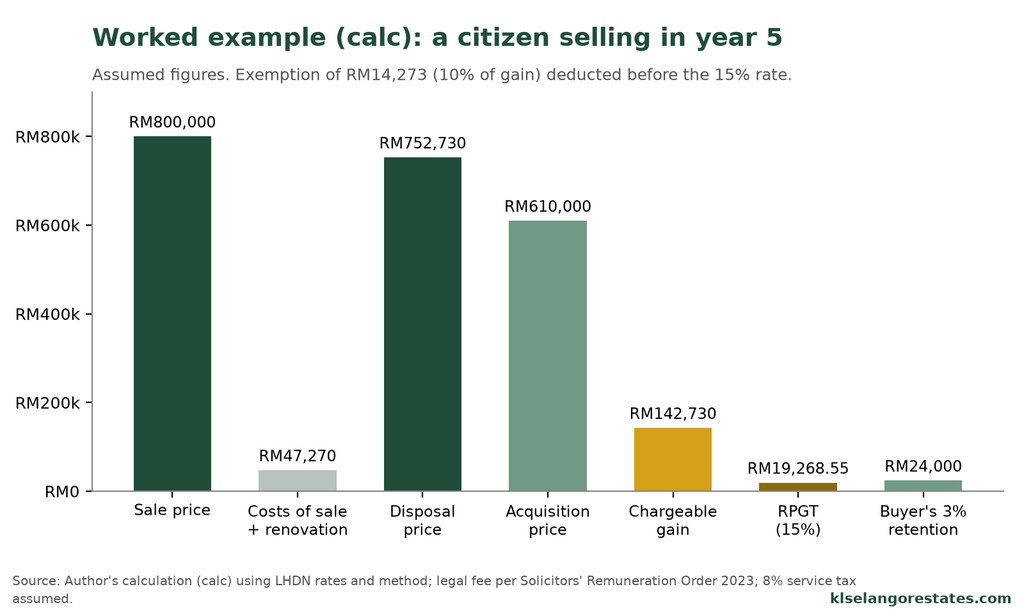
A Malaysian citizen bought a KL condo under an SPA dated 1 March 2022 for RM600,000, with RM10,000 of documented incidental buying costs. In 2026 she renovated the kitchen for RM20,000, with receipts. She signs an SPA to sell on 15 November 2026 for RM800,000. That falls in her fifth year of ownership.
- Incidental costs of sale (calc): an agreed 2% agency fee of RM16,000 plus 8% service tax (RM1,280), and the solicitors' scale fee of RM9,250 plus 8% service tax (RM740). Total: RM27,270.
- Disposal price (calc): RM800,000 − RM27,270 − RM20,000 = RM752,730.
- Acquisition price (calc): RM600,000 + RM10,000 = RM610,000.
- Chargeable gain (calc): RM142,730.
- Exemption (calc): the greater of RM10,000 or 10% of RM142,730, so RM14,273.
- Taxable (calc): RM128,457. At the fifth-year rate of 15%, the RPGT is RM19,268.55.
- Buyer's retention (calc): 3% of RM800,000 = RM24,000. That is more than the tax, so about RM4,731 would be due back to her once her return is processed, unless she uses the deemed-tax option at the start.
If she had waited until her sixth year (an SPA on or after 1 March 2027), the rate for a citizen would be 0%. That is the kind of decision worth checking before you accept an offer, not after.
Part 3: Stamp duty self-assessment from 1 January 2027
Stamp duty on the transfer (the memorandum of transfer, or MOT) is normally paid by the buyer, so it does not usually come out of your proceeds. It still matters to sellers for two reasons.
First, from 1 January 2027, transfers bought through an SPA or at a public auction move to LHDN's Stamp Duty Self-Assessment System. The buyer's side works out the duty, files the return on MyTax within 30 days of signing and pays within 30 days of filing. Duty is charged on the price or the market value, whichever is higher. A transfer that is not properly stamped cannot be registered, so a delay or dispute on the buyer's side can hold up your completion and your payment.
Second, if you are transferring to family at a low price or as a gift, market value still drives the stamp duty and, for non-family gifts, the RPGT. Get both checked together.
I explained the new system, the deadlines and the penalties in detail in Stamp Duty Self-Assessment From 1 January 2027.
Part 4: Every cost before you get paid
The estate agent's fee
The Board of Valuers, Appraisers, Estate Agents and Property Managers publishes a maximum scale of fees (the Seventh Schedule, rule 48). For a sale or purchase of land and buildings, the maximum is 3% of the price, with a minimum fee of RM1,000 per property. It is a ceiling, not a set rate: the actual fee is what you and the agency agree in writing. Agencies registered for service tax add 8% on top.
The fee is paid by whoever appoints the agent. For a subsale, that is normally the seller. Read the appointment letter before you sign it: who you appoint, whether it is exclusive and for how long, and when the fee becomes due.
Your lawyer's fee
Under the Solicitors' Remuneration Order 2023 (in force from 15 July 2023), the scale fee for a sale and transfer is the same whether the solicitor acts for the vendor or the purchaser: 1.25% on the first RM500,000 (minimum RM500), 1% on the next RM7 million, and a negotiated fee not exceeding 1% above RM7.5 million. Disbursements and service tax are extra. On an RM800,000 sale, the scale fee works out at RM9,250 before service tax (calc).
Redeeming your loan
If the property is charged to a bank, part of the buyer's money goes to redeem your loan first. Your lawyer asks your bank for a redemption statement, which states the exact sum needed on a given date. Check your loan agreement for any early settlement or lock-in charge and the notice period the bank requires. These are contractual and vary between banks, so the only reliable figure is the one in your own documents. There are also small costs to register the discharge of charge.
Bills and other deductions
- Outgoings: assessment tax, quit rent, and for strata properties the maintenance charges and sinking fund. Most SPAs apportion these to the completion date, so clear arrears early and keep the receipts.
- Consents: if the land has a restriction in interest, state consent is usually needed for the transfer. If the strata title has not been issued, the developer's or management's consent and an assignment may be needed instead. Both take time and may carry fees.
- RPGT: whatever is not covered by the buyer's retention.
- Utilities and final readings on handover.
Can you sell without an agent?
Yes. Nothing in law requires you to use one. You will still need a lawyer for the SPA and transfer, and you will be doing the pricing, marketing, viewings, buyer screening and negotiation yourself. If you do appoint an agent, check that they are registered with the Board, and agree the fee and scope in writing.
A seller's checklist
- Find your purchase SPA and confirm your acquisition date and price.
- Work out your holding period at different possible SPA dates, and your RPGT band.
- Confirm your category: citizen or PR, company, or non-citizen.
- Gather receipts for renovations and improvements, and for the legal and agency fees on both purchase and sale.
- Ask your bank for an indicative redemption figure, the early settlement terms and the notice period.
- Check for arrears of assessment, quit rent and strata charges, and clear them.
- Check whether state, developer or management consent is needed for the transfer.
- Agree the agency fee and scope in writing, and confirm the agent's registration.
- Ask your tax adviser whether to use the once-in-a-lifetime exemption on this sale, and whether to give the buyer a deemed-tax notification.
- Diarise the 60-day filing deadline (CKHT 1A or CKHT 3) and the 90-day payment deadline from the SPA date.
Questions to put to your lawyer and tax adviser
- What is my exact holding period, and would a later SPA date change my RPGT rate?
- Which of my costs will LHDN accept as enhancement or incidental costs, and what evidence do I need?
- Should I elect the private residence exemption now, or keep it?
- Is the deemed-tax option available to me, and when must I notify the buyer?
- What does my loan agreement say about early settlement and notice?
- Are any consents needed, and how long will they take?
- What is my realistic net figure after every deduction?
The practical conclusion
Your sale price is the start of the sum, not the end of it. Before you accept an offer, work out your holding period, your RPGT category, your documented costs and your loan position, and get a realistic net figure from your lawyer. Most surprises at completion come from dates and paperwork, not the price. An agent can help you price and market the property and gather documents, but your lawyer and tax adviser must confirm the numbers that matter.
General information only. This is not legal, tax or financial advice. Rates and rules were checked on 13 November 2026 (MYT) against LHDN's published pages, the Solicitors' Remuneration Order 2023 and the Board's scale of fees, and may change. The worked example uses assumed figures for illustration. Every sale depends on its own documents and facts. Please have a Malaysian lawyer and a tax adviser review your case before you sign.
Jessica Leong | Registered Estate Agent E3208
PropNex Realty Sdn Bhd (E (1) 1800/1), KLCC branch
Marc Residence, Jalan Pinang, Kuala Lumpur | Office 03-2161 8608
Call/WhatsApp 010-464 6088
Sources (checked 13 November 2026, MYT)
- LHDN: Real Property Gains Tax (RPGT) Rates
- LHDN: Retention and Remittance by Acquirer (last updated 25 May 2026)
- LHDN: Responsibility of Disposer and Acquirer
- LHDN: Introduction to the RPGT Self-Assessment System
- LHDN: Types of RPGT Return Forms
- LHDN: Disposal Date and Acquisition Date
- LHDN: Disposal Price and Acquisition Price
- LHDN: Determination of Chargeable Gain / Allowable Loss
- LHDN: Exemption
- LHDN: Disposal Price Deemed To Be Equal To Acquisition Price
- LHDN: Imposition of Penalties and Increases of Tax
- Solicitors' Remuneration Order 2023, P.U. (A) 207/2023 (gazette copy): paragraph 2(a), First Schedule Table A and Rule 1
- Board of Valuers, Appraisers, Estate Agents and Property Managers: Scale of Fees, Seventh Schedule (Rule 48) (the Board is moving to lpeph.gov.my)
- KPMG Malaysia: Service tax rate increase to 8% and expansion of taxable services (2024)
- Stamp Duty Self-Assessment From 1 January 2027 (my earlier article, with its LHDN sources)