Should You Buy a KL Home Now or Wait? What NAPIC's H1 2026 Numbers, the OPR Hold and Budget 2027 Actually Say
Nobody can tell you where Kuala Lumpur prices will be next year, and I won't pretend to. What I can do is set out what the official data shows today, what is changing in 2027 and how to decide based on your own situation rather than a headline.
Also on Medium: read it on Medium

"Should I buy now or wait?" is the question I hear most, and it is one of the most searched property questions in Malaysia. It usually comes with a second one: "Will prices drop?"
The honest answer is that nobody knows. Anyone who tells you confidently that KL prices will fall, or rise, in 2027 is guessing. What we do have is a fresh set of official numbers: the National Property Information Centre's (NAPIC) report for the first half of 2026, released on 10 September 2026. We also have Bank Negara Malaysia's (BNM) latest rate decision and the Budget 2027 proposals.
This article sets out what those sources say about Kuala Lumpur, what they cannot tell you, and a practical way to decide. It is a follow-up to my articles on the OPR hold in November and BNM's property loan data.
The short version
- KL prices rose modestly, not sharply. NAPIC puts KL's average house price at RM825,282 in Q2 2026 (preliminary), up from RM803,500 a year earlier. The KL House Price Index rose 2.7% year on year.
- Activity was steady. KL recorded 6,618 residential transactions in H1 2026, up 2.4% on H1 2025's 6,460.
- New launches slowed sharply. Developers launched only 1,610 new homes in KL in H1 2026, and 334 of them sold in the period, a sales rate of 20.7%.
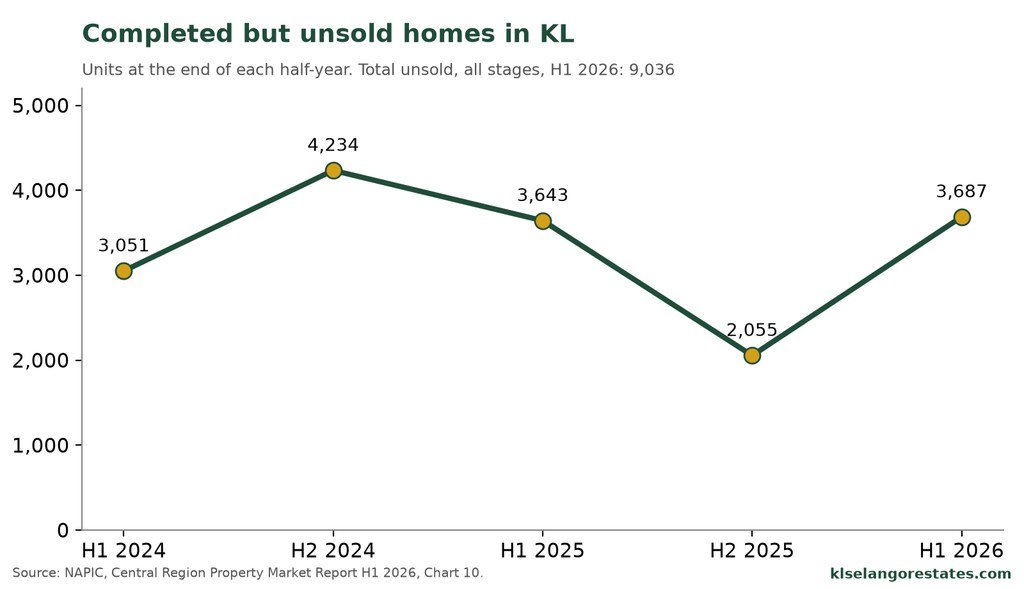
- There is stock to choose from. NAPIC counted 9,036 unsold homes in KL at the end of H1 2026, including 3,687 that were completed.
- Rates are stable, for now. The OPR has been 2.75% since July 2025 and was held again on 5 November 2026. The next decision is on 21 January 2027.
- Budget 2027 could change the sums for some first-time buyers. The proposal links a wider stamp duty exemption to SPAs signed from 1 January 2027. It is not yet law.
- The right answer depends more on you than on the market. Your income security, deposit, time horizon and the specific property matter more than a national average.
What NAPIC's numbers say about Kuala Lumpur
Prices: a modest rise
NAPIC's Central Region report for H1 2026 says KL "recorded the highest house price in the country, rising to RM825,282 in Q2 2026P compared to Q2 2025 (RM803,500)". The "P" means preliminary, so the figure can be revised. The all-house price index for KL stood at 207.8 points, with an annual change of +2.7% in Q2 2026, against −0.2% a year earlier.
For comparison, Selangor's average fell slightly, to RM561,187 from RM567,435, and its index changed by −1.1%. Nationally, NAPIC's press release reported the Malaysian House Price Index up 0.9% year on year.
Two cautions. First, an average price mixes everything from older flats to luxury condos, so a change in the mix of homes sold can move it. Second, a 2.7% annual rise is not a boom. It is roughly in line with a market that is ticking along, not one running away from buyers, and not one collapsing either.
NAPIC also gave examples of individual schemes. It reported increases for some established KL terraces and well-connected condominiums, and it noted "instances of declines in selected schemes". In other words, the averages hide a wide spread. The building and the location you choose matter more than the city-wide number.
Transactions: steady, not frantic
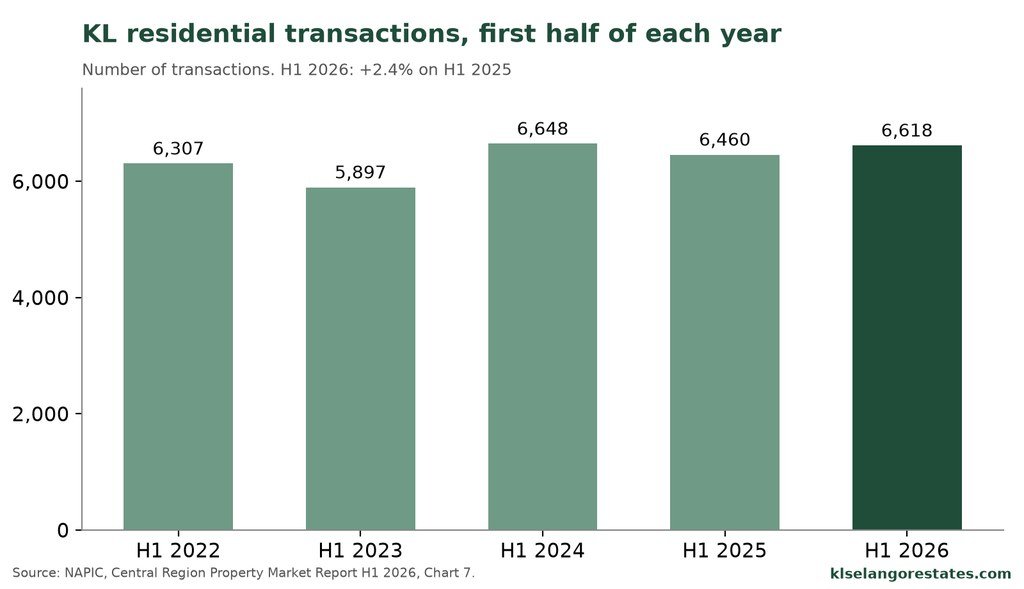
KL's 6,618 residential transactions in H1 2026 sit in the same band as the last five first halves: between 5,897 and 6,648. Their value rose 2.3% to RM6.11 billion. People are still buying, at a pace similar to recent years.
New launches: fewer, and selling more slowly
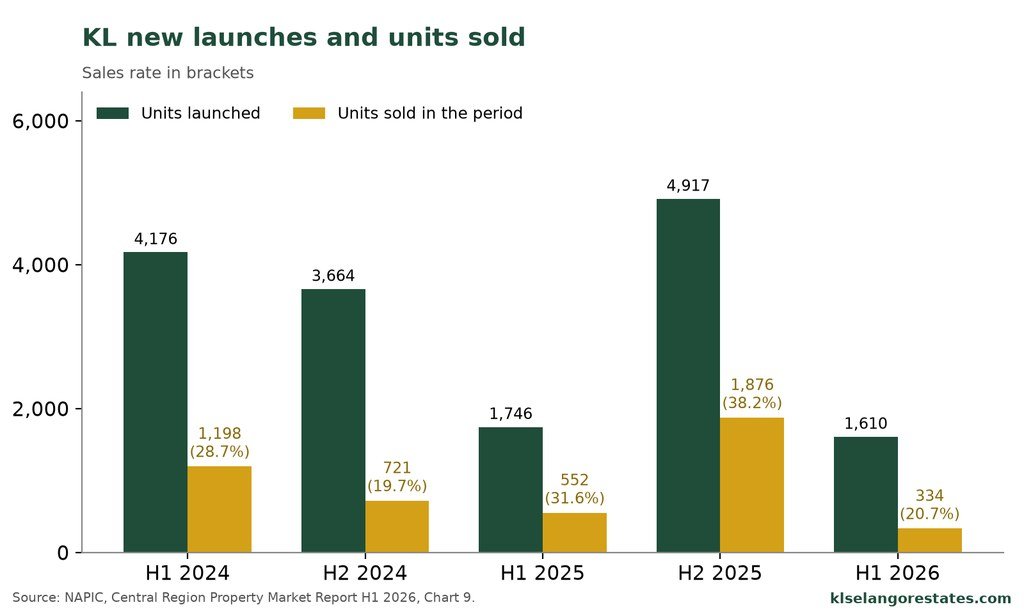
This is where the data is most interesting for buyers. KL developers launched 1,610 units in H1 2026, the lowest of the five half-years NAPIC shows, and sold 334 of them within the period. That 20.7% sales rate compares with 38.2% in H2 2025 and 31.6% in H1 2025.
A low first-period sales rate does not mean a project has failed. Many launches sell over a longer period than the half-year NAPIC measures. But it does suggest buyers are taking their time, and developers know it. For a buyer, that can mean more room to compare schemes and terms. It does not guarantee a lower price on any particular unit.
Unsold stock and the pipeline
NAPIC counted 9,036 unsold homes in KL at the end of H1 2026: 2,851 not yet under construction, 2,498 under construction and 3,687 completed. The completed-but-unsold figure rose from 2,055 at the end of 2025.
Looking further ahead, NAPIC lists 27,554 homes as incoming supply in KL and 40,048 as planned supply, on top of an existing stock of 584,933. Not all planned homes will be built on time, or at all. But a buyer is unlikely to run out of choice in KL in the next few years.
What these numbers can't tell you
Official statistics are the best starting point we have, but they have limits that matter for a buying decision.
- They look backwards. H1 2026 covers January to June. The report came out in September, and conditions in your target area may have moved since.
- They are city-wide. KL covers everything from older walk-up flats to KLCC high-rises. A 2.7% index rise says little about one building in Setapak or one tower in Mont Kiara.
- They are partly preliminary. NAPIC marks the Q2 2026 price figures as preliminary, and they can be revised in the next report.
- They record transactions, not asking prices. What owners and developers ask can sit well above what buyers actually pay, especially when sales are slow.
So use the NAPIC figures to set your expectations, then do the local work: compare recent transacted prices for similar units in the same development or street, and visit at different times of day.
Subsale or new launch in this market?
The numbers suggest two different kinds of opportunity. In the subsale market, steady transaction numbers mean there is usually recent evidence to judge a fair price, and you can inspect exactly what you are buying. For an older building, check the management, the sinking fund and any planned works before you commit. I set out how in my guide to checking an older condo's finances.
In the new-launch market, slower sales give buyers time to compare. Look at the developer's track record, the payment schedule, the completion date and what any package actually includes. A rebate or "free" item is only worth something if the net price still compares well with similar completed homes nearby.
What interest rates are doing
BNM's Monetary Policy Committee held the Overnight Policy Rate at 2.75% on 5 November 2026, its last meeting of the year. The rate has been at that level since a 0.25 percentage point cut on 9 July 2025. Under BNM's framework, the Standardised Base Rate for new floating-rate retail loans equals the OPR, so the hold leaves floating instalments unchanged.
The next MPC decision is on 21 January 2027. BNM has also published the rest of its 2027 dates: 4 March, 6 May, 8 July, 9 September and 4 November.
How much would a move matter? As an illustration only, on a RM500,000 loan over 35 years:
- at 4.10%, the monthly instalment is about RM2,244 (calc);
- if the rate were 0.25 points lower, at 3.85%, it would be about RM2,169, roughly RM75 less (calc);
- if it were 0.25 points higher, at 4.35%, it would be about RM2,320, roughly RM76 more (calc).
A quarter-point change matters, but it is rarely what makes or breaks a purchase. Your loan amount, tenure and the bank's spread matter more. Waiting for a possible rate cut that may or may not come is a weak reason on its own to delay.
Loans are still being approved, more selectively
BNM's monthly statistics show Malaysians applied for RM363.4 billion of residential loans in January to September 2026, up 2.6% on the same period of 2025. Banks approved RM139.4 billion, down 3.8%. These are national ringgit totals, not approval odds, and many buyers apply to several banks for the same property. But they are a reminder to get a realistic loan assessment before you commit, whatever you decide about timing.
What Budget 2027 could change
Budget 2027, tabled on 9 October 2026, proposes a wider stamp duty exemption for Malaysian citizens buying their first home, for SPAs signed from 1 January 2027 to 31 December 2030. As proposed, homes priced up to RM750,000 would get a full exemption on the first RM500,000 and 50% on the balance. The current exemption, covering homes up to RM500,000, applies to SPAs signed up to 31 December 2027.
So if you are a first-time buyer looking at a home priced between RM500,000 and RM750,000, the SPA date could matter. I worked through the numbers in my Budget 2027 first-home article. Remember that it remains a proposal until the exemption order is gazetted.
From 1 January 2027, transfers bought by SPA also move to stamp duty self-assessment. That changes the paperwork more than the cost, and I explained it in Stamp Duty Self-Assessment From 1 January 2027.
Rent or buy?
This deserves its own article, but a few points are worth making here.
NAPIC reports that average rental yields for apartments and condominiums across the Central Region ranged from 1.3% to 10.8% in H1 2026. A range that wide tells you there is no single answer. Some buildings rent well relative to their price, and others don't.
The useful comparison is personal and specific. Take a unit you would actually buy and a similar one you would actually rent. Compare the monthly rent with the full monthly cost of owning: the loan instalment, maintenance and sinking fund, assessment and quit rent, insurance and a repair allowance. Then add the one-off costs of buying, and set them against how long you expect to stay. The longer your horizon, the more those upfront costs are spread out.
When buying now can make sense
- Your income is stable and you have a deposit and a buffer for at least several months of instalments.
- You expect to stay at least several years, so transaction costs are spread over time.
- You have found a property that fits your needs, with a building and management you have checked.
- The price is in line with recent transactions for comparable units, not just the asking price.
- You are a new-launch buyer who has compared schemes and terms, and you understand the progress payments. Buyers of new launches pay no agency fee, as the developer pays the agent.
When waiting can make sense
- Your job, income or location may change in the next year or two.
- You don't yet have a comfortable deposit and emergency buffer.
- You are a first-time buyer between RM500,000 and RM750,000 who would benefit from a 2027 SPA date if the Budget proposal is gazetted.
- You haven't found a property that genuinely fits, and you would be buying just to "get in".
- Your loan assessment shows the instalment would leave you stretched.
Notice that most of these reasons are personal, not market-based. That is deliberate. Timing the market is hard even for professionals. Matching a purchase to your own circumstances is something you can control.
A practical decision checklist
- Get a loan pre-assessment from more than one bank, so you know your realistic budget.
- Work out your full monthly cost of owning, not just the instalment.
- Compare asking prices with recent transacted prices for similar units in the same area.
- Decide your holding horizon honestly, and price in the costs of buying and later selling.
- Check whether the Budget 2027 first-home proposal, or the current exemption, applies to you, and how the SPA date affects it.
- For new launches, compare developers, schemes and progress-payment exposure. For subsales, check the building's management and finances.
- Decide what would change your mind, and write it down before you start viewing.
What to watch next
- 21 January 2027: BNM's first MPC decision of 2027.
- The exemption order giving legal effect to the Budget 2027 first-home proposal.
- NAPIC's next report, covering the full year 2026, for whether KL's launch sales and completed-unsold stock improve.
- The new-launch pipeline in the areas you are considering, which you can track through local authority approvals and launches.
The practical conclusion
The KL data doesn't point to a crash, and it doesn't point to a rush. Prices rose modestly, transactions held steady, new launches slowed and there is plenty of stock to choose from. That is a market where a well-prepared buyer can take their time, compare carefully and negotiate. It is not one where waiting automatically wins. If your finances and plans are ready and you find the right property at a fair price, the data gives you no strong reason to wait. If they aren't, the data gives you no reason to hurry.
General information only. This is not financial, investment, legal or tax advice, and it is not a forecast. NAPIC's Q2 2026 figures are preliminary and may be revised. Figures were checked on 13 November 2026 (MYT) against the sources listed. Instalment figures are illustrations. Please get advice on your own circumstances before you commit.
Jessica Leong | Registered Estate Agent E3208
PropNex Realty Sdn Bhd (E (1) 1800/1), KLCC branch
Marc Residence, Jalan Pinang, Kuala Lumpur | Office 03-2161 8608
Call/WhatsApp 010-464 6088
Sources (checked 13 November 2026, MYT)
- NAPIC (JPPH, Ministry of Finance): Central Region Property Market Report H1 2026: Charts 7, 8, 9, 10, 11 and 12; Table 2; residential price and rental sections
- NAPIC press release: The Launch of the Property Market Report H1 2026 (10 September 2026)
- Bank Negara Malaysia: Monetary Policy Statement, 5 November 2026, with the 2027 MPC schedule
- Bank Negara Malaysia: OPR Decisions
- Bank Negara Malaysia: Monthly Highlights and Statistics, September 2026: Tables 1.10 and 1.12
- Ministry of Finance: Budget 2027 Tax Measures: Appendix 16
- My earlier articles: OPR held at 2.75%, BNM property loans, Jan–Sep 2026, Budget 2027 and your first condo and stamp duty self-assessment