BNM Holds OPR at 2.75% (5 Nov 2026): What It Means for Home Loan Instalments, Buyers and Owners in KL and Selangor
Bank Negara Malaysia kept the Overnight Policy Rate unchanged at its final 2026 meeting. Here is what that means for the Standardised Base Rate, floating home-loan instalments, buyers and owners — and what to watch at the January 2027 MPC.
Also on Medium: read it on Medium

On 5 November 2026, Bank Negara Malaysia’s Monetary Policy Committee (MPC) decided to maintain the Overnight Policy Rate (OPR) at 2.75%. That was the final scheduled MPC meeting of 2026. The short answer for most homeowners and buyers in Kuala Lumpur and Selangor is simple:
Your floating home-loan instalment does not change automatically because of this decision. The Standardised Base Rate (SBR) that banks use for new retail floating-rate loans is set equal to the OPR. Holding the OPR means holding the SBR at 2.75%.
This article explains, in plain language:
- what the OPR and SBR are, from Bank Negara’s own framework;
- why the MPC held the rate this time;
- what changes (and what does not) for floating home loans today;
- an illustrative instalment example you can adapt to your own figures;
- practical checklists for buyers, refinancers, existing owners and landlords; and
- the published 2027 MPC dates to watch next.
Not advice. This is general information from Bank Negara Malaysia’s Monetary Policy Statement of 5 November 2026, Bank Negara’s OPR Decisions table, the Revised Reference Rate Framework (including the March 2026 policy document and consumer guide), and neutral press reports, as at 6 November 2026. Loan pricing is personal: your bank’s spread, your credit profile, your remaining tenure and whether your loan is floating or fixed all matter. Please speak to your bank and, if needed, a licensed financial adviser or lawyer before you commit to a purchase, refinance or restructuring. Nothing here is a forecast of the next OPR move.
The decision in one minute
- Decision: MPC maintained the OPR at 2.75% (Bank Negara Malaysia, Monetary Policy Statement, 5 November 2026).
- Growth: BNM said recent indicators point to continued strength in the third quarter of 2026, with strong exports amid sustained domestic demand, and that solid momentum is expected to bring 2026 growth to above 5%. The Department of Statistics Malaysia’s advance GDP estimate for Q3 2026 was 5.3% year-on-year (DOSM). Growth is expected to remain resilient in 2027, with the external sector a major driver.
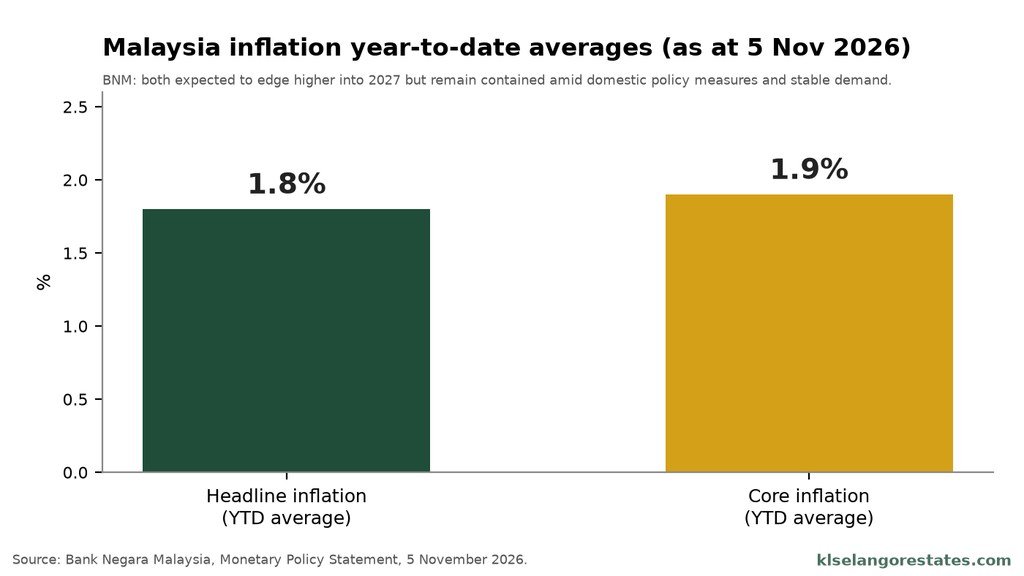
- Inflation: Year-to-date, headline inflation averaged 1.8% and core inflation 1.9%. Both are expected to edge higher into 2027 but remain contained amid domestic policy measures and stable demand. The MPC said it will remain vigilant to cost pressures and domestic demand.
- Stance: At the current OPR level, the MPC considers the monetary policy stance consistent with continued price stability and sustainable economic growth, and will remain vigilant.
- Home loans: Under BNM’s framework, SBR = OPR. Holding OPR at 2.75% means no automatic change to floating retail loan instalments from this decision.
- Next meetings (2027): 21 January, 4 March, 6 May, 8 July, 9 September and 4 November 2027 (all Thursdays), as published on the same statement page.
What the OPR and SBR are
The Overnight Policy Rate is Bank Negara’s main policy interest rate. The MPC sets it at scheduled meetings and announces the decision in a Monetary Policy Statement.
The Standardised Base Rate is the common reference rate banks must use for new retail floating-rate loans (including housing loans) from 1 August 2022. Under the Revised Reference Rate Framework:
- SBR = OPR for all banks;
- your effective lending rate is priced as SBR + spread;
- the spread covers things such as credit and liquidity risk, operating costs and profit margin;
- when the OPR changes, banks must adjust the SBR by the same amount within seven working days (BNM Policy Document on the Reference Rate Framework, March 2026, paragraph 9.6); and
- older loans still referenced to the Base Rate (BR) or Base Lending Rate (BLR) move in tandem with the SBR after the framework, so a change in OPR still flows through to those floating loans as well.
Bank Negara’s consumer guide puts it simply: instalments on floating-rate loans change when the OPR changes (unless something else, such as your credit risk, also changes). So a hold is not a cut and not a hike. For most floating home loans, today’s instalment stays where it is because of this decision.
How we got to 2.75% — and how long it has been held
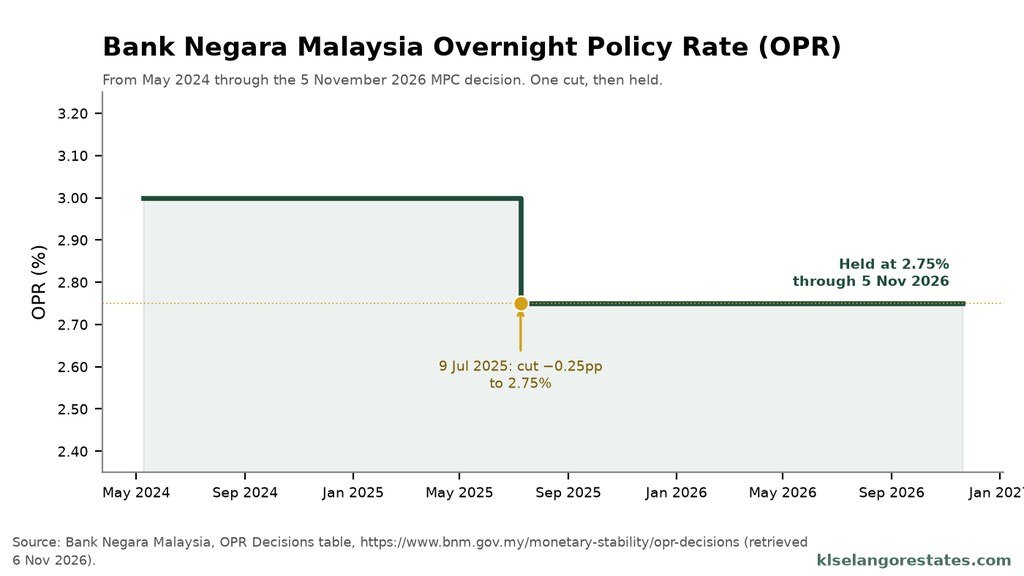
BNM’s official OPR Decisions table shows the path clearly:
- On 9 July 2025, the MPC cut the OPR by 0.25 percentage points to 2.75%.
- At every subsequent scheduled meeting through 5 November 2026 — including September and November 2025, and January, March, May, July, September and November 2026 — the OPR was held at 2.75% (change recorded as 0).
So this November decision extends a hold that has now run for more than a year since the July 2025 cut. That matters for cash-flow planning: many Klang Valley owners and buyers have been budgeting around a stable SBR of 2.75% for some time. Stability is useful, but it is not a promise about the next meeting.
Why the MPC held the rate
Bank Negara’s statement on 5 November 2026 is the primary source. In brief:
Globally, BNM pointed to continued resilience in growth, supported by strong technology investment and stable labour markets. Inflation had edged up on higher energy costs. Geopolitical uncertainties remain, with downside risks from prolonged tensions, tighter global financial conditions, market valuations and fiscal vulnerabilities.
For Malaysia, recent indicators pointed to continued strength in growth in the third quarter of 2026, underpinned by strong export performance amid sustained domestic demand. BNM said the solid growth momentum is expected to bring 2026 growth to above 5%. Looking ahead, sound fundamentals are expected to keep growth resilient in 2027. The external sector is expected to remain a major driver, supported by the global technology upcycle and firm tourist spending. Stable labour markets, ongoing investment and Budget 2027 measures support private consumption. Downside risks include a prolonged Middle East conflict and lower commodity production.
On inflation, year-to-date headline and core averages were 1.8% and 1.9%. Into 2027, geopolitical developments, elevated global commodity prices and adverse weather are expected to push inflation higher, but BNM said both headline and core should remain contained amid domestic policy measures and stable demand. The MPC will remain vigilant to cost pressures and domestic demand.
The Star and The Edge both reported the hold on 5 November 2026, consistent with the official statement. Where press adds poll counts or colour, treat those as the newspaper’s reporting, not as BNM figures.
What changes for floating home loans today
From this decision: nothing automatic.
Because SBR tracks OPR, a hold at 2.75% means:
- banks do not need to reprice the SBR for an OPR change;
- floating home-loan instalments priced off SBR (or BR/BLR moving with SBR) do not rise or fall solely because of this MPC outcome;
- fixed-rate loans were never going to move with this decision anyway.
What can still change your monthly payment, even when the OPR is held:
- your bank revising the spread for a new loan offer (competition, risk assessment, product rules);
- a contractual review tied to your credit risk on an existing facility (BNM’s framework allows spread increases only to reflect credit-risk changes during the tenure, not to raise profit margins);
- switching products, refinancing, or ending a promotional lock-in;
- arrears, restructuring, or other account events.
So “OPR unchanged” is not the same as “every bank’s advertising rate is frozen forever”. It means the policy reference rate did not move.
Illustrative instalment: today vs a +0.25pp SBR scenario
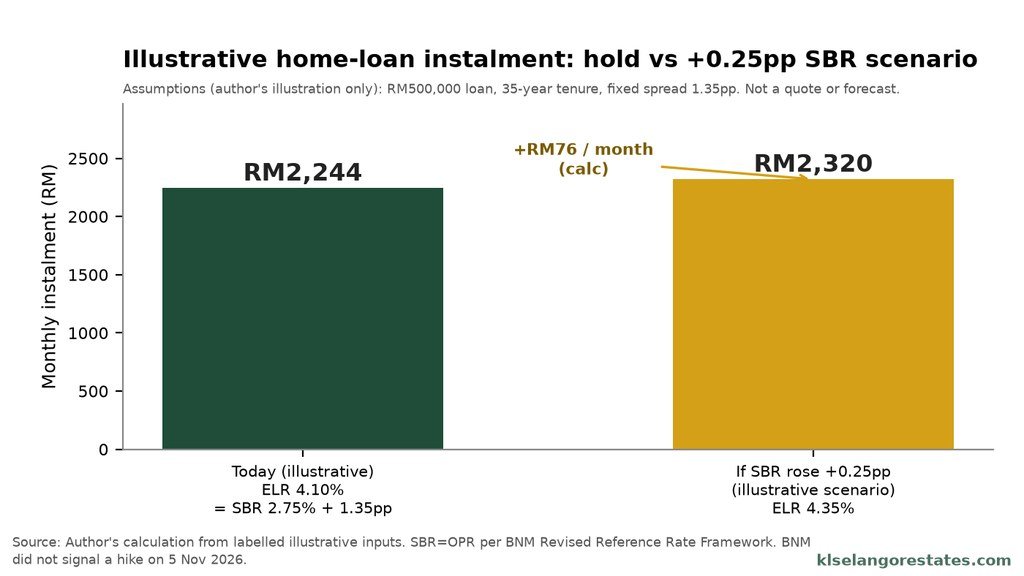
BNM did not signal a hike on 5 November 2026. The scenario below is not a forecast. It is a labelled calculation so you can see the cash-flow maths if the SBR ever moved by a typical 25-basis-point step.
Assumptions (illustrative only — not a bank quote):
- Loan amount: RM500,000
- Tenure: 35 years (420 monthly instalments)
- Illustrative spread: 1.35 percentage points (fixed in both scenarios)
- Today’s illustrative effective lending rate (ELR): SBR 2.75% + 1.35pp = 4.10%
- Scenario ELR if SBR rose by 0.25pp to 3.00%: 4.35%
Method: standard equal monthly instalment formula M = P × r(1+r)^n / ((1+r)^n − 1), where P is the principal, r is the monthly rate (annual ELR ÷ 12), and n is the number of months.
Results (author’s calculation):
- Today (illustrative): effective lending rate 4.10%, monthly instalment RM2,244
- If SBR +0.25pp (illustrative): effective lending rate 4.35%, monthly instalment RM2,320
- Difference: about +RM76 a month
Over a year, that difference is about RM912 (12 × RM76; author’s calculation). Scale the same method to your own loan amount, remaining tenure and actual ELR on your letter of offer or bank statement. A shorter remaining tenure or a larger loan will move the ringgit difference; the direction of a +25bp move is the same.
Practical checklists
If you are buying in KL or Selangor
- Ask every bank for the ELR as SBR + spread, not just a headline “rate from” figure.
- Confirm whether the offer is floating (moves with SBR) or fixed for a lock-in period, and what happens when the lock-in ends.
- Stress-test your budget at today’s instalment and at a +0.25pp and +0.50pp ELR using the formula above (or your bank’s calculator). Label those as scenarios, not predictions.
- Keep stamp duty, legal fees, valuation and moving costs in your cash plan — the OPR decision does not change those rules by itself.
- For foreign buyers, separate rules on thresholds and stamp duty still apply; see the related reading below.
If you are refinancing
- Compare the all-in ELR, lock-in, early settlement fees on the old loan, and legal/valuation costs on the new one.
- A stable OPR can make refinance maths clearer month to month, but savings still depend on your remaining balance and tenure.
- Get the lock-in end date and any clawback of rebates or legal fee subsidies in writing from your current bank before you sign.
If you already have a floating home loan
- You should not see an automatic instalment change solely from the 5 November 2026 hold.
- Check your latest bank notice or app: confirm the current SBR/BR/BLR and your spread.
- If your instalment did change recently for another reason (credit review, product switch, end of promo), ask the bank to separate that explanation from any OPR narrative.
- Keep an emergency buffer sized to at least a few months of instalments; policy rates can move at future meetings even after a long hold.
If you are a landlord
- The OPR does not set residential or commercial rents. Rent is a private contract between landlord and tenant (and, where it applies, the evolving tenancy law framework).
- What the OPR can affect is the landlord’s own financing cost on a floating investment loan — which may change how much buffer you want, not what the law says you may charge.
- Do not tell tenants “BNM raised/cut rents”; that is not how the system works.
What to watch next
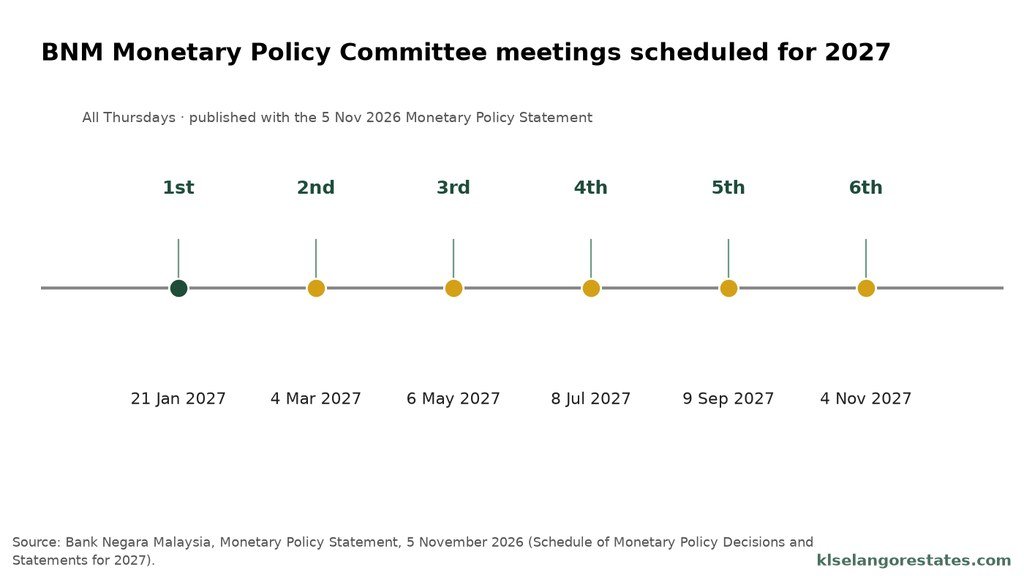
The next published MPC date is 21 January 2027. Between now and then, useful things to watch — still from official or neutral sources — include:
- BNM’s next Monetary Policy Statement and any change (or hold) in the OPR;
- inflation prints and whether headline/core stay contained as BNM expects;
- growth data as 2026 full-year figures firm up after the “above 5%” guidance; and
- your own bank’s SBR display and letter of offer wording if you are mid-application.
Do not treat newspaper polls as a decision. The decision is what the MPC publishes on the day.
Related reading
- Bank lelong properties in the Klang Valley: a first-time buyer’s guide
- Stamp duty self-assessment from 2027
- MM2H and foreign buyers of property in KL and Selangor in 2026
- Office space in KL and Selangor, H1 2026: occupancy and rents
Sources
All read or re-checked on 6 November 2026.
- Bank Negara Malaysia, Monetary Policy Statement, 5 November 2026: https://www.bnm.gov.my/-/monetary-policy-statement-05112026
- Bank Negara Malaysia, OPR Decisions table: https://www.bnm.gov.my/monetary-stability/opr-decisions
- Bank Negara Malaysia, Revised Reference Rate Framework announcement, 11 August 2021 (effective 1 August 2022): https://www.bnm.gov.my/-/pd-revised-reference-rate
- Bank Negara Malaysia, Consumer Guide on the Revised Reference Rate Framework (updated 12 August 2022): https://www.bnm.gov.my/documents/20124/938039/Consumer+Guide_RRF_EN.pdf
- Bank Negara Malaysia, Policy Document — Reference Rate Framework, March 2026: https://www.bnm.gov.my/documents/20124/938039/pd-rrf-mar2026.pdf
- Department of Statistics Malaysia, Advance Gross Domestic Product (GDP) Estimates, Q3 2026 (advance estimate 5.3%): https://www.dosm.gov.my/portal-main/release-content/advance-gross-domestic-product-gdp-estimates-q32026
- The Star, “Bank Negara keeps OPR steady at 2.75%”, 5 November 2026: https://www.thestar.com.my/business/business-news/2026/11/05/bank-negara-keeps-opr-steady-at-275
- The Edge Malaysia, “Bank Negara Malaysia holds policy rate steady”, node 824668: https://theedgemalaysia.com/node/824668
About the author
Jessica Leong | Registered Estate Agent E3208 PropNex Realty Sdn Bhd (E (1) 1800/1), KLCC branch. Jessica covers new launch condos in Kuala Lumpur and Selangor, industrial property in Selangor, bank auction (lelong) properties, and Selangor offices, shophouses and en-bloc deals. See her new launch pages for Kuala Lumpur, KLCC, Petaling Jaya and Selangor.
PropNex Realty Sdn Bhd, A-G-03, Marc Residence, No. 3, Jalan Pinang, 50400 Kuala Lumpur Office: 03-2161 8608 · Call/WhatsApp: 010-464 6088 Website: klselangorestates.com
This article is general information based on public sources as at 6 November 2026. It is not legal, tax, financial, valuation or investment advice. The Overnight Policy Rate and Standardised Base Rate can change at future MPC meetings. Illustrative instalment figures are the author’s calculations from labelled assumptions and are not bank quotes or forecasts. Please confirm current rates, spreads and instalments with your own bank.