Why Your Property Agent Asks for Your IC and Where Your Money Comes From: AMLA and PDPA for Malaysian Property Buyers and Sellers
Malaysian estate agents are required by anti-money laundering law to check who you are, and by data protection law to look after what they collect. Here is what you can be asked for, why, what happens if the checks cannot be completed, and what an agency may and may not do with your data.
Also on Medium: read it on Medium
You have agreed a price, the booking form is ready, and then your agent asks for a copy of your IC or passport, your occupation and employer, and what the purchase is for. If you are buying through a company, the questions extend to its directors and shareholders. Some reply: "What about the PDPA?"
It is a fair question. The answer is that two laws apply at the same time. The Anti-Money Laundering, Anti-Terrorism Financing, Anti-Restricted Activity Financing and Proceeds of Unlawful Activities Act 2001 (AMLA) requires registered estate agents to know who their clients are. The Personal Data Protection Act 2010 (PDPA) controls what happens to that information afterwards. This guide explains both for buyers, sellers, landlords and tenants anywhere in Malaysia, including companies and foreigners.
The short answer
- A registered estate agent must carry out customer due diligence (CDD) on both the buyer and the seller, or the landlord and the tenant. It is not optional and it is not a sign that anyone suspects you.
- The PDPA does not let you opt out of a check the law requires. It does require the agency to tell you why it collects your data, keep it secure, use it only for proper purposes and not keep it longer than necessary.
- Marketing is a separate matter. Using your details for newsletters or promotions needs your consent, and you can tell the agency to stop at any time.
Why estate agents fall under anti-money laundering law
Property is valuable, can be held through companies or nominees and can be paid for in hard-to-trace ways, which attracts money launderers. Paragraph 23 of the First Schedule to the AMLA therefore lists "activities relating to an estate agency practice carried out by a registered estate agent" among the businesses that are reporting institutions, with Bank Negara Malaysia (BNM) as the supervising competent authority.
This is not new. Bank Negara's copy of the 2007 Asia/Pacific Group mutual evaluation of Malaysia records that suspicious transaction reporting applied to registered estate agents from 10 August 2006, and the remaining AMLA reporting obligations, including CDD and record keeping, from 9 March 2007.
The detailed rules are in BNM's policy document on AML/CFT/CPF and targeted financial sanctions for designated non-financial businesses and professions (DNFBPs) and non-bank financial institutions, issued on 5 February 2024 and in effect from 6 February 2024. It replaced the version in effect from 1 January 2020, which itself replaced sector guidelines dating from 2013, and it is still the one listed on BNM's AML/CFT policy page.
For property, the key line is short. Paragraph 14F.1.1 says registered estate agents must "conduct CDD on both purchaser and seller, or landlord and tenant of a property". Some other businesses only need to check customers above a set amount (RM3,000 for moneylenders, for example), but the policy document sets no minimum for estate agents. BNM even suggests a bilingual "Notice to Customer" that agencies may display, telling clients to have their identification document ready.
The law itself was tightened this year. The AMLA (Amendment) Act 2025 came into force on 1 March 2026. It renamed the Act, added restricted-activity (weapons proliferation) financing, and extended many duties, including CDD, record keeping and reporting, to the directors, officers and employees of reporting institutions. Under the amended Act, failing to carry out CDD (s.16) or to file a required report (s.14) is an offence punishable by a fine of up to RM1 million.
What you may be asked for
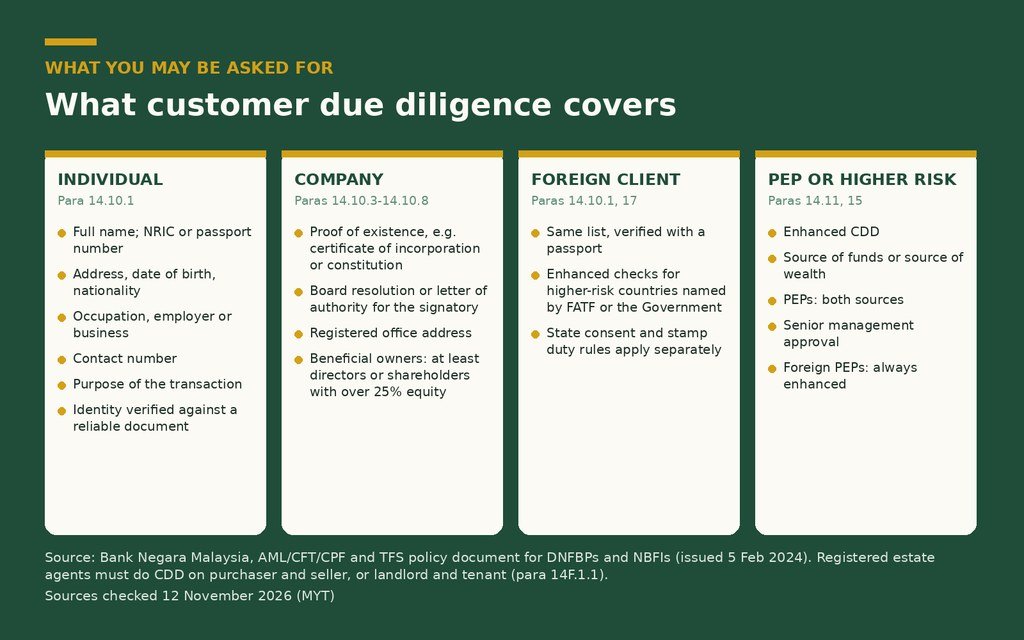
If you are an individual. Paragraph 14.10.1 lists the minimum: full name; NRIC, passport or other official document number; residential and mailing address; date of birth; nationality; occupation type; employer or nature of your business; contact number; and the purpose of the transaction. The agent must then verify your identity using reliable, independent documents or data. In practice, that usually means seeing your MyKad or passport and keeping a copy.
If someone signs for you. The agent must check that the person is authorised, and identify and verify them too (paragraph 14.3(b)). Expect to show a power of attorney or letter of authority as well as the representative's own ID.
If you are a foreign buyer, seller or tenant. The same list applies, usually with your passport. There is more on this in the section for foreign buyers and sellers below.
If you are buying, selling or renting through a company. The agency needs to understand the business and who owns and controls it (paragraphs 14.10.3 to 14.10.8). That covers proof of existence such as the certificate of incorporation or constitution, the board resolution or letter of authority for whoever is signing, the registered office address, and the beneficial owners: at minimum, the directors or shareholders with more than 25% of the equity, or the partners of a partnership. BNM's template CDD form gives the SSM section 58 and 78 forms as examples of how this can be verified. Companies listed on Bursa Malaysia and certain regulated institutions are partly exempt (paragraph 14.10.9).
If the deal is done remotely. Agencies may deal with clients remotely but must verify identity in other ways, such as a video call (paragraph 14.14).
Purpose, source of funds and source of wealth
Standard CDD already includes the purpose of the transaction and your occupation or business. The questions go further when the agency assesses the deal as higher risk. Enhanced CDD under paragraph 14.11.1 includes "enquiring on the source of wealth or source of funds", and for politically exposed persons both must be obtained.
The terms differ. FATF's guidance on politically exposed persons explains that source of funds is the origin of the particular money used in this transaction, while source of wealth is how a person built up their overall wealth. For an ordinary buyer, the honest answer might be a housing loan plus savings from salary, or the proceeds of selling another property. Agencies are also expected to keep watching during the deal: paragraph 14.12.1 asks them to check that transactions stay consistent with what they know about you, "including where necessary, the source of funds".
None of this means you are under suspicion. The agency simply has to be able to show BNM that it knew who it was dealing with.
Politically exposed persons
A politically exposed person (PEP) is someone who holds or has held a prominent public function, such as a senior politician, a senior government, judicial or military official, a senior executive of a state-owned corporation or an important political party official. Middle-ranking and junior officials are not covered. The rules extend to family members (parents, siblings, spouse, children and spouse's parents) and close associates.
Foreign PEPs always receive enhanced checks. Domestic PEPs are assessed case by case and get enhanced CDD only if the relationship is assessed as higher risk (paragraph 15). FATF's guidance is clear that refusing a client simply because they are a PEP is contrary to the standard. The point is extra care, not exclusion.
"PDPA" is not a reason to skip the checks
The PDPA normally requires your consent before your personal data is processed. Section 6(2)(c) makes an exception where processing is necessary "for compliance with any legal obligation" (other than a contractual one) to which the agency is subject. Section 39(b) allows disclosure that is "required or authorized by or under any law". AMLA CDD is exactly that kind of legal obligation.
So if you decline to provide what CDD requires, the PDPA does not change the outcome. Paragraph 14.15.1 of the BNM policy document says that where a reporting institution cannot complete CDD, it shall not commence business relations or perform any transaction for a potential customer (or must end the relationship with an existing one), and it must consider lodging a suspicious transaction report. The policy document governs what the agency may do for you. It is not a ruling on the property sale itself, which is a matter for your lawyer.
Two further points are worth knowing:
- Using a false name is an offence by the customer. Under section 18 of the AMLA, dealing with a reporting institution in a fictitious, false or incorrect name is punishable by a fine of up to RM3 million, up to five years' imprisonment, or both.
- An agent cannot tell you about a report. Section 14A makes it an offence, with a fine of up to RM3 million, up to five years' imprisonment, or both, to disclose that a suspicious transaction report is being or has been made. Reports go to BNM's Financial Intelligence and Enforcement Department.
What the agency must do with your data
The PDPA applies to anyone who processes personal data in commercial transactions (section 2), and "agency" is expressly part of that definition. Estate agencies are not among the classes that must register with the Personal Data Protection Commissioner; under the Class of Data Users Order, the "real estate" class covers licensed housing developers. Section 13(2) is clear, though, that unregistered data controllers must still comply with every other part of the Act.
In practice, the seven Personal Data Protection Principles mean:
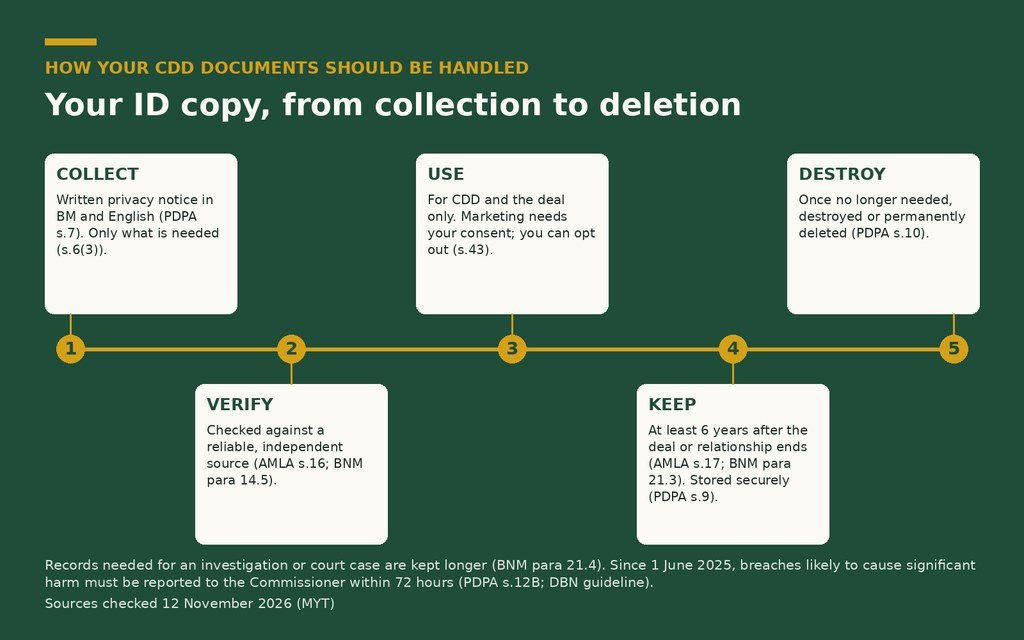
- Notice and choice (s.7). You should receive a written notice, in Bahasa Malaysia and English, explaining what data is collected, why, who it may be disclosed to, whether supplying it is obligatory and what happens if you do not, and how to ask for access or make a complaint.
- Purpose and disclosure (ss.6 and 8). Data collected for CDD should be used for CDD and the transaction, and shared only with the classes of third parties you were told about, unless an exception in section 39 applies.
- Security (s.9). The agency must take practical steps to protect your data from loss, misuse and unauthorised access, including when it is transferred. Since 1 April 2025, outside data processors working for the agency are bound by this too.
- Retention (s.10). Data must not be kept longer than necessary and must then be destroyed or permanently deleted. For CDD records, the AMLA sets the minimum: at least six years after the transaction is completed or the relationship ends (AMLA s.17; policy document paragraph 21.3), and longer if the records are needed for an investigation or court case.
- Accuracy, access and correction (ss.11, 12, 30 and 31). You can ask what the agency holds about you, and it must generally respond within 21 days. You can ask for inaccurate data to be corrected.
The 2024 amendments to the PDPA came into force in three stages in 2025. Since 1 April 2025, breaching the principles can lead to a fine of up to RM1 million, up to three years' imprisonment, or both. Since 1 June 2025:
- organisations must appoint a data protection officer where the Commissioner's DPO guideline thresholds are met (more than 20,000 data subjects, more than 10,000 for sensitive data including financial information, or regular and systematic monitoring);
- data breaches that cause or are likely to cause "significant harm" must be reported to the Commissioner within 72 hours, and affected individuals told within seven days after that, under the breach notification guideline. Data that could enable identity fraud is one of the guideline's markers of significant harm;
- you can ask for your data to be sent to another organisation (data portability, s.43A), subject to technical feasibility.
Separately, section 130 makes it an offence to collect, disclose or sell personal data held by an organisation without its consent, with a fine of up to RM500,000, up to three years' imprisonment, or both.
Compliance data is not marketing data
This is where the two laws meet in practice. Your IC copy and CDD answers are collected because the law requires them. They should not reappear in a promotional mailing list. If an agency wants to send you new launches or newsletters, that is marketing, which needs your consent under the General Principle. Under section 43, you can tell any agency in writing to stop or not begin using your data for direct marketing. If it ignores you, you can apply to the Commissioner.
Foreign buyers and sellers
The same checks, with a passport. Non-Malaysians go through the same CDD as everyone else, whether buying, selling or renting. Paragraph 14.10.1 asks for an NRIC number, passport number or the reference number of another official document, plus your nationality. BNM's template CDD form gives a foreign passport or an identity card issued by the United Nations as examples of acceptable verification documents.
Why foreign deals may get more questions. The policy document's definition of "higher risk" lists "non-resident customers" as one factor, together with country risk, such as countries identified by FATF or other credible sources as having weak AML controls. Agencies must consider whether a customer is resident or non-resident, and where customers come from, when profiling risk (paragraph 10.6.2). If the agency assesses the relationship as higher risk, enhanced CDD applies, which can include asking about source of funds or wealth (paragraph 14.11.1). Being foreign is a factor, not an automatic verdict. One of BNM's estate agent red flags is payment that does not come from the customer's country of origin without a logical explanation, so if your money comes from a third country, explain why early.
Your data gets the same protection. The PDPA protects any "individual who is the subject of the personal data", with no nationality condition, and applies to organisations established in Malaysia (section 2). A Malaysian agency owes a foreign client the same notice, security, retention and access duties.
State consent and minimum prices. Separately, section 433B of the National Land Code requires non-citizens and foreign companies to get State Authority approval to acquire land, with applications made through the state land office (Selangor's page, for example). The Ministry of Economy's Guideline on the Acquisition of Properties (in force from 13 July 2022) bars foreign interests from buying property worth less than RM1 million per unit, low-cost and low-medium-cost homes, Malay reserve land and units allocated to Bumiputera interests. States set their own thresholds on top. Johor's land office lists RM1 million for residential property, while the 2014 Selangor circular its land office still cites sets RM2 million for homes in Zones 1 and 2 and RM1 million in Zone 3, for strata titles only (including landed strata). Check the current rules for your state with your lawyer before committing, and see my guide to the 8% stamp duty for foreign home buyers.
Practical ways to protect your IC copy
- Ask for the privacy notice first. A compliant agency should have one ready.
- Add a purpose line to the copy. For example, "For AMLA customer due diligence only", followed by the agency's name and the date. Write it across the image without covering your name, IC number, photo or address, because the agent must be able to read those to verify you.
- Use a secure channel. Agree how documents will be sent, such as a direct message or an agency portal, and avoid group chats. Send copies only to people you have confirmed act for a registered agency.
- Share only what is asked. Under section 6(3), data must be adequate but not excessive for the purpose. It is reasonable to ask why a document is needed.
- Ask how long it will be kept and how it will be destroyed afterwards.
Neutral red flags around cash and ownership
BNM's policy document lists examples of red flags for estate agents. They are prompts for closer checks, not proof of wrongdoing, and many have innocent explanations. They include:
- deposits paid in a significant amount of cash;
- payments made by third parties without a logical explanation, or by several parties;
- the buyer's name being changed at the last minute without a reasonable reason, or the property being put in a nominee's name;
- a purchase without end financing, or one that does not fit the buyer's profile;
- payment coming from outside the buyer's country of origin without an explanation;
- buying several properties in a short time in a way that does not fit the buyer's profile, or reselling quickly without a reasonable explanation;
- company or trust structures that obscure who the real owner is;
- a seller accepting far less than they paid without an explanation.
If one of these applies to you for a good reason, say so early and offer the paperwork.
What to expect from a compliant agent
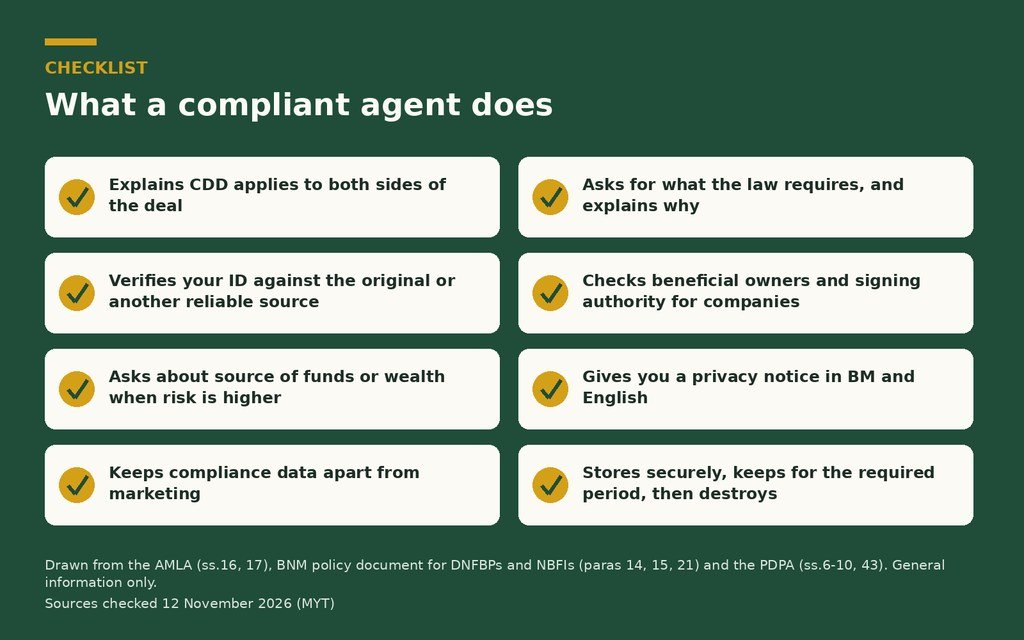
- Explains early that CDD applies to both sides of the deal, buyer and seller or landlord and tenant.
- Asks for what the law requires, and can explain why each item is needed.
- Verifies your identity against the original document or another reliable source.
- Asks about beneficial owners and signatory authority when a company is involved.
- Asks about source of funds or wealth when the risk is higher, and treats PEPs with extra care rather than refusing them outright.
- Gives you a privacy notice in Bahasa Malaysia and English.
- Keeps compliance data separate from marketing, and asks before adding you to any mailing list.
- Stores documents securely, keeps them for the legally required period, and destroys them afterwards.
Questions to ask your agent
- Are you a registered estate agent, and which registered firm are you acting for?
- Who in your agency will see my documents, and who else will you share them with?
- How should I send them to you?
- Where can I read your privacy notice, and who do I contact about my data?
- How long will you keep my records, and how will you destroy them?
- Will you use my details for marketing? If so, how do I opt out?
If you think your data has been misused
Start by writing to the agency, or its data protection officer, asking what it holds and who it has shared it with. You can make a formal data access request under section 30. If the reply is unsatisfactory, section 104 lets any individual complain in writing to the Personal Data Protection Commissioner, who can investigate. Complaints can be lodged through the Commissioner's online complaint portal, and your rights are summarised on the Commissioner's data subject rights page. If your identity has been used for fraud, also report it to the police.
The bottom line
AMLA and the PDPA are not in conflict. One tells the agent to find out who you are; the other governs how the agent treats what it learns. A good agent does both without fuss: asks for what the law requires, explains why, keeps it safe, and never turns your IC copy into a sales lead. If you are buying, selling or letting property in Malaysia and want to know what will be asked of you before you start, I am happy to walk you through it.
General information only. This is not legal advice. The laws, BNM policy document and Personal Data Protection Commissioner guidelines referred to were checked on 12 November 2026 (MYT) and may change. Each agency's procedures depend on its own risk assessment. For questions about your specific situation, please speak to a Malaysian lawyer.
Jessica Leong | Registered Estate Agent E3208
PropNex Realty Sdn Bhd (E (1) 1800/1), KLCC branch
Marc Residence, Jalan Pinang, Kuala Lumpur | Office 03-2161 8608
Call/WhatsApp 010-464 6088
Sources
- Anti-Money Laundering, Anti-Terrorism Financing and Proceeds of Unlawful Activities Act 2001 (Act 613), updated text as at 1 July 2022 (Bank Negara Malaysia copy): ss.13, 14, 14A, 16, 17, 18 and First Schedule paragraph 23
- Anti-Money Laundering, Anti-Terrorism Financing and Proceeds of Unlawful Activities (Amendment) Act 2025 (Act A1761)
- P.U. (B) 76/2026: appointment of 1 March 2026 as the commencement date of Act A1761
- Bank Negara Malaysia: Policy Document on AML/CFT/CPF and TFS for DNFBPs and NBFIs (issued 5 February 2024, effective 6 February 2024) and the policy document PDF: paragraphs 6.2 ("higher risk"), 10.6.2, 11.4.2, 11.5.13, 14 to 14.16, 14F, 15, 17, 19, 20, 21 and Appendices 3 and 14
- Bank Negara Malaysia: AML/CFT and TFS for DNFBPs and NBFIs (issued 31 December 2019, effective 1 January 2020), now superseded
- Bank Negara Malaysia AML/CFT site: current policy documents
- Asia/Pacific Group on Money Laundering: Mutual Evaluation Report of Malaysia (2007), Bank Negara Malaysia copy
- FATF Guidance: Politically Exposed Persons (Recommendations 12 and 22), June 2013
- Personal Data Protection Act 2010 (Act 709), reprint as at 15 September 2026: ss.2, 4, 5, 6, 7, 8, 9, 10, 11, 12, 12A, 12B, 13, 30, 31, 38, 39, 43, 43A, 45, 104 and 130
- Personal Data Protection (Amendment) Act 2024 (Act A1727)
- Gazette notification of the commencement dates of Act A1727 (1 January, 1 April and 1 June 2025)
- Personal Data Protection Commissioner: the 13 classes of data controllers that must register
- Personal Data Protection Commissioner: Guideline on Appointment of Data Protection Officer (25 February 2025)
- Personal Data Protection Commissioner: Guideline on Data Breach Notification (25 February 2025)
- Personal Data Protection Commissioner: Data Subject Rights and online complaint portal
- Ministry of Economy: Garis Panduan Perolehan Hartanah (Guideline on the Acquisition of Properties), in force from 13 July 2022: paragraphs 2.3 and 10 and the Ministry's guideline page
- Pejabat Tanah dan Galian Negeri Selangor: Garis Panduan Perolehan Hartanah Oleh Kepentingan Asing (Seksyen 433B KTN), citing Pekeliling Pengarah Tanah dan Galian Selangor Bil. 1/2014
- Pejabat Tanah dan Galian Johor: Perolehan Hartanah Oleh Kepentingan Asing
- Skrine, "Anti-Money Laundering Act Enhanced" (2 April 2026)