The LRT3 Shah Alam Line Is Open: What Ridership and NAPIC Price Data Mean for Homes and Shops in PJ, Shah Alam and Klang
The 20-station line opened on 29 June 2026. Official data show ridership fell by more than a third once fares began, and NAPIC's latest price index predates the opening. Here is what the numbers do and do not say, with a checklist for buying near a station.
Also on Medium: read it on Medium
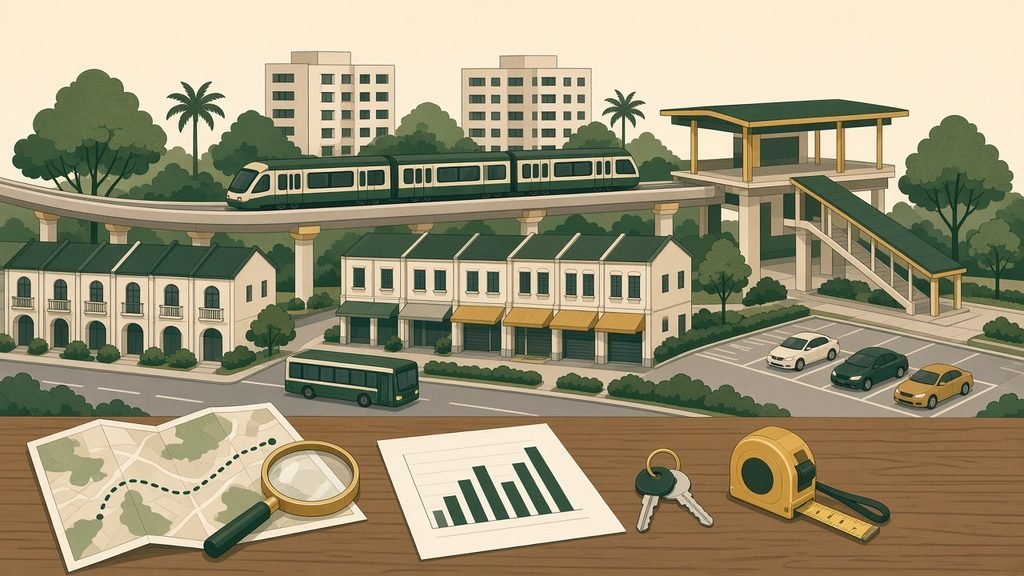
After years of delays, the LRT3 Shah Alam Line is running. Prime Minister Datuk Seri Anwar Ibrahim launched it on 28 June 2026, and passenger service began the next day. The 37.8km line has 20 stations from Bandar Utama in Petaling Jaya to Johan Setia in Klang, through Shah Alam. It is expected to serve about two million people along the corridor.
If you own, or plan to buy, a home or a shop in PJ, Shah Alam or Klang, you will hear a lot about the line in sales talk: “walking distance to LRT”, “prices will go up once the train runs”. This article looks at what the official numbers actually show so far:
- Ridership, from the government’s open data portal, data.gov.my, which publishes Prasarana’s daily figures.
- House prices, from NAPIC’s Malaysian House Price Index for the first half of 2026, which reports Petaling and Klang separately.
- Shop prices, from NAPIC’s Klang Valley Shop Price Index.
The short answer: it is too early to see the line in the price data, and no official figure measures an “LRT premium”. The useful questions are more practical, and there is a checklist at the end.
Not advice. This is general information from data.gov.my, NAPIC (JPPH), Ministry of Finance and Parliament statements, Prasarana and Rapid KL statements and news reports, as at 30 October 2026. Ridership data are published monthly. The open-data portal’s latest figures run to 31 August 2026, and Prasarana’s own page shows a September total (checked 3 November 2026). Please do your own checks and speak to your own lawyer, banker or valuer before you buy.
The line in brief
- Route: 37.8km, 20 stations, Bandar Utama (PJ) to Johan Setia (Klang).
- Stations open: Bandar Utama, Kayu Ara, BU 11, Damansara Idaman, Subang, Glenmarie 2, Kerjaya, Stadium Shah Alam, Dato’ Menteri, UiTM Shah Alam, Seksyen 7 Shah Alam, Bandar Baru Klang, Pasar Klang, Jalan Meru, Jambatan Kota, Taman Selatan, Seri Andalas, Klang Jaya, Bandar Bukit Tinggi and Johan Setia (Bernama, 27 June 2026).
- Connections: the MRT Kajang Line at Bandar Utama and the LRT Kelana Jaya Line at Glenmarie 2. There is no direct train into central KL.
- Cost: RM16.63 billion, the figure the Cabinet approved in 2018 after cutting the project from RM31.65 billion.
- Trains: 22 three-car trains, with a capacity of about 223,560 passengers a day, according to the deputy transport minister. Peak-hour trains run about every eight minutes, The Star reported.
- Targets: 67,000 passengers a day in the first year and more than 117,000 a day within five years.
- Feeder services: 40 feeder buses on 13 routes at RM1 a ride, and 44 Rapid On-Demand vans in 20 zones at RM2 a trip, from 6am to 11.30pm.
- Park & Ride: 2,300 bays at six stations: Kayu Ara, Damansara Idaman, Pasar Klang, Seri Andalas, Bandar Bukit Tinggi and Johan Setia.
- Fares: free from 29 June to 14 August 2026, after one extension. Paid from 15 August, including feeder buses and Park & Ride. A full Bandar Utama to Johan Setia trip costs RM4.30 cashless, RM4.90 in cash and RM2.40 with a concession card.
- Five more stations: Tropicana, Raja Muda, Temasya, Bukit Raja and Bandar Botanik were previously dropped from the project. The government has approved an extra RM4.7 billion to reinstate them. The timing has been reported differently (see below).
The line also runs on a separate fare system. If you change to the Kajang or Kelana Jaya line, you tap out and tap in again, and each line charges its own fare.
What two months of official ridership show
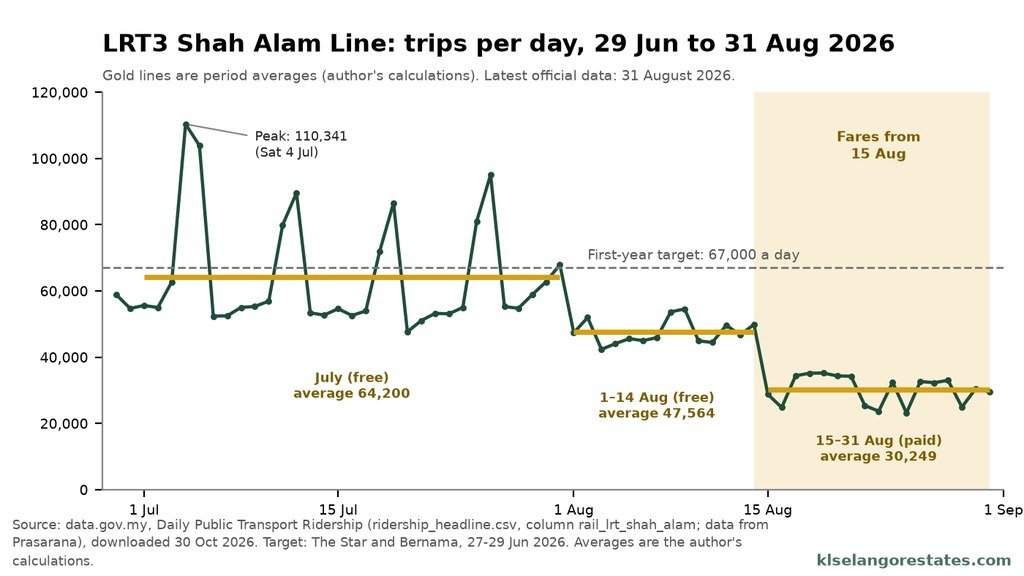
The government’s open data portal publishes daily ridership for every Rapid KL rail line. I downloaded the file again on 30 October 2026. Its latest date is still 31 August 2026. The portal says the figures are audited before publication and updated monthly. The September update had not appeared when I checked. Prasarana’s own monthly ridership page, checked on 3 November 2026, lists 909,579 trips on the Shah Alam Line in September 2026. That is about 30,300 a day (my calculation), little changed from the 30,249 a day average for 15 to 31 August. Prasarana marks its figures as subject to change.
The figures count trips, not people. Someone who rides to work and back counts twice.
Here is what the data show. All averages are my own calculations from the official file.
| Period | Fares | Days | Average trips a day |
|---|---|---|---|
| 29–30 June | Free | 2 | 56,788 |
| July | Free | 31 | 64,200 |
| 1–14 August | Free | 14 | 47,564 |
| 15–31 August | Paid | 17 | 30,249 |
Some other points from the same file:
- The first full day, Monday 29 June, recorded 58,865 train trips. Rapid KL said more than 60,000 trips were made that day once feeder buses and on-demand vans were included.
- The busiest day was Saturday 4 July, with 110,341 trips. Weekends in July were far busier than weekdays: 89,789 a day against 55,299 (my calculation). That pattern suggests many people were trying the line out while it was free.
- Ridership was already falling before fares began. The 1–14 August average was 26% below July’s.
- Once fares started, it fell again. The 15–31 August average was 36% below the first half of August, and 53% below July (my calculations).
- On weekdays, which matter more for commuters, the line averaged 52,682 trips a day while it was free. That fell to 32,670 in the paid weeks, excluding the Merdeka holiday on 31 August. That is a drop of about 38% (my calculation).
- Against the target, the paid-period average was about 45% of the 67,000-a-day first-year target and about 14% of the line’s stated daily capacity (my calculations).
What the ridership numbers do not tell you
It would be wrong to say the line has “failed” on 17 days of paid data. A few cautions:
- The paid period is short. It is two and a half weeks, and it ends on a public holiday. Prasarana’s September total points to ridership levelling off, but October may look different as commuters settle into new routines.
- The first-year target is for a full year, not the first two months.
- The line feeds other lines. Most trips into KL need a change at Bandar Utama or Glenmarie 2, with a second tap and a second fare. When The Star rode the line one weekday evening in September, most passengers got on and off at Bandar Utama and Glenmarie 2. In Shah Alam most got off at Seksyen 7, and in Klang at Bandar Bukit Tinggi. Smaller stations were much quieter.
- Land around many stations is still being developed. Public transport advocates quoted by The Star said it was too early to judge demand.
For a buyer, the practical point is simple. Ridership is concentrated at a few stations, and the stations with the most people are interchanges and stations next to established commercial areas.
What NAPIC’s house price index shows for Petaling and Klang
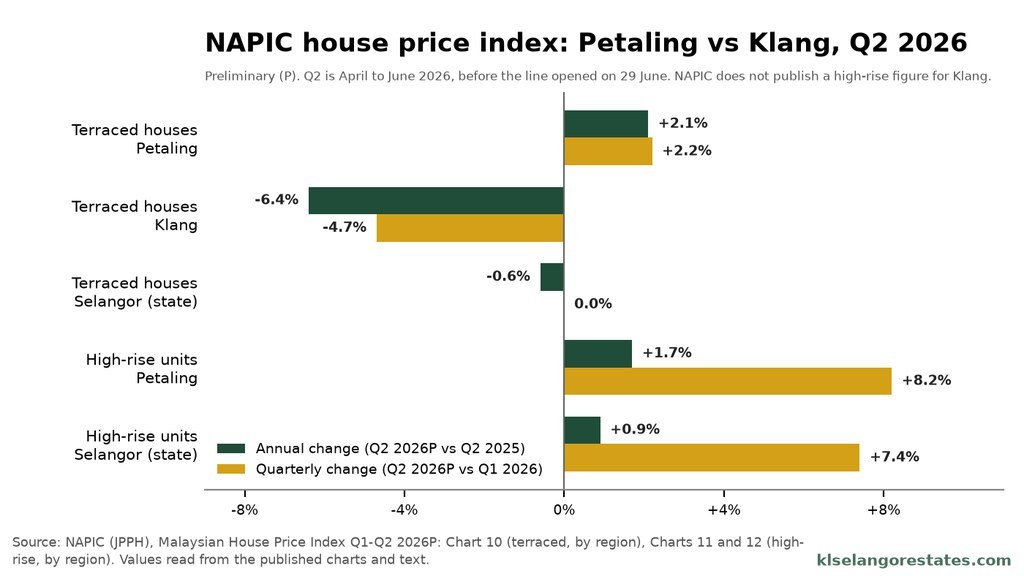
NAPIC’s latest Malaysian House Price Index (MHPI) covers the first half of 2026, and its figures are preliminary. NAPIC is the National Property Information Centre of the Valuation and Property Services Department (JPPH).
Nationally, the MHPI rose 0.9% year on year in Q2 2026 to 234.7 points. NAPIC called this the slowest annual growth since the post-pandemic recovery began in 2022. The national average house price was RM506,317. Selangor’s index fell 1.1% year on year, and its average price was RM561,187.
Inside Selangor, NAPIC breaks the figures down by region. The line runs through two of them. Petaling district takes in PJ, Subang Jaya and, broadly, the Shah Alam stations. Klang district covers the stations from Bandar Baru Klang to Johan Setia.
Terraced houses, Q2 2026 (preliminary):
- Petaling: up 2.1% on a year earlier, and up 2.2% on the previous quarter.
- Klang: down 6.4% on a year earlier, and down 4.7% on the previous quarter. This was the steepest annual fall of the Selangor regions NAPIC listed.
- Selangor as a whole: down 0.6% on a year earlier and flat on the quarter. The average Selangor terraced house was RM634,465.
High-rise homes, Q2 2026 (preliminary):
- Petaling: up 1.7% on a year earlier, after a 1.6% fall in the year to Q2 2025. It was up 8.2% on the quarter, after falling 7.8% in Q1 2026. The index stood at 217.3 and the average high-rise unit was RM403,289, above the national average of RM383,864.
- Selangor as a whole: up 0.9% on a year earlier and 7.4% on the quarter. The average high-rise unit was RM304,660.
- Klang: NAPIC does not publish a separate high-rise figure for Klang.
Why this is not the “LRT effect”
Two things limit what these numbers can tell you about the line.
- Timing. Q2 2026 covers April to June. The line opened on 29 June, so the figures are essentially before the opening. Any effect of the line itself will only start to appear in later releases.
- Geography. The MHPI measures whole districts, not distances to stations. Petaling and Klang each contain neighbourhoods near the line and many that are nowhere near it. A district’s index cannot tell you whether homes near a station did better than homes 3km away.
The big quarterly swings in Petaling high-rise prices, down 7.8% then up 8.2%, are also a reminder that preliminary quarterly figures move around. They are best read over several quarters.
Shops: what NAPIC’s shop price index shows
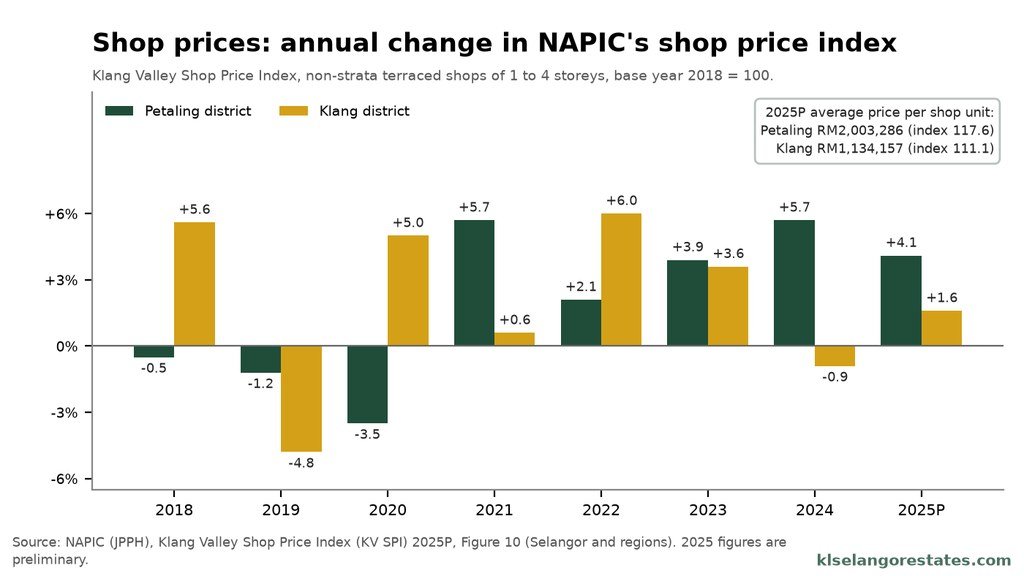
For shops, NAPIC publishes the Klang Valley Shop Price Index (KV SPI). It covers non-strata terraced shops of one to four storeys, and the latest edition runs to 2025, also preliminary. I wrote about it in more detail in my article on Klang Valley shophouse prices.
For 2025, before the line opened:
| District | Index (2018 = 100) | Change in 2025 | Average price per m² | Average price per unit |
|---|---|---|---|---|
| Petaling | 117.6 | +4.1% | RM4,982 | RM2,003,286 |
| Klang | 111.1 | +1.6% | RM3,028 | RM1,134,157 |
| Selangor | 117.4 | +2.2% | RM3,798 | RM1,351,379 |
Petaling has the highest shop price index of any Selangor district NAPIC tracks. Klang’s index fell 0.9% in 2024 and rose 1.6% in 2025. Again, these are district-wide numbers, and they predate the line.
On rents, NAPIC’s Property Market Report for H1 2026 gives ground-floor shop rents in the central town prime area of Petaling district of RM2,500 to RM8,000 a month. It does not give a figure for shops near LRT3 stations.
For a shop, the train matters less than who walks past your door. The Star’s September ride suggested the busiest stations were next to established commercial areas. A shop beside a quiet station with no surrounding activity may see little difference from the train.
Is there an “LRT premium”?
You may hear claims that homes near a new LRT station are worth a fixed percentage more. No official source measures this for the LRT3 line. NAPIC does not publish prices by distance to a station. Its house and shop indices are by district, and the latest figures predate the opening. Neither data.gov.my nor Prasarana publishes property data.
The nearest thing to an official comment is general. In its H1 2026 Property Market Report, NAPIC noted rising rents in some high-demand areas of Kuala Lumpur, “particularly those adjacent to LRT and MRT stations”. It gave no figure, and it was not talking about the Shah Alam Line.
So if anyone quotes you an “LRT premium” for a PJ, Shah Alam or Klang property, ask where the number comes from. If it is not based on recent transactions of comparable units, treat it as a sales line, not data. A bank valuer will look at comparable transactions, not at the train.
That doesn’t mean the line has no value to owners. A reliable train link can make a home easier to rent or sell, and it can cut commuting costs. But how much, and where, will only show in transaction data over the coming years.
What the line actually changes for residents
The value of a station depends on how you would use it. A few practical points:
- Getting to KL: there is no direct train into the city centre. From Klang or Shah Alam you change at Glenmarie 2 for the Kelana Jaya Line, or at Bandar Utama for the Kajang Line.
- Cost: the full end-to-end trip is RM4.30 cashless each way. For 22 working days a month, two trips a day comes to about RM189 a month on the Shah Alam Line alone (my calculation). A second line’s fare comes on top if you change.
- Feeder buses: RM1 a ride. Two rides a day for 22 days is RM44 a month (my calculation).
- Parking: Park & Ride is only at six stations, with 2,300 bays in total, and it has been chargeable since 15 August. Check the current rate on Rapid KL’s MyRapid site.
- Concession fares: students, senior citizens and persons with disabilities can get concession fares with a MyRapid concession card.
The five extra stations
At the launch, the Prime Minister said the government had approved an extra RM4.7 billion to reinstate five stations: Tropicana, Raja Muda, Temasya, Bukit Raja and Bandar Botanik, The Star reported. Reports on the timing differ:
- Bernama quoted the line’s chief on 27 June as saying the work would get under way by the end of 2026.
- On 29 June, the deputy transport minister told the Dewan Rakyat that the government planned a second phase after 2030, adding five stations and seven trains.
Don’t pay for a future station. If a property’s appeal depends on one of these five, assume nothing until construction starts and a completion date is published.
Checklist: buying a home near an LRT3 station
- Walk it yourself. Walk from the unit’s front door to the station gate at the time you would commute. Note the real distance, any road crossings, covered walkways, lighting and gradient. “Near the LRT” on a brochure is not a measurement.
- Check which station, and what it connects to. An interchange like Bandar Utama or Glenmarie 2, or a station next to a commercial area, is used differently from a quiet stop.
- Check the feeder bus. If you will not walk, find the feeder route and stop nearest the property, and check its frequency at your commuting time.
- Check Park & Ride. Only six stations have it. If you plan to drive to the train, check whether the nearest car park has space at peak hours, and what it costs.
- Check noise and privacy. Units facing the viaduct or a station may get more noise, lights and foot traffic. Visit at peak time and late at night.
- Check title and tenure. Is it freehold or leasehold, and how many years are left on the lease? Does the title carry any restriction on who can buy, such as Malay reserved land or a bumiputera lot? For a high-rise unit, has the strata title been issued?
- Check the land use. Some serviced apartments and SOHO units near transport hubs stand on commercial land, which can mean different utility tariffs, loan terms and maintenance costs. See my article on serviced apartments in KL and Selangor.
- Ask for the maintenance charges and sinking fund. For a strata unit, get the current monthly charges, the sinking fund and the latest audited accounts, and ask whether any special levy is planned.
- Price it on transactions, not on the train. Compare recent transacted prices of similar units nearby. Your lawyer or banker can tell you what the bank’s valuation is likely to rely on.
- Check what is planned nearby. Ask the local council (such as MBPJ, MBSJ, MBSA or MBDK, depending on location) about approved developments around the station. New supply can affect both rents and resale prices.
- Budget for the full cost. Include stamp duty, legal fees, loan costs and moving costs. See my guide to Budget 2027 and first-home stamp duty.
Checklist: buying or renting out a shop near a station
- Watch the foot traffic. Stand outside the shop at the morning and evening peaks and at the weekend. Is anyone walking from the station past this row?
- Check the route between the station and the shop. A main road without a crossing, or a long detour, can cut off a shop even if it is close on a map.
- Check parking for customers. Many shop customers still drive. Station parking is for train users and is not a substitute.
- Check the land use and approved use. Make sure the title, the approved building plan and any council licence allow the business you or your tenant intend to run.
- Look at existing rents and vacancies. Note how many units in the row are empty or on long-term “to let” signs. That says more than the train does.
- Price on comparable shop transactions. NAPIC’s district-level shop index is a guide to the trend, not to an individual row of shops.
For buying a shop or factory for your own business, see my guides to Klang Valley shophouse prices and buying or renting an SME factory in Selangor.
For existing owners and landlords
- Advertise what is real. If your unit is a short walk from a station, say how far and how long the walk takes. Tenants will check.
- Mention the feeder bus if one stops nearby, and the connection to the Kajang or Kelana Jaya line.
- Don’t reprice on the train alone. Rents depend on what comparable units nearby are actually being let for.
- Keep records. If you sell later, recent rental and transaction evidence will matter more to a buyer’s bank than the line on the map.
What to watch next
- October ridership. data.gov.my updates monthly. The next release will show whether paid ridership settled, rose or kept falling.
- NAPIC’s next house price index. The Q3 2026 figures, covering July to September, will be the first full quarter with the line running. Watch Petaling and Klang.
- NAPIC’s 2026 shop price index. It will be the first full year of the line for shops.
- The five extra stations. Look for a construction start and a completion date.
- Feeder routes. Prasarana said feeder bus and van routes would be adjusted to commuter demand.
What is still not confirmed
- Any official measure of an “LRT premium” for homes or shops near the Shah Alam Line. None exists.
- Ridership after September 2026. October had not been published when I checked on 3 November 2026.
- When the five extra stations will open. Reports differ between work starting by the end of 2026 and a second phase after 2030.
- Prices after the opening. NAPIC’s latest house price index covers Q2 2026, and its shop index covers 2025.
Related reading
- Klang Valley shophouse prices: what NAPIC’s new shop price index shows
- Selangor new launches in H1 2026: what NAPIC’s data show
- Serviced apartments in KL and Selangor: unsold units in 2026
- Bank lelong properties in the Klang Valley: a first-time buyer’s guide
- Budget 2027 and first-home stamp duty: SPA timing
Sources
- data.gov.my, Daily Public Transport Ridership (ridership_headline; data from Prasarana and the Ministry of Transport), column rail_lrt_shah_alam, downloaded 30 October 2026: https://storage.data.gov.my/transportation/ridership_headline.csv (catalogue: https://data.gov.my/data-catalogue/ridership_headline)
- NAPIC (JPPH), Malaysian House Price Index Q1–Q2 2026P: https://napic.jpph.gov.my/storage/app/media/3-penerbitan/Shahrul/Bahagian%20Indeks%20Harta%20Tanah/Laporan%20Jadual%20MHPI/Q2%202026/MHPI%20Report%20Q1-Q2%202026P.pdf
- NAPIC (JPPH), Klang Valley Shop Price Index (KV SPI) 2025P: https://napic.jpph.gov.my/storage/app/media/3-penerbitan/Shahrul/Bahagian%20Indeks%20Harta%20Tanah/Laporan%20Jadual%20SHPI/Q4%202025/Report%20%20KV%20SPI%201st%20Edition%202025_update.pdf
- NAPIC (JPPH), Property Market Report First Half 2026: https://napic.jpph.gov.my/storage/app/media/3-penerbitan/Shahrul/Bahagian%20Pasaran%20Harta%20Tanah/Laporan%20Pasaran%20Harta%20Separuh%20Tahun%20dan%20Jadual/Q2%202026/LAPORAN%20PASARAN%20HARTA%20H1%202026.pdf
- Ministry of Finance, media release, “Total cost of the LRT3 Project Reduced By 47%”, 12 Jul 2018: https://www.mof.gov.my/portal/arkib/press/MR2018/July/MR120718.pdf
- Malay Mail, “Cabinet greenlights LRT3 after Prasarana slashes cost to RM16.63b”, 12 Jul 2018: https://www.malaymail.com/news/malaysia/2018/07/12/cabinet-greenlights-lrt3-after-prasarana-slashes-cost-to-rm16.63b/1651413
- Bernama, “PM Anwar To Launch LRT3 Shah Alam Line Tomorrow”, 27 Jun 2026: https://www.bernama.com/en/news.php?id=2573717
- The Star, “Anwar launches RM16.63bil LRT3 Shah Alam Line”, 28 Jun 2026: https://www.thestar.com.my/news/nation/2026/06/28/anwar-launches-rm1663bil-lrt3-shah-alam-line
- Bernama, “LRT3 Shah Alam: One-month Free Rides Starting Monday – PM Anwar”, 28 Jun 2026: https://www.bernama.com/en/news.php?id=2574012
- Bernama, “LRT3 Capacity Sufficient To Meet Projected Ridership Through 2040 - Deputy Minister”, 29 Jun 2026: https://www.bernama.com/en/news.php?id=2574296
- Malay Mail, “Bandar Utama to Johan Setia: A guide to the new LRT3 Shah Alam Line”, 19 Jun 2026: https://www.malaymail.com/news/malaysia/2026/06/19/bandar-utama-to-johan-setia-a-guide-to-the-new-lrt3-shah-alam-line/224134
- Malay Mail, “Strong start for Shah Alam LRT3 as Rapid KL reports 60,000 trips on first full day of service”, 30 Jun 2026: https://www.malaymail.com/news/malaysia/2026/06/30/strong-start-for-shah-alam-lrt3-as-rapid-kl-reports-60000-trips-on-first-full-day-of-service/225845
- Bernama, “Fare For LRT3 Shah Alam Line Comes Into Effect Tomorrow”, 14 Aug 2026: https://bernama.com/en/news.php?id=2594506
- FMT, “Passengers on the LRT Shah Alam line to start paying fares tomorrow”, 14 Aug 2026: https://www.freemalaysiatoday.com/category/nation/2026/08/14/passengers-on-the-lrt-shah-alam-line-to-start-paying-fares-tomorrow
- The Star, “Commuters test new line, urge fixes”, 12 Sep 2026: https://www.thestar.com.my/metro/metro-news/2026/09/12/commuters-test-new-line-urge-fixes
About the author
Jessica Leong | Registered Estate Agent E3208
PropNex Realty Sdn Bhd (E (1) 1800/1), KLCC branch. Jessica covers new launch condos in Kuala Lumpur and Selangor, industrial property in Selangor, bank auction (lelong) properties, and Selangor offices, shophouses and en-bloc deals. See her new launch pages for Kuala Lumpur, KLCC, Petaling Jaya and Selangor.
PropNex Realty Sdn Bhd, A-G-03, Marc Residence, No. 3, Jalan Pinang, 50400 Kuala Lumpur
Office: 03-2161 8608 · Call/WhatsApp: 010-464 6088
Website: klselangorestates.com
This article is general information based on public sources as at 30 October 2026. It is not legal, tax, financial or investment advice. Ridership and price figures are subject to revision, and NAPIC’s 2025 and 2026 figures are preliminary. No official source measures a price premium for properties near the LRT3 Shah Alam Line. Please do your own checks and consult your own lawyer, banker or valuer before buying or selling property.